
Duloxetine Hydrochloride
If you find any inaccurate information, please let us know by providing your feedback here
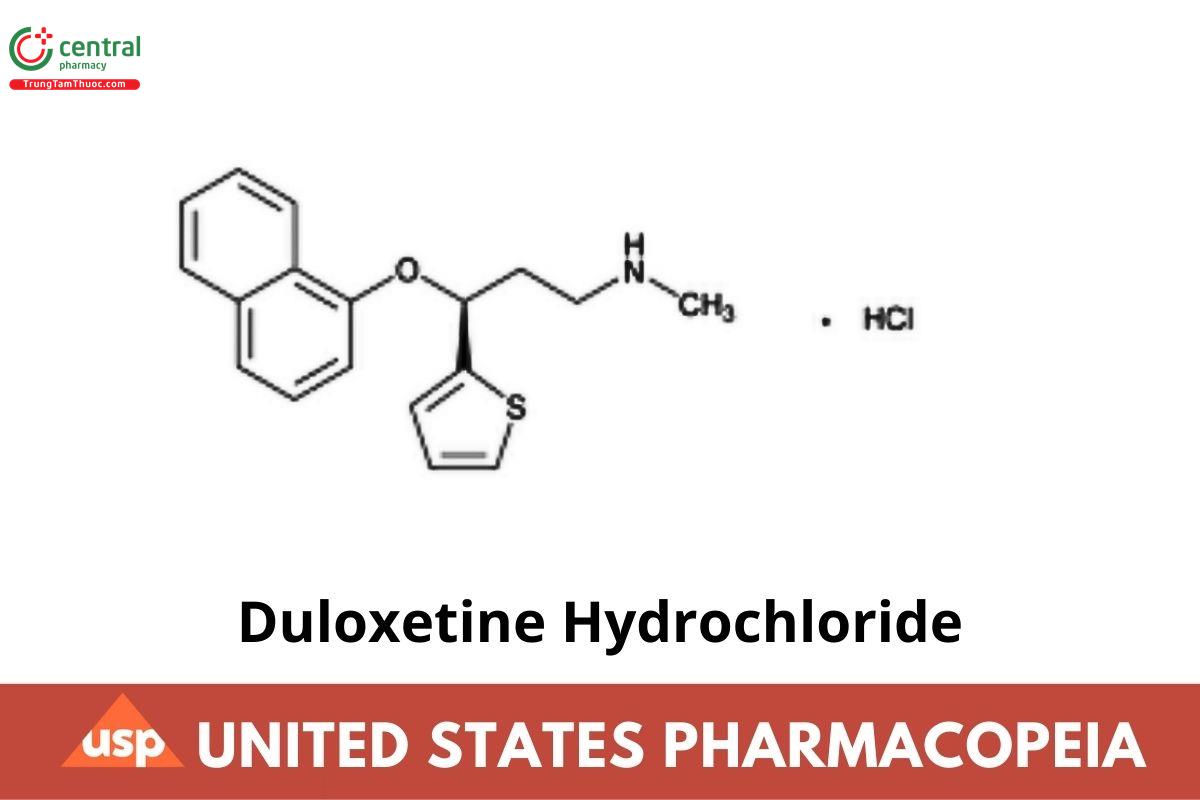

This article is compiled based on the United States Pharmacopeia (USP) – 2025 Edition
Issued and maintained by the United States Pharmacopeial Convention (USP)
2-Thiophenepropanamine, N-methyl-γ-(1-naphthalenyloxy)-, hydrochloride, (S)-;
(+)-(S)-N-Methyl-γ-(1-naphthyloxy)-2-thiophenepropylamine hydrochloride CAS RN®: 136434-34-9; UNII: 9044SC542W.
1 DEFINITION
Duloxetine Hydrochloride contains NLT 97.0% and NMT 102.0% of duloxetine hydrochloride (C18H19NOS · HCl), calculated on the dried basis.
2 IDENTIFICATION
Change to read:
A. SPECTROSCOPIC IDENTIFICATION TESTS (197), Infrared Spectroscopy: 197K
B. The retention time of the major peak of the Sample solution corresponds to that of the duloxetine S-isomer from the System suitability solution in the test for Limit of Duloxetine Related Compound A.
C. IDENTIFICATION TESTS GENERAL, Chloride (191)
Sample solution: 5 mg/mL in methanol
Acceptance criteria: Meets the requirements
3 ASSAY
PROCEDORE
Protect solutions of duloxetine from light.
Buffer: 2.9 g/L of phosphoric acid in water. Adjust with sodium hydroxide solution to a pH of 2.5. To each L of this solution add 10.3 g of sodium 1-hexanesulfonate monohydrate, and dissolve..
Mobile phase: Acetonitrile, n-propanol, and Buffer (13:17:70)
Diluent: Acetonitrile and water (25:75)
System suitability solution: 0.2 mg/ml. of USP Duloxetine Hydrochloride RS (contains duloxetine related compound F) in Mobile phase, Heat the solution to at least 40 for a minimum of 1 h. [Note-The resulting solution contains duloxetine alcohol, duloxetine 4-naphthyl isomer, a naphthol, duloxetine B-naphthol-1-yl isomer, and duloxetine related compound F.
Standard solution: 0.1 mg/mL of USP Duloxetine Hydrochloride RS in Diluent
Sample solution: 0.1 mg/mL of Duloxetine Hydrochloride in Diluent
Chromatographic system
(See Chromatography (621). System Suitability)
Mode: LC
Detector: UV 230 nm
Column: 4.6-mm x 15-cm; 3.5µm packing L7
Column temperature: 40:3°
Flow rate: 1 mL/min
Injection volume: 10 µL
Run time: 2 times the retention time of duloxetine
System suitability
Sample: System suitability solution
[NOTE-See Table 1 for the relative retention times.]
Suitability requirements
Resolution: NLT 1.5 between duloxetine and duloxetine related compound F
Tailing factor: NMT 1.5 for duloxetine
Relative standard deviation: NMT 1.0% for duloxetine
Analysis
Samples: Standard solution and Sample solution
Calculate the percentage of duloxetine hydrochloride (C, H, NOS HCI) in the portion of sample taken:
Result = (rU/(rS) × (CS /CU) x 100
rU = peak response the Sample solution
rS = peak response from the Standard solution
CS = concentration of USP Duloxetine Hydrochloride RS in the Standard solution (mg/mL)
CU = concentration of Duloxetine Hydrochloride in the Sample solution (mg/mL)
Acceptance criteria: 97.0%~102.0% on the dried basis
4 IMPURITIES
RESIDUE ON IGNITюм (281): NMT 0.2%
ORGANIC INFURITIES
Protect solutions of duloxetine from light.
Buffer, Mobile phase, Diluent, and System suitability solution: Proceed as directed in the Assay.
Sensitivity solution: 0.2 µg/mL of USP Duloxetine Hydrochloride RS in Diluent
Sample solution: 0.2 mg/mL of Duloxetine Hydrochloride in Diluent
Chromatographic system: Proceed as directed in the Assay, except for Run time.
Run time: 2.4 times the retention time of duloxetine
System suitability
Samples: System suitability solution and Sensitivity solution
[NOTE See Table 1 for the relative retention times.]
Suitability requirements
Resolution: NLT 1.5 between duloxetine 4-naphthyl isomer and a-naphthol; NLT 1.5 between duloxetine and duloxetine related compound
F. System suitability solution
Tailing factor: NMT 1.5 for duloxetine, System suitability solution
Relative standard deviation: NMT 1.0% for duloxetine, System suitability solution
Signal-to-noise ratio: NLT 20 for the duloxetine peak, Sensitivity solution
Analysis
Sample: Sample solution
Calculate the percentage of any individual impurity in the portion of Duloxetine Hydrochloride taken:
Result = (rU/(rS) x (1/F) x 100
rU = peak area for each impurity from the Sample solution
rS = sum of all the peak areas from the Sample solution
F = relative response factor (see Table 1)
| Name | Relative Retention Time | Relative Response Factor | Acceptance Criteria, NMT (%) |
| Duloxetine alcohola | 0.15 | 0.36 | 0.1 |
| Duloxetine 4-napthyl isomerb | 0.43 | 1.0 | 0.1 |
| α-Naptholc | 0.48 | 1.8 | 0.1 |
| Duloxetine -naphthol-1-yl isomerd | 0.74 | 1.0 | 0.1 |
| Duloxetinee | 1.0 | - | - |
| Fluoronaphthalenef | 1.4 | 0.51 | 0.1 |
| Any individual unspecified impurity | - | 0.1 | 0.1 |
| Total impurities | - | - | 0.6 |
a 3-(Methylamino) 1 (thiophen-2-yl)propan-1-ol
b 4-(3-(Methylamino)-1-(thiophen-2-yl)propyljnaphthalen-1-ol
c Naphthalen-1-ol.
d 2-[3-(Methylamino)-1-(thiophen-2-yl)propyl naphthalen-1-ol
e (S)-N-Methyl-3-(naphthalen-1-yloxy)-3-(thiophen-3-yl)propan-1-amine
f 1-Fluoronaphthalene.
LIMIT OF DULOXETINE RELATED COMPOUND A
Mobile phase: Hexane and isopropyl alcohol (83:17). To 1 L of this mixture add 2 mL of diethylamine.
System suitability solution: 0.1 mg/ml. each of USP Duloxetine Hydrochloride RS and USP Duloxetine Related Compound A RS in Mobile phase. Sonication may be used to aid in dissolution
Sensitivity solution: 0.1 µg/ml of USP Duloxetine Hydrochloride RS in Mobile phase
Sample solution: 0.1 mg/ml. of Duloxetine Hydrochloride in Mobife phase. Sonication may be used to aid in dissolution.
Chromatographic system
(See Chromatography (521), System Suitability)
Mode: LC
Detector: UV 230 nm
Column: 4.6-mm x 25-cm; 5-um packing L40
Column temperature: 40°
Flow rate: 1 mL/min
Injection volume: 10 µL
Run time: 2 times the retention time of duloxetine
System suitability
Samples: System suitability solution and Sensitivity solution
(Non-The relative retention times for duloxetine and duloxetine related compound A are 1.0 and 1.3, respectively
Suitability requirements
Resolution: NLT 3.5 between duloxetine and duloxetine related compound A, System suitability solution
Tailing factor: 0.8-1.5 each for duloxetine and duloxetine related compound A, System suitability solution
Relative standard deviation: NMT 5.0% for duloxetine, System suitability solution
Signal-to-noise ratio: NLT 3, Sensitivity solution
Analysis
Sample: Sample solution
Calculate the percentage of duloxetine related compound A in the portion of Duloxetine Hydrochloride taken:
Result = (rU/rS) x 100
rU = peak response of duloxetine related compound A from the Sample solution
rS = sum of the peak responses of duloxetine and duloxetine related compound A from the Sample solution
Acceptance criteria: NMT 0.5%
5 SPECIFIC TESTS
LOSS ON DRYING (731)
Analysis: Dry at 105° for 3 h.
Acceptance criteria: NMT 0.5%
6 ADDITIONAL REQUIREMENTS
PACKAGING AND STORAGE: Protect from light. Store at room temperature.

