
Doxapram Hydrochloride
If you find any inaccurate information, please let us know by providing your feedback here
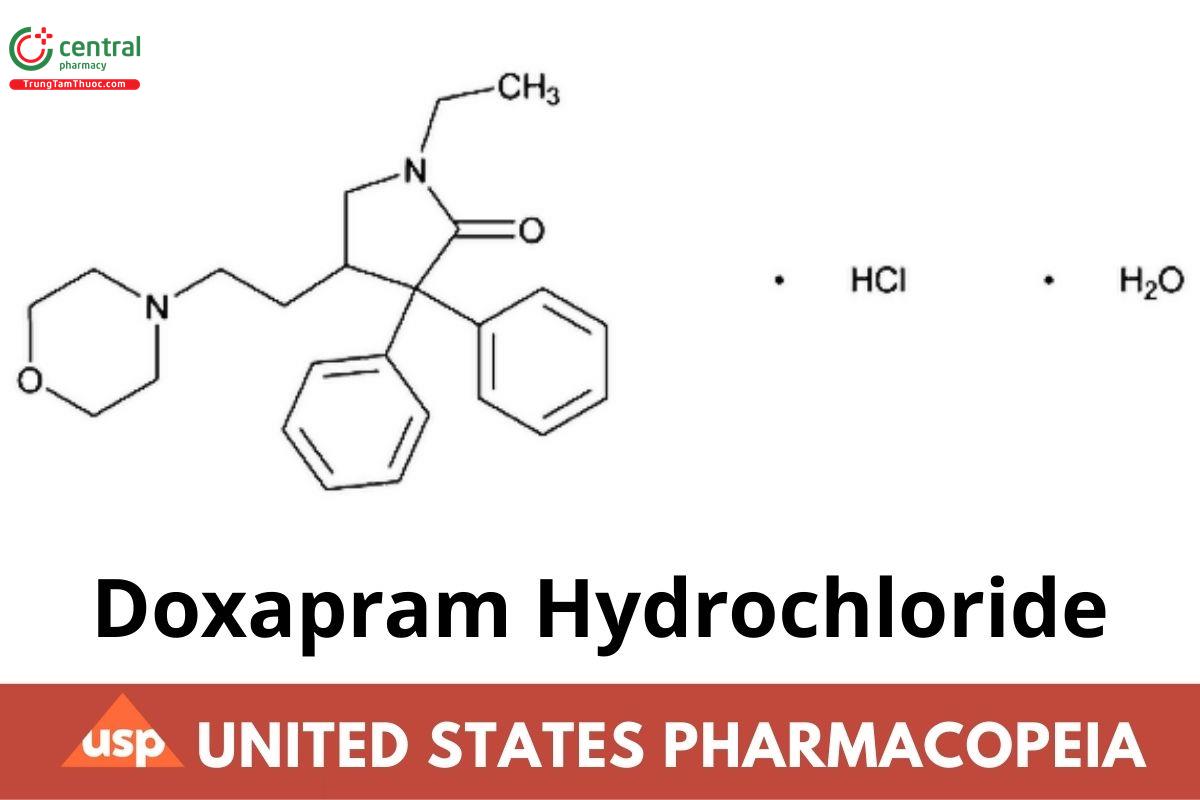

This article is compiled based on the United States Pharmacopeia (USP) – 2025 Edition
Issued and maintained by the United States Pharmacopeial Convention (USP)
C24H30N2O2 · HCl · H2O 432.99
C24H30N2O2 · HCl 414.97
2-Pyrrolidinone, 1-ethyl-4-[2-(4-morpholinyl)ethyl]-3,3-diphenyl-, monohydrochloride, monohydrate, (±)-;
(+)-1-Ethyl-4-(2-morpholinoethyl)-3,3-diphenyl-2-pyrrolidinone monohydrochloride monohydrate CAS RN: 7081-53-0: UNII: P5RU6U0Q5Y.
Anhydrous CAS RN: 113-07-5; UNII: FB8713U6DM.
1 DEFINITION
Doxapram Hydrochloride, dried at 105° for 2 h, contains NLT 98.0% and NMT 102.0% of doxapram hydrochloride (C24H30N2O2 · HCl).
2 IDENTIFICATION
Change to read:
A.SPECTROSCOPIC IDENTIFICATION TESTS (197), Infrared Spectroscopy: 197K (CN 1-MAY-2020)
B. The retention time of the major peak of the Sample solution corresponds to that of the Standard solution, as obtained in the Assay.
C. IDENTIFICATION TESTS GENERAL (191), Chloride: Meets the requirements
3 ASSAY
PROCEDURE
Solution A: To each L. of water, add 0.1 mL of trifluoroacetic acid..
Solution B: To each L of acetonitrile, add 0.1 mL of trifluoroacetic acid.
Mobile phase: See Table 1.
Table 1
| Time (min) | Solution A (%) | Solution B (%) |
| 0 | 90 | 10 |
| 20 | 50 | 50 |
| 25 | 50 | 50 |
| 25.1 | 90 | 10 |
| 30 | 90 | 10 |
Diluent: Acetonitrile and water (30:70)
Standard solution: 0.2 mg/mL of USP Doxapram Hydrochloride RS in Diluent
Sample solution: 0.2 mg/mL of Doxapram Hydrochloride in Diluent
Chromatographic system
(See Chromatography 〈621〉, System Suitability.)
Mode: LC
Detector: UV 220 nm
Column: 4.6-mm × 5-cm; 2.5-µm packing L1
Column temperature: 35°
Flow rate: 1.0 mL/min
Injection volume: 5 µL
System suitability
Sample: Standard solution
Suitability requirements
Tailing factor: NMT 2.0
Relative standard deviation: NMT 0.73%
Analysis
Samples: Standard solution and Sample solution
Calculate the percentage of doxapram hydrochloride (C24H30N2O2 · HCl) in the portion of Doxapram Hydrochloride taken:
Result = (ru /rs ) × (Cs /Cu ) × 100
ru = peak response of doxapram from the Sample solution
rs = peak response of doxapram from the Standard solution
Cs = concentration of USP Doxapram Hydrochloride RS in the Standard solution (mg/mL)
Cu = concentration of Doxapram Hydrochloride in the Sample solution (mg/mL)
Acceptance criteria: 98.0%–102.0%, previously dried at 105° for 2 h
4 IMPURITIES
RESIDUE ON IGNITION (281): NMT 0.3%
ORGANIC IMPURITIES
Solution A, Solution B, Mobile phase, Diluent, and Chromatographic system: Proceed as directed in the Assay.
System suitability solution: 2 mg/mL of USP Doxapram Hydrochloride RS and 0.04 mg/mL of USP Doxapram Related Compound B RS in Diluent
Standard solution: 0.004 mg/mL each of USP Doxapram Hydrochloride RS and USP Doxapram Related Compound B RS in Diluent
Sample solution: 2 mg/mL of Doxapram Hydrochloride in Diluent
System suitability
Samples: System suitability solution and Standard solution
[NOTE-See Table 2 for relative retention times.]
Suitability requirements
Resolution: NLT 1.5 between doxapram related compound B and doxapram, System suitability solution
Relative standard deviation: NMT 5.0% for doxapram related compound B and doxapram, Standard solution
Analysis
Samples: Standard solution and Sample solution
Calculate the percentage of doxapram related compound B in the portion of Doxapram Hydrochloride taken:
Result = (ru /rs ) × (Cs /Cu ) × 100
ru = peak response of doxapram related compound B from the Sample solution
rs = peak response of doxapram related compound B from the Standard solution
Cs = concentration of USP Doxapram Related Compound B RS in the Standard solution (mg/mL)
Cu = concentration of Doxapram Hydrochloride in the Sample solution (mg/mL)
Calculate the percentage of doxapram chloroethyl analog or any individual unspecied impurity in the portion of Doxapram Hydrochloride taken:
Result = (ru /rs ) × (Cs /Cu ) × 100
ru = peak response of doxapram chloroethyl analog or any individual unspecied impurity from the Sample solution
rs = peak response of doxapram from the Standard solution
Cs = concentration of USP Doxapram Hydrochloride RS in the Standard solution (mg/mL)
Cu = concentration of Doxapram Hydrochloride in the Sample solution (mg/mL)
Acceptance criteria: See Table 2. Disregard any peak below 0.05%.
Table 2
Name | Relative Retention Time | Acceptance Criteria, NMT (%) |
| Doxapram related compound B | 0.9 | 0.2 |
| Doxapram | 1.0 | - |
| Doxapram chloroethyl analoga | 3.9 | 0.2 |
| Any individual unspecied impurity | - | 0.2 |
| Total impurities | - | 1.0 |
a 4-(2-Chloroethyl)-1-ethyl-3,3-diphenylpyrrolidin-2-one.
5 SPECIFIC TESTS
pH 〈791〉
Sample solution: 10 mg/mL of Doxapram Hydrochloride in water
Acceptance criteria: 3.5–5.0
Loss on Drying 〈731〉
Analysis: Dry at 105° for 2 h.
Acceptance criteria: 3.0%–4.5%
6 ADDITIONAL REQUIREMENTS
Packaging and Storage: Preserve in tight containers.
USP Reference Standards 〈11〉
USP Doxapram Hydrochloride RS
USP Doxapram Related Compound B RS
1-Ethyl-4-{2-[(2-hydroxyethyl)amino]ethyl}-3,3-diphenylpyrrolidin-2-one hydrochloride.
C22H29CIN2O2 388.93

