
Dorzolamide Hydrochloride
If you find any inaccurate information, please let us know by providing your feedback here

Tóm tắt nội dung
This article is compiled based on the United States Pharmacopeia (USP) – 2025 Edition
Issued and maintained by the United States Pharmacopeial Convention (USP)
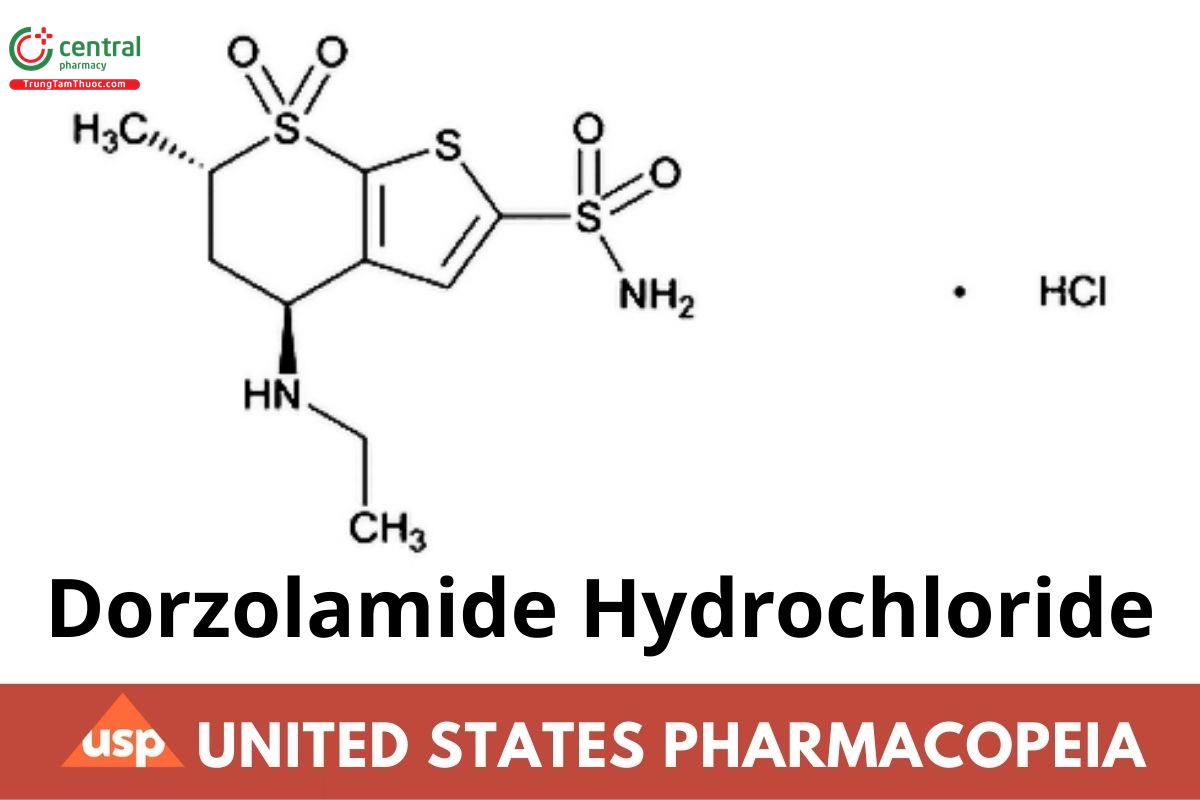
C10H16N2O4S3 · HCl 360.90
4H-Thieno[2,3-b]thiopyran-2-sulfonamide, 4-(ethylamino)-5,6-dihydro-6-methyl-, 7,7-dioxide, monohydrochloride, (4S-trans)-;(4S,6S)-4-(Ethylamino)-5,6-dihydro-6-methyl-4H-thieno[2,3-b]thiopyran-2-sulfonamide 7,7-dioxide, monohydrochloride CAS RN: 130693-82-2; UNII: QZO5366EW7.
1 DEFINITION
Dorzolamide Hydrochloride contains NLT 99.0% and NMT 101.0% of dorzolamide hydrochloride (C10H16N2O4S3 · HCl), calculated on the anhydrous basis.
2 IDENTIFICATION
A. SPECTROSCOPIC IDENTIFICATION TESTS (197), Infrared Spectroscopy: 197M
B. The retention time of the major peak of the Sample solution corresponds to that of the Standard solution, as obtained in the Assay.
C. IDENTIFICATION TESTS GENERAL, Chloride (191)
3 ASSAY
PROCEDURE
Buffer: 3.7 g/L of monobasic potassium phosphate in water
Solution A: Acetonitrile and Buffer (6.5:94)
Solution B: Acetonitrile
Mobile phase: See Table 1.
Table 1
| Time (min) | Solution A (%) | Solution B (%) |
| 0 | 100 | 0 |
| 15 | 100 | 0 |
| 30 | 50 | 50 |
| 37 | 100 | 0 |
| 44 | 100 | 0 |
Standard solution: 0.6 mg/mL of USP Dorzolamide Hydrochloride RS in Solution A
Sample solution: 0.6 mg/mL of Dorzolamide Hydrochloride in Solution A
Chromatographic system
(See Chromatography 〈621〉, System Suitability.)
Mode: LC
Detector: UV 254 nm
Column: 4.6-mm × 25-cm; packing L1
Column temperature: 35°
Flow rate: 1.5 mL/min
System suitability
Sample: Standard solution
Suitability requirements
Column eciency: NLT 6500 theoretical plates
Tailing factor: 0.6–1.2
Relative standard deviation: NMT 1.0%
Analysis
Samples: Standard solution and Sample solution
Calculate the percentage of dorzolamide hydrochloride (C10H16N2O4S3 · HCl) in the portion of Dorzolamide Hydrochloride taken:
Result = (ru /rs ) × (Cs /Cu ) × 100
ru = peak area of the Sample solution
rs = peak area of the Standard solution
Cs = concentration of USP Dorzolamide Hydrochloride RS in the Standard solution (mg/mL)
Cu = concentration of Dorzolamide Hydrochloride in the Sample solution (mg/mL)
Acceptance criteria: 99.0%–101.0% on the anhydrous basis
4 IMPURITIES
Residue on Ignition 〈281〉: NMT 0.1%, an ignition temperature of 600° being used
4.1 Organic Impurities
Solution A, Solution B, Mobile phase, Sample solution, Chromatographic system, and System suitability: Proceed as directed in the Assay.
Analysis
Sample: Sample solution
Calculate the percentage of each individual impurity in the portion of Dorzolamide Hydrochloride taken:
Result = (rU /rT ) × 100
rU = peak area of each individual impurity from the Sample solution
rT = sum of all the peak areas from the Sample solution
Acceptance criteria
Any individual impurity: NMT 0.1%
Total impurities: NMT 0.5%
4.2 Limit of Dorzolamide Hydrochloride Related Compound A
Mobile phase: tert-Butyl methyl ether, chromatographic n-heptane, acetonitrile, and water (63:35:2:0.2)
System suitability solution: Transfer 18 mg of USP Dorzolamide Hydrochloride RS and 2 mg of USP Dorzolamide Hydrochloride Related Compound A RS, each, to a 15-mL centrifuge tube. Dissolve in 4 mL of 0.5 N ammonium hydroxide, and add 4 mL of ethyl acetate. Separate the ethyl acetate layer, and transfer to a 15-ml centrifuge tube. Add 4 mL of ethyl acetate to the aqueous layer, and mix. Separate the ethyl acetate layer, and combine it with the first extract. Evaporate the combined organic layers to dryness on a water bath maintained at 50° under a stream of nitrogen. Dissolve the residue in 3 mL of acetonitrile, add 3 drops of (S)-(-)-a-methylbenzyl isocyanate (discard the reagent if it is colored), and allow to react for 5 min on a water bath maintained at 50". Evaporate the mixture to dryness on a water bath maintained at 50° under a stream of nitrogen. Dissolve the residue in 10 mL of a mixture of tert-butyl methyl ether, glacial acetic acid, and acetonitrile (87:10:3).
Sample solution: Transfer 20 mg of Dorzolamide Hydrochloride to a 15-ml centrifuge tube, dissolve in 4 ml. of 0.5 N ammonium hydroxide, and add 4 mL of ethyl acetate. Separate the ethyl acetate layer, and transfer to a 15-mL centrifuge tube. Add 4 mL of ethyl acetate to the aqueous layer, and mix. Separate the ethyl acetate layer, and combine it with the first extract. Evaporate the combined organic layers to dryness on a water bath maintained at 50° under a stream of nitrogen. Dissolve the residue in 3 mL of acetonitrile, add 3 drops of (S)-(-)-a-methylbenzyl isocyanate (discard the reagent if it is colored), and allow to react for 5 min on a water bath maintained at 50°. Evaporate the mixture to dryness on a water bath maintained at 50° under a stream of nitrogen. Dissolve the residue in 10 mL of a mixture of tert-butyl methyl ether, glacial acetic acid, and acetonitrile (87:10:3).
Chromatographic system
(See Chromatography (621), System Suitability.)
Mode: LC
Detector: UV 254 nm
Column: 4.6-mm x 25-cm; packing L3
Flow rate: 2 mL/min
Injection volume: 10 µL
System suitability
Sample: System suitability solution
[Note—The relative retention times for dorzolamide and dorzolamide hydrochloride related compound A are about 1.0 and 1.5, respectively.]
Suitability requirements
Resolution: NLT 4.0 between dorzolamide and dorzolamide hydrochloride related compound A
Column eciency: NLT 4000 theoretical plates for the dorzolamide hydrochloride peak
Tailing factor: NMT 1.4
Analysis
Samples: System suitability solution and Sample solution
Calculate the percentage of dorzolamide hydrochloride related compound A in the portion of Dorzolamide Hydrochloride taken:
Result = [ri /(ri + rs )] × 100
ri = peak area of dorzolamide hydrochloride related compound A from the Sample solution
rs = peak area of dorzolamide hydrochloride from the Sample solution
Acceptance criteria: NMT 0.5%
5 SPECIFIC TESTS
WATER DETERMINATION, Method (921)
Sample: 0.4 g
Acceptance criteria: NMT 0.5%
6 ADDITIONAL REQUIREMENTS
PACKAGING AND STORAGE: Preserve in well-closed containers, protected from light, and store at 15°-30°.
Change to read:
USP REFERENCE STANDARDS (11)
USP Dorzolamide Hydrochloride RS
USP Dorzolamide Hydrochloride Related Compound A RS
(4R,6R)-4-(Ethylamino)-5,6-dihydro-6-methyl-4H-thieno[2,3-b]thiopyran-2-sulfonamide-7,7- dioxide, monohydrochloride.
C10H16N2O4S3 · HCl 360.89 (ERR 1-Aug-2021)

