
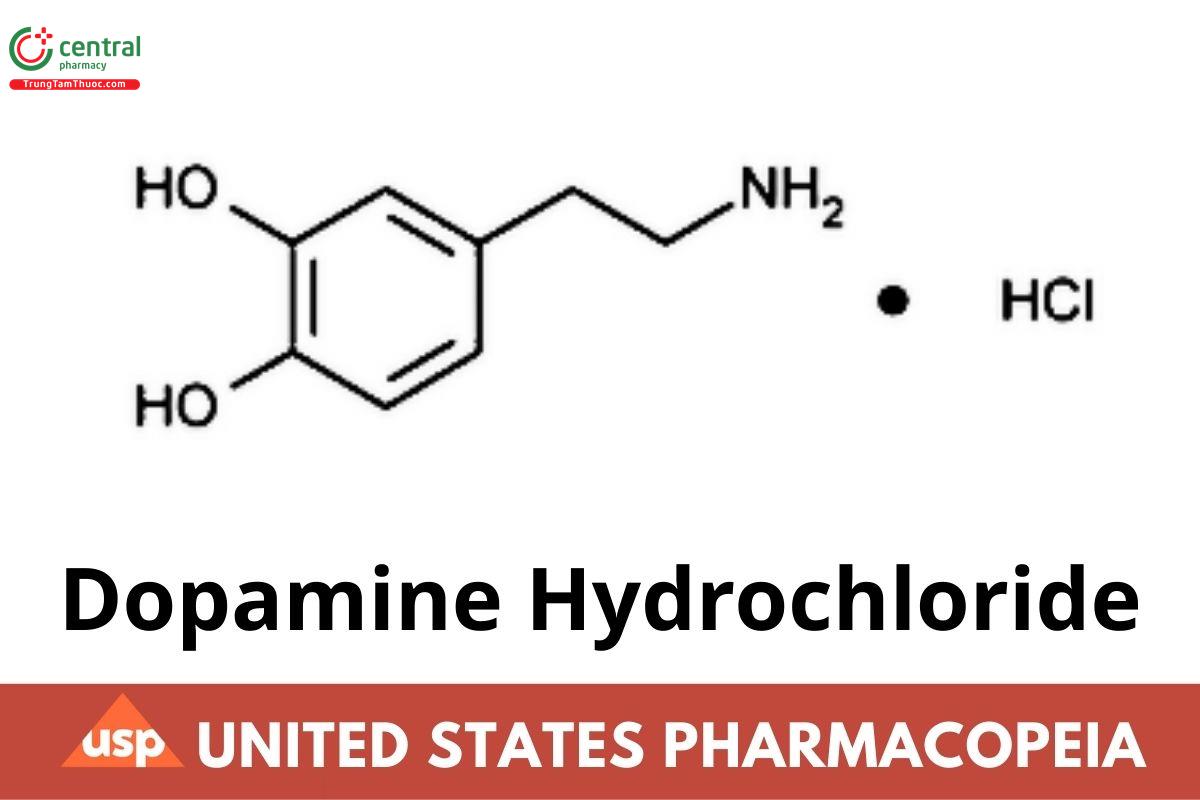
Dopamine Hydrochloride
If you find any inaccurate information, please let us know by providing your feedback here

This article is compiled based on the United States Pharmacopeia (USP) – 2025 Edition
Issued and maintained by the United States Pharmacopeial Convention (USP)
C8H11NO2 · HCl 189.64
1,2-Benzenediol, 4-(2-aminoethyl)-, hydrochloride;
4-(2-Aminoethyl)pyrocatechol hydrochloride CAS RN: 62-31-7; UNII: 7L3E358N9L
1 DEFINITION
Dopamine Hydrochloride contains NLT 98.0% and NMT 102.0% of dopamine hydrochloride (C8H11NO2 · HCl), calculated on the dried basis.
2 IDENTIFICATION
Change to read:
A. SPECTROSCOPIC IDENTIFICATION TESTS (197), Infrared Spectroscopy: 197A or (USP 1-Aug-2022) 197K
Delete the following:
B. SPECTROSCOPIC IDENTIFICATION TESTS (197), Ultraviolet-Visible Spectroscopy: 1970
Sample solution: 40 µg/mL in Medium
Medium: Sodium bisulfite in water (1 in 1000) (USP 1-Aug-2022)
Add the following:
B. The retention time of the major peak of the Sample solution corresponds to that of the Standard solution, as obtained in the Assay (USP 1-Aug-2022)
C. IDENTIFICATION TESTS-GENERAL (191), Chemical Identification Tests, Chloride: Meets the requirements
3 ASSAY
Change to read:
PROCEDURE
Buffer: Dissolve 21 g of citric acid in 200 mL of 1 N sodium hydroxide in a 1-L flask. Dilute with water to volume. To 600 mL of this solution add 400 mL of 0.1 N hydrochloric acid.
Solution A: Dissolve 1.08 g of 1-octanesulfonic acid sodium salt in 880 mL of Buffer in a 1-L flask. Add 50 mL of methanol and 70 mL of acetonitrile.
Solution B: Dissolve 1.08 g of 1-octanesulfonic acid sodium salt in 700 mL of Buffer in a 1-L flask. Add 100 mL of methanol and 200 mL of acetonitrile.
Mobile phase: See Table 1.
Table 1
| Time (min) | Solution A (%) | Solution B (%) |
| 0.0 | 90 | 10 |
| 5.0 | 90 | 10 |
| 20.0 | 40 | 60 |
| 25.0 | 40 | 60 |
| 25.1 | 90 | 10 |
| 35.0 | 90 | 10 |
Standard solution: 0.5 mg/mL of USP Dopamine Hydrochloride RS in Solution A
Sample solution: 0.5 mg/mL of Dopamine Hydrochloride in Solution A
Chromatographic system
(See Chromatography (621), System Suitability.)
Mode: LC
Detector: UV 280 nm
Column: 3.9-mm x 15-cm; 4.0-µm packing 11
Flow rate: 1 mL/min
Injection volume: 10 µL
System suitability
Sample: Standard solution
Suitability requirements
Tailing factor: NMT 2.5
Relative standard deviation: NMT 0.73%
Analysis
Samples: Standard solution and Sample solution
Calculate the percentage of dopamine hydrochloride (C8H11NO2 · HCl) in the portion of Dopamine Hydrochloride taken:
Result = (ru /rs ) × (Cs /Cu ) × 100
ru = peak response of dopamine from the Sample solution
rs = peak response of dopamine from the Standard solution
Cs = concentration of USP Dopamine Hydrochloride RS in the Standard solution (mg/mL)
Cu = concentration of Dopamine Hydrochloride in the Sample solution (mg/mL) (USP 1-Aug-2022)
Acceptance criteria: 98.0%–102.0% on the dried basis
4 IMPURITIES
RESIDUE ON IGNITION (281): NMT 0.1%
CHLORIDE AND SULFATE (221), Sulfate
Standard solution: 0.10 mL of 0.020 N sulfuric acid
Sample solution: 500 mg of Dopamine Hydrochloride in 40 mL of water
Acceptance criteria: Any turbidity produced in the Sample solution is NMT that produced in the Standard solution.
Change to read:
ORGANIC IMPURITIES
Buffer, Solution A, Solution B, Mobile phase, and Chromatographic system: Proceed as directed in the Assay.
System suitability solution: 0.024 mg/mL each of USP Dopamine Related Compound A RS and USP Dopamine Related Compound B.RS in Solution A
Sensitivity solution: 0.001 mg/mL of USP Dopamine Hydrochloride RS in Solution A
Standard solution: 0.002 mg/mL each of USP Dopamine Hydrochloride RS. USP Dopamine Related Compound A RS, USP Dopamine Related Compound B RS, and USP Dopamine Related Compound C RS in Solution A
Sample solution: 2.0 mg/mL of Dopamine Hydrochloride in Solution A
System suitability
Samples: System suitability solution, Sensitivity solution, and Standard solution
[NOTE-See Table 2 for the relative retention times.]
Suitability requirements
Resolution: NLT 5.0 between dopamine related compound B and dopamine related compound A, System suitability solution
Relative standard deviation: NMT 5.0% for dopamine related compound A, dopamine related compound B, and dopamine related compound C, Standard solution
Signal-to-noise ratio: NLT 20, Sensitivity solution
Analysis
Samples: Standard solution and Sample solution
Calculate the percentage of dopamine related compound A, dopamine related compound B, and dopamine related compound C in the portion of Dopamine Hydrochloride taken:
Result = (ru /rs ) × (Cs /Cu ) × 100
ru = peak response of dopamine related compound A, dopamine related compound B, or dopamine related compound C from the Sample solution
rs = peak response of dopamine related compound A, dopamine related compound B, or dopamine related compound C from the Standard solution
Cs = concentration of the USP Dopamine Related Compound A RS, USP Dopamine Related Compound B RS, or USP Dopamine Related Compound C RS in the Standard solution (mg/mL)
Cu = concentration of Dopamine Hydrochloride in the Sample solution (mg/mL)
Calculate the percentage of any unspecied impurity in the portion of Dopamine Hydrochloride taken:
Result = (ru /rs ) × (Cs /Cu ) × 100
ru = peak response of any unspecied impurity from the Sample solution
rs = peak response of dopamine hydrochloride from the Standard solution
Cs = concentration of USP Dopamine Hydrochloride RS in the Standard solution (mg/mL)
Cu = concentration of Dopamine Hydrochloride in the Sample solution (mg/mL)
Acceptance criteria: See Table 2. The reporting threshold is 0.05%.
Table 2
| Name | Relative Retention Time | Acceptance Criteria, NMT (%) |
| Dopamine | 1.0 | - |
| Dopamine related compound B | 2.1 | 0.1 |
| Dopamine related compound A | 2.8 | 0.1 |
| Dopamine related compound C | 4.2 | 0.1 |
| Any unspecied impurity | - | 0.10 |
| Total impurities | - | 0.2 (USP 1-Aug-2022) |
5 SPECIFIC TESTS
Delete the following:
READILY CARBONIZABLE SUBSTANCES TEST (271)
Sample solution: 100 mg of Dopamine Hydrochloride in 5 mL of sulfuric acid
Acceptance criteria: The solution has no more color than Matching Fluid A (see Color and Achromicity (631), Color Determination and Standards) (USP 1-Aug-2022)
PH (791)
Sample solution: 1 in 25
Acceptance criteria: 3.0-5.5
LOSS ON DRYING (731)
Analysis: Dry at 105° for 2 h.
Acceptance criteria: NMT 0.5%
Delete the following:
CLARITY AND COLOR OF SOLUTION
Sample solution: 400 mg of Dopamine Hydrochloride in 10 ml of sodium bisulfite solution (1 in 1000)
Acceptance criteria: This solution is clear and colorless, or practically colorless. (USP 1-Aug-2022)
6 ADDITIONAL REQUIREMENTS
Change to read:
PACKAGING AND STORAGE: Preserve in tight containers. Store at controlled (USP 1-Aug-2022) room temperature.
Change to read:
USP REFERENCE STANDARDS (11)
USP Dopamine Hydrochloride RS
USP Dogamine Related Compound A RS
5-(2-Aminoethyl)-2-methoxyphenol.
C9H13NO2 167.21
USP Dopamine Related Compound B RS
4-(2-Aminoethyl)-2-methoxyphenol.
C9H13NO2 167.21
USP Dopamine Related Compound C RS
2-(3,4-Dimethoxyphenyl)ethan-1-amine.
C10H15NO2 181.23 (USP 1-Aug-2022)

