
Docusate Potassium
If you find any inaccurate information, please let us know by providing your feedback here
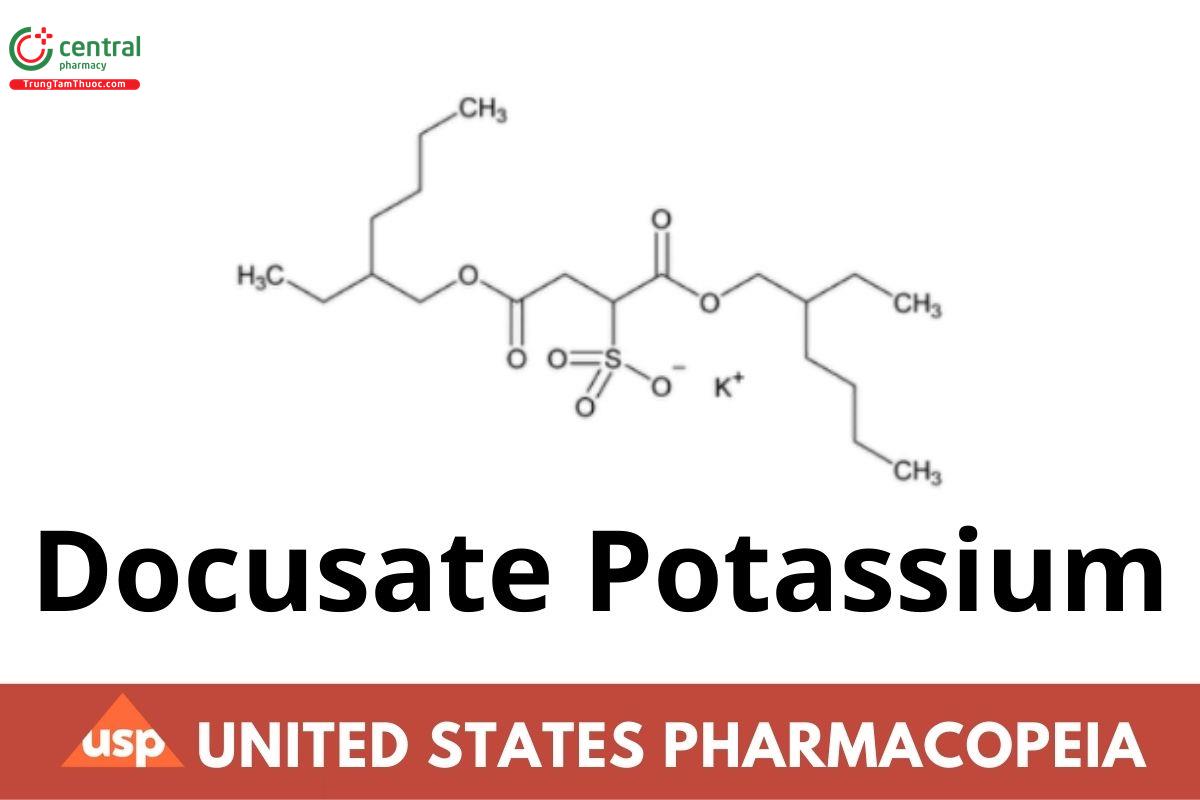

This article is compiled based on the United States Pharmacopeia (USP) – 2025 Edition
Issued and maintained by the United States Pharmacopeial Convention (USP)
DOWNLOAD PDF HERE
1 DEFINITION
Docusate Potassium contains NLT 95.0% and NMT 100.5% of docusate potassium (C20H37KO7S), calculated on the dried basis.
2 IDENTIFICATION
Change to read:
A. Spectroscopic Identification Tests 〈197〉, Infrared Spectroscopy: 197F(CN 1-May-2020)
Sample: Place a small piece of Docusate Potassium on a salt plate, add 1 drop of acetone, and promptly cover with another salt plate. Rub the plates together to dissolve the specimen, slide the plates apart, and allow the acetone to evaporate.
Acceptance criteria: Meets the requirements
B. The sample imparts a violet color to a nonluminous flame. Because the presence of small quantities of sodium masks the color, screen out the yellow color produced by sodium by viewing through a blue
filter that blocks emission at 589 nm (sodium) but is transparent to emission at 404 nm (potassium). [Note—Traditionally, cobalt glass has been used, but other suitable filters are commercially available.]
3 ASSAY
Procedure
Solution A: 2.500 g/L of tetra-n-butylammonium iodide in water
Solution B: A solution containing 100 g/L of anhydrous sodium sulfate and 10 g/L of sodium carbonate in water
Sample: 100 mg
Analysis: Dissolve the Sample in 50 mL of chloroform in a glass-stoppered, 250-mL conical flask. Add 50 mL of Solution B and 500 μL of bromophenol blue TS. Titrate with Solution A until 1 mL from the endpoint, and shake the stoppered flask vigorously for 2 min. Continue the titration in 2-drop increments, shaking vigorously for 10 s after each addition, and then allow the flask to stand for 10 s. Continue the titration until the chloroform layer just assumes a blue color. Each mL of Solution A is equivalent to 3.118 mg of docusate potassium (C20H37KO7S).
Acceptance criteria: 95.0%–100.5% on the dried basis
4 IMPURITIES
Residue on Ignition 〈281〉: 18.0%–20.0% on the dried basis
Limit of Bis(2-ethylhexyl) Maleate
Mobile phase: Alcohol and water (78:22), filtered and degassed
Standard solution: 80 μg/mL of USP Bis(2-ethylhexyl) Maleate RS in alcohol
Sample solution: 20 mg/mL of Docusate Potassium in alcohol. [Note—If necessary, warm the mixture by using the steam bath to achieve a complete dissolution.]
Chromatographic system
(See Chromatography 〈621〉, System Suitability.)
Mode: LC
Detector: UV 210 nm
Column: 4.6-mm × 3-cm; 3.5-μm packing L1
Column temperature: 30°
Flow rate: 1 mL/min
Injection volume: 3 μL
System suitability
Sample: Standard solution
Suitability requirements
Relative standard deviation: NMT 2.0%
Analysis
Samples: Standard solution and Sample solution
Calculate the percentage of bis(2-ethylhexyl) maleate in the portion of Docusate Potassium taken:
Result = (rU/rS) × (CS/CU) × 100
rU = peak response of bis(2-ethylhexyl) maleate from the Sample solution
rS = peak response of bis(2-ethylhexyl) maleate from the Standard solution
CS = concentration of USP Bis(2-ethylhexyl) Maleate RS in the Standard solution (mg/mL)
CU = concentration of Docusate Potassium in the Sample solution (mg/mL)
Acceptance criteria: NMT 0.4%
5 SPECIFIC TESTS
Loss on Drying 〈731〉
Analysis: Dry in a glass container at 105° for 4 h.
Acceptance criteria: NMT 3.0%
6 ADDITIONAL REQUIREMENTS
Packaging and Storage: Preserve in well-closed containers.
USP Reference Standards 〈11〉
USP Bis(2-ethylhexyl) Maleate RS C H O 340.51
USP Docusate Potassium RS

