
Dobutamine Hydrochloride
If you find any inaccurate information, please let us know by providing your feedback here
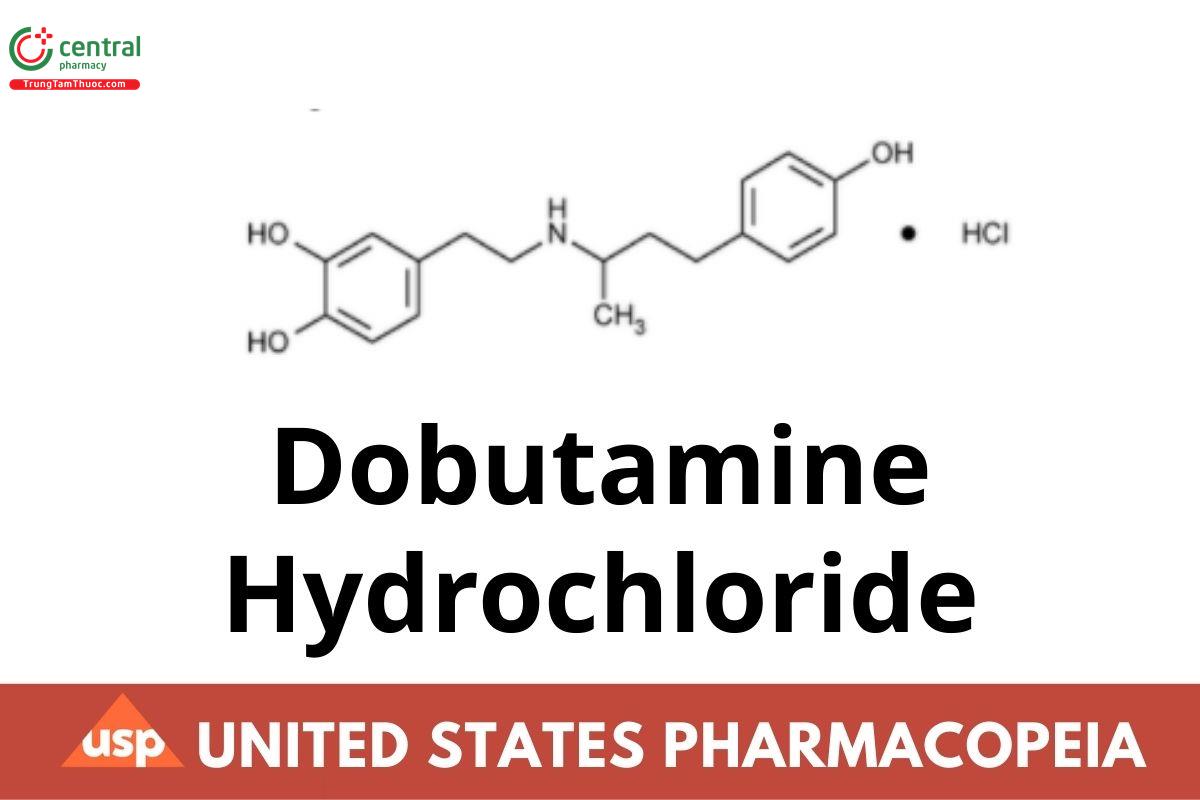

This article is compiled based on the United States Pharmacopeia (USP) – 2025 Edition
Issued and maintained by the United States Pharmacopeial Convention (USP)
DOWNLOAD PDF HERE
1 DEFINITION
Dobutamine Hydrochloride contains NLT 98.0% and NMT 102.0% of dobutamine hydrochloride (C18H23NO3 · HCl), calculated on the anhydrous basis.
[Caution—Great care should be taken to prevent inhaling particles of dobutamine hydrochloride and exposing the skin to it. Protect the eyes.]
2 IDENTIFICATION
A. Spectroscopic Identification Tests 〈197〉, Infrared Spectroscopy: 197A or 197K
B. The retention time of the major peak of the Sample solution corresponds to that of the Standard solution, as obtained in the Assay.
Delete the following:
C. Chloride (USP 1-Aug-2023)
Add the following:
C. Identification Tests—General 〈191〉, Chemical Identification Tests, Chloride
Sample solution: 50 mg/mL of Dobutamine Hydrochloride in a mixture of water and methanol (50:50)
Analysis: Proceed as directed in the chapter using the procedure for amine hydrochlorides, except wash the precipitate with three 1-mL portions of water.
Acceptance criteria: Meets the requirements of the test for amine hydrochlorides (USP 1-Aug-2023)
3 ASSAY
Change to read:
Procedure
Solutions containing dobutamine hydrochloride must be prepared fresh at the time of use and refrigerated until injected.
Solution A: Transfer 23 g of monobasic ammonium phosphate to a 2-L volumetric flask, and add 1900 mL of water. Adjust with phosphoric acid to a pH of 2.2, and dilute with water to volume.
Mobile phase: Acetonitrile and Solution A (20:80)
Standard solution: 0.5 mg/mL of USP Dobutamine Hydrochloride RS in water
Sample solution: 0.5 mg/mL of Dobutamine Hydrochloride in water
Chromatographic system
(See Chromatography 〈621〉, System Suitability.)
Mode: LC
Detector: UV 280 nm
Column: 3.9-mm × 30-cm; 15–20-μm packing L1. [Note—Alternatively, a column with 10-μm particle size may be used.] (USP 1-Aug-2023)
Flow rate: 1.5 mL/min
Injection volume: 20 μL
System suitability
Sample: Standard solution
Suitability requirements
Tailing factor: NMT 2.0
Relative standard deviation: NMT 0.73%
Analysis
Samples: Standard solution and Sample solution
Calculate the percentage of dobutamine hydrochloride (C18H23NO3 · HCl) in the portion of Dobutamine Hydrochloride taken:
Result = (rU/rS) × (CS/CU) × 100
rU= peak response of dobutamine from the Sample solution
rS= peak response of dobutamine from the Standard solution
CS= concentration of USP Dobutamine Hydrochloride RS in the Standard solution (mg/mL)
CU= concentration of Dobutamine Hydrochloride in the Sample solution (mg/mL)
Acceptance criteria: 98.0%–102.0% on the anhydrous basis
4 IMPURITIES
Residue on Ignition 〈281〉: NMT 0.2%
Change to read:
Organic Impurities
Solution A: 2.6 g/L of sodium 1-octanesulfonate in water. Pipet 3 mL of triethylamine into 1 L of this solution. Adjust the solution with phosphoric acid to a pH of 2.5.
Solution B: Methanol and acetonitrile (82:18)
Diluent: Solution A and Solution B (50:50)
Mobile phase: See Table 1.
Table 1
Time (min) | Solution A (%) | Solution B (%) |
| 0 | 65 | 35 |
| 5 | 65 | 35 |
| 20 | 20 | 80 |
| 25 | 20 | 80 |
| 26 | 65 | 35 |
| 30 | 65 | 35 |
Sensitivity solution: 1.25 μg/mL of USP Dobutamine Hydrochloride RS in Diluent
Standard solution: 0.025 mg/mL each of USP Dobutamine Related Compound C RS, USP Dopamine Hydrochloride RS, and USP Raspberry
Ketone RS; and 0.005 mg/mL of USP Dobutamine Hydrochloride RS in Diluent
Sample solution: 5 mg/mL of Dobutamine Hydrochloride in Diluent
Chromatographic system
(See Chromatography 〈621〉, System Suitability.)
Mode: LC
Detector: UV 280 nm
Column: 4.6-mm × 15-cm; 5-μm packing L1
Flow rate: 1 mL/min
Injection volume: 20 μL
System suitability
Samples: Sensitivity solution and Standard solution
Suitability requirements
Resolution: NLT 1.5 between dopamine and raspberry ketone, Standard solution
Tailing factor: NMT 2.0 for dobutamine, Standard solution
Relative standard deviation: NMT 2.0% for dobutamine, Standard solution
Signal-to-noise ratio: NLT 10, Sensitivity solution
Analysis
Samples: Standard solution and Sample solution
Calculate the percentage of dopamine, raspberry ketone, and dobutamine related compound C (USP 1-Aug-2023) in the portion of Dobutamine Hydrochloride taken:
Result = (rU/rS) × (CS/CU) × 100
rU= peak response of dobutamine related compound C, dopamine, and raspberry ketone (USP 1-Aug-2023) from the Sample solution
rS= peak response of dobutamine related compound C, dopamine, and raspberry ketone (USP 1-Aug-2023) from the Standard solution
CS= concentration of the corresponding Reference Standard in the Standard solution (mg/mL)
CU= concentration of Dobutamine Hydrochloride in the Sample solution (mg/mL)
Calculate the percentage of any (USP 1-Aug-2023) unspecified impurities in the portion of Dobutamine Hydrochloride taken:
Result = (rU/rS) × (CS/CU) × 100
rU= peak response of any (USP 1-Aug-2023) unspecified impurity from the Sample solution
rS= peak response of dobutamine from the Standard solution
CS= concentration of USP Dobutamine Hydrochloride RS in the Standard solution (mg/mL)
CU= concentration of Dobutamine Hydrochloride in the Sample solution (mg/mL)
Acceptance criteria: See Table 2. The reporting threshold is 0.05%.
| Name | Relative Retention Time | Acceptance Criteria, NMT (%) |
| Dopamine | 0.33 | 0.5 |
| Raspberry ketone | 0.45 | 0.5 |
| Dobutamine | 1.00 | - |
| Dobutamine related compound C | 1.38 | 0.5 |
| Any unspecified impurity | - | 0.10 |
| Total impurities | - | 1.0 |
5 SPECIFIC TESTS
Water Determination 〈921〉, Method I: NMT 1.0%
6 ADDITIONAL REQUIREMENTS
Packaging and Storage: Preserve in tight containers. Store at controlled room temperature.
Change to read:
USP Reference Standards 〈11〉
USP Dobutamine Hydrochloride RS
USP Dobutamine Related Compound C RS
N-(3,4-Dimethoxyphenethyl)-4-(4-methoxyphenyl)butan-2-amine hydrochloride.
C21H29NO3 · HCl 379.93▲ (USP 1-Aug-2023)
USP Dopamine Hydrochloride RS
USP Raspberry Ketone RS
4-(4-Hydroxyphenyl)butan-2-one.
C10H12O2 164.20

