
DISINTEGRATION AND DISSOLUTION OF DIETARY SUPPLEMENTS
If you find any inaccurate information, please let us know by providing your feedback here

Tóm tắt nội dung
This article is compiled based on the United States Pharmacopeia (USP) – 2025 Edition
Issued and maintained by the United States Pharmacopeial Convention (USP)
1 INTRODUCTION
This general chapter is provided to determine compliance with the disintegration and dissolution standards for dietary supplements where stated in the individual monographs.
For the purposes of this chapter, dietary supplement dosage forms have been divided into three categories: Vitamin-Mineral Dosage Forms, Botanical Dosage Forms, and Dietary Supplements Other Than Vitamin-Mineral and Botanical Dosage Forms. Vitamin-Mineral Dosage Forms include articles prepared with vitamins, minerals, or combinations of these dietary ingredients, as described in Table 1. Botanical Dosage Forms comprise formulations containing ingredients of botanical origin, including plant materials and extracts. Dietary Supplements Other Than Vitamin-Mineral and Botanical Dosage Forms encompass dietary supplements formulated with lawfully recognized dietary ingredients that are different from those pertaining to the two foregoing categories (e.g., amino acids, Chondroitin, and glucosamine).
Where a dietary supplement represents a combination of the categories mentioned above, and there is a difference between the requirements for the individual categories, the more stringent requirement applies, [NOTE-"More stringent requirement" means stricter acceptance criteria and/or milder operational conditions.]
Disintegration and dissolution tests as described in this chapter are quality-control tools to assess performance characteristics of dietary supplement finished dosage forms. These performance standards are intended to detect problems that may arise due to use or misuse, or changes in coatings, lubricants, disintegrants, and other components. These performance tests are also intended to detect manufacturing process issues, such as overcompression and overdrying, that would affect the release characteristics of the final dosage forms. These tests are not intended to be used as a demonstration or as a surrogate for in vivo absorption, bioavailability, or effectiveness, unless an in vitro-in vivo correlation (IVIVC) has been established.
2 DISINTEGRATION
This test is provided to determine whether dietary supplement capsules or tablets disintegrate within the prescribed time when placed in a liquid medium at the experimental conditions presented below. Compliance with the limits on Disintegration stated in the individual monographs for dietary supplements is required, except where the label states that the products are intended for use as troches, are to be chewed, or are designed as extended-release dosage forms. Dietary supplements claiming to be extended-release dosage forms must comply with standards other than disintegration to verify that the release of the dietary ingredients from the dosage form is for a defined period of time. Dietary supplements claiming to be extended-release dosage forms must not be labeled as in compliance with USP unless a USP monograph exists for such product. Determine the type of dosage form under test from the labeling and from observation, and apply the appropriate procedure to 6 or more units.
For purposes of this test, disintegration does not imply complete solution of the unit or even of its active constituent. Complete disintegration is defined as that state in which any residue of the unit, except fragments of insoluble coating or capsule shell, remaining on the screen of the test apparatus or adhering to the lower surface of the disk (if used) is a soft mass having no palpably firm core.
2.1 APPARATUS
Apparatus A: Use the Apparatus described in Disintegration (701), Apparatus for capsules or tablets that are NMT 18 mm long. For larger capsules or tablets, use Apparatus B.
Apparatus B: The apparatus consists of a basket-rack assembly, a 1000-mL low-form beaker for the immersion fluid, a thermostatic arrangement for heating the fluid between 35° and 39°, and a device for raising and lowering the basket in the immersion fluid at a constant frequency rate between 29 and 32 cycles/min through a distance of 53-57 mm. The volume of the fluid in the vessel is such that at the highest point of the upward stroke, the wire mesh remains at least 15 mm below the surface of the fluid and descends to NLT 25 mm from the bottom of the vessel on the downward stroke. At no time should the top of the basket-rack assembly become submerged. The time required for the upward stroke is equal to the time required for the downward stroke, and the change in stroke direction is a smooth transition rather than an abrupt reversal of motion. The basket-rack assembly moves vertically along its axis. There is no appreciable horizontal motion or movement of the axis from the vertical.
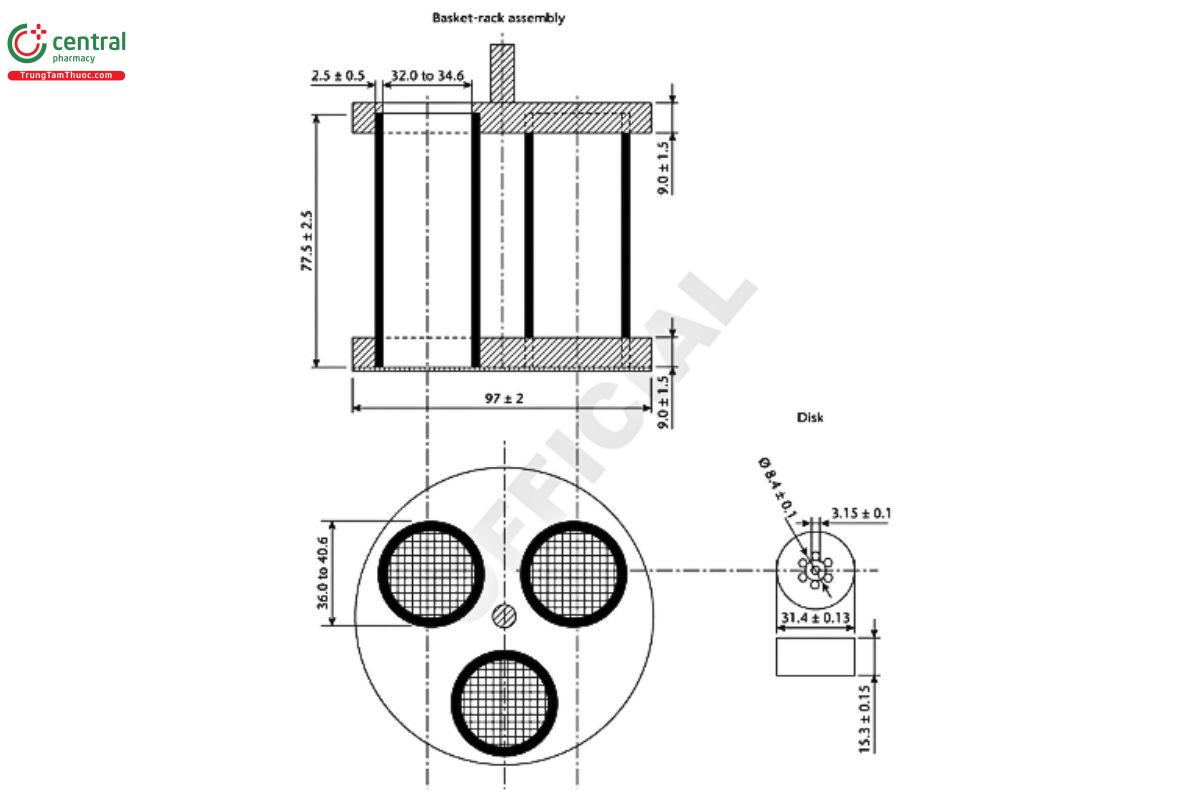
Basket-rack assembly: The basket-rack assembly (see Figure 1) consists of three open-ended transparent tubes, each 77.5 ± 2.5 mm long and having an inside diameter of 32.0-34.6 mm and a wall 2.0-3.0 mm in thickness; the tubes are held in a vertical position by two plastic plates, each 97 ± 2 mm in diameter and 7.5-10.5 mm in thickness, with three holes, 36.0-40.6 mm in diameter, equidistant from the center of the plate and equally spaced from one another. Attached to the undersurface of the lower plate is 10-mesh No. 23 (0.025-inch) W- and M-gauge woven stainless-steel wire cloth having a plain square weave. The parts of the apparatus are assembled and rigidly held by means of three bolts passing through the two plastic plates. A suitable means is provided to suspend the basket-rack assembly from the raising and lowering device, using a point on its axis. The design of the basket-rack assembly may be varied somewhat, provided that the specifications for the glass tubes and the screen mesh size are maintained.
Beaker: Low form, 1000 mL; the difference between the diameter of the plastic plates, which hold the tubes in a vertical position, and the inside diameter of the beaker should be NMT 6 mm.1
Disks: Each tube is provided with a perforated cylindrical disk 15.3 ± 0.15 mm in thickness and 31.4 ± 0.13 mm in diameter. The disk is made of a suitable, transparent plastic material having a specific gravity of between 1.18 and 1.20. Seven holes 3.15 ± 0.1 mm in diameter extend between the ends of the cylinder, one of the holes being in the center and the other six parallel to it and spaced equally tangent to a circle with a radius of 4.2 mm from the center of the disk. All surfaces of the disk are smooth.2
2.2 PROCEDURE
Test 6 dosage units as described below for each type of dosage form. [NOTE-Two basket arrangements for a total of six tubes are necessary for Apparatus B.] If 1 or 2 dosage units fail to disintegrate completely, repeat the test on 12 additional dosage units.
Uncoated tablets: Place 1 tablet in each of the tubes of the basket and, if prescribed, add a disk to each tube. Operate the apparatus, using water or the specified medium as the immersion fluid, maintained at 37 ± 2°. At the end of 30 min, lift the basket from the fluid and observe the tablets.
Plain-coated tablets: Place 1 tablet in each of the tubes of the basket and, if the tablet has a soluble external sugar coating, immerse the basket in water at room temperature for 5 min. Then, if prescribed, add a disk to each tube and operate the apparatus, using water or the specified medium as the immersion fluid, maintained at 37 ± 2°. At the end of 30 min, lift the basket from the fluid and observe the tablets.
Delayed-release (enteric-coated) tablets: Omit the use of a disk. Place 1 tablet in each of the six tubes of the basket, and if the tablet has a soluble external sugar coating, immerse the basket in water at room temperature for 5 min. Then operate the apparatus using simulated gastric fluid TS, maintained at 37 ± 2°, as the immersion fluid. After 1 h of operation in simulated gastric fluid TS, lift the basket from the fluid and observe the tablets: the tablets show no evidence of disintegration, cracking, or softening. Operate the apparatus using simulated intestinal fluid TS, maintained at 37 ± 2", as the immersion fluid for the time specified in the monograph. Lift the basket from the fluid and observe the tablets.
Delayed-release (enteric-coated) soft-shell capsules: Place 1 softgel capsule in each of the six tubes of the basket. Omit the use of a disk. Operate the apparatus using simulated gastric fluid TS, maintained at 37 ± 2°, as the immersion fluid. After 1 h of operation in simulated gastric fluid TS, lift the basket from the fluid and observe the softgels: the softgels show no evidence of disintegration or rupture that would permit the escape of the contents. Operate the apparatus with disks using simulated intestinal fluid TS, maintained at 37 ± 2°, as the immersion fluid for NMT 60 min. Lift the basket from the fluid and observe the capsules.
Hard-shell capsules: Apply the test for Uncoated tablets using, as the immersion fluid, maintained at 37 ± 2°, a 0.05 M acetate buffer prepared by mixing 2.99 g of sodium acetate trihydrate and 1.66 mL of glacial acetic acid with water to obtain a 1000-mL solution with a pH of 4.50 ± 0.05. Attach a removable wire cloth, as described in Basket-rack assembly, to the surface of the upper plate of the basket-rack assembly. At the end of 30 min, lift the basket from the fluid and observe the capsules.
Soft-shell capsules: Proceed as directed in the Rupture Test for Soft-Shell Capsules.
2.3 USE OF DISKS
Vitamin-mineral dosage forms: Add a disk to each tube unless otherwise specified in the Procedure above or in the individual monograph.
Botanical dosage forms: Omit the use of disks unless otherwise specified in the Procedure above or in the individual monograph.
Dietary supplements other than vitamin-mineral and botanical dosage forms: Omit the use of disks unless otherwise specified above or in the individual monograph.
2.4 TOLERANCES
All of the 6 dosage units initially tested or NLT 16 of a total of 18 dosage units tested disintegrate completely.
3 RUPTURE TEST FOR SOFT-SHELL CAPSULES
Medium: Water, 500 mL
Apparatus: Use Apparatus 2 as described in Dissolution (711), Apparatus, operating at 50 rpm.
Time: 15 min
- PROCEDURE: Place 1 capsule in each vessel, and allow the capsule to sink to the bottom of the vessel before starting rotation of the blade. Use sinkers if the capsules float. Observe the capsules throughout the test and at the end of the test. The capsule shell is considered ruptured if breached, exposing or allowing the fill contents to escape.
- TOLERANCES: The requirements are met if all of the capsules tested rupture in NMT 15 min. If 1 or 2 of the capsules rupture in >15 min but NMT 30 min, repeat the test on 12 additional capsules: NMT 2 of the total of 18 capsules tested rupture in >15 min but NMT 30 min. For soft gelatin capsules that do not conform to the above rupture test acceptance criteria, repeat the test with the addition of Papain to the Medium in the amount that results in an activity of NMT 550,000 units/L of Medium or with the addition of Bromelain in the amount that results in an activity of NMT 30 gelatin-digesting units (GDU)/L of Medium. [NOTE-Determine papain activity using the Assay in the monograph for Papain and bromelain activity using the procedure in bromelain, in the Reagent Specifications section.]
4 DISSOLUTION
This test is provided to determine compliance with the Dissolution requirements where stated in the individual monographs for dietary supplements. The operative assumption inherent in this test is that if the index vitamin or mineral or marker compound(s) for a botanical is dissolved within the time frame and under conditions specified, the dosage form does not suffer from formulation- or manufacturing-related problems affecting the adequate release of the active ingredients.
4.1 FOR DOSAGE FORMS CONTAINING OR COATED WITH GELATIN
For hard or soft gelatin capsules and gelatin-coated tablets that do not conform to the dissolution specification because of the presence of cross-linking, the dissolution procedure should be repeated with the addition of enzymes to the medium, as described below.
Dissolution medium with pH ≤4.0
- Enzyme: Pepsin, activity determined by the procedure in pepsin, in the Reagent Specifications section
- Amount: A quantity of pepsin that results in an activity of NMT 750,000 units/L of dissolution medium
Dissolution medium with pH >4.0 and <6.8
- Enzyme: Papain, activity determined by the Assay in the monograph for Papain; or bromelain, activity determined by the procedure in bromelain, in the Reagent Specifications section
- Amount: A quantity of papain that results in an activity of NMT 550,000 units/L of dissolution medium, or a quantity of bromelain that results in an activity of NMT 30 GDU/L of dissolution medium
Dissolution medium with pH ≥6.8
- Enzyme: Pancreatin, protease activity determined by the procedure in Assay for protease activity (Casein digestive powder) in the monograph for Pancreatin
- Amount: A quantity of pancreatin that results in a protease activity of NMT 2,000 units/L of dissolution medium
Dissolution medium containing surfactants or other components known to denature the enzyme: If the dissolution medium contains surfactants or other components known to denature the enzyme to be used, a pretreatment step should be applied. The pretreatment step is performed under the same dissolution conditions (apparatus, rotation, and flow rate), except to use a medium with the corresponding amount of enzyme as directed in the preceding section and without the surfactant or component known to denature the enzyme. To achieve the final specified volume of medium, the pretreatment step may be conducted with a smaller volume of medium without the surfactant or component in such a manner that the final specified volume is achieved after the addition of the surfactant or component at the end of the pretreatment step. Perform the pretreatment step until capsule rupture, but for NMT one-half of the total dissolution time specified in the procedure. The pretreatment time is included in the total dissolution time specified in the procedure.
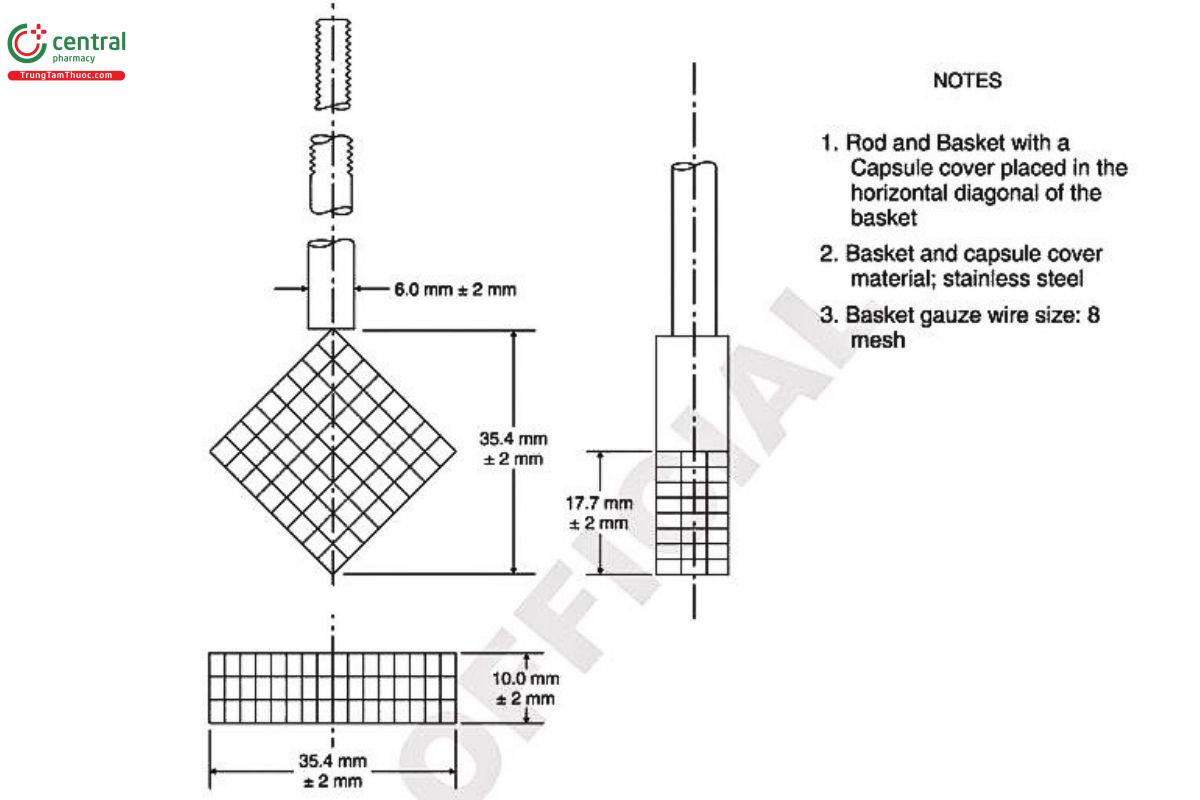
APPARATUS: See (711) for a description of the apparatus used, apparatus suitability test, and other related information. Where the procedure specifies the use of a stationary basket, use the quadrangular basket of stainless steel wire gauze as shown in Figure 2a and Figure 2b.
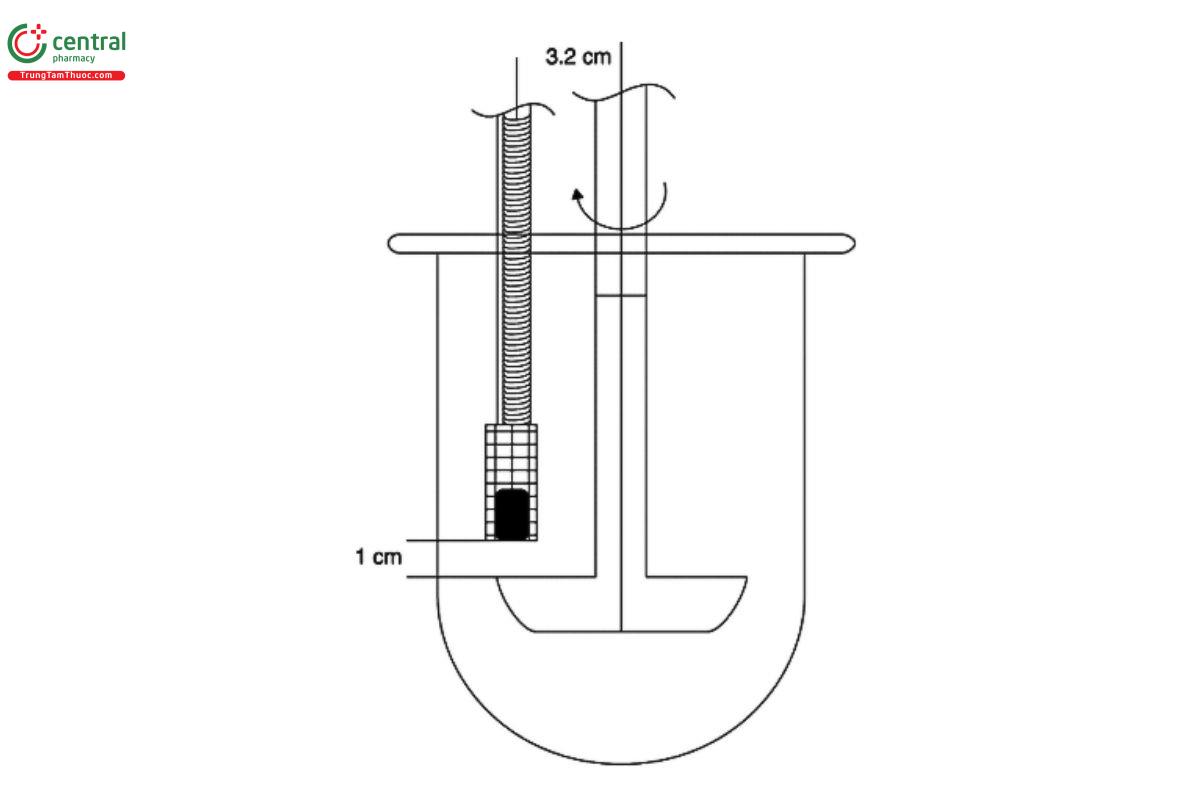
The capsule is placed in a basket, soldered in one of its upper, narrow sides to the end of a steel rod (see Figure 2a). The capsule cover is placed in the horizontal diagonal of the basket. The rod assembly is inserted vertically through the cover of the dissolution vessel, and fixed by means of two teflon nuts, 3.2 cm from the center of the vessel, or by any other appropriate means. The lower edge of the bottom of the basket is adjusted to about 1 cm above the top of the paddle blade (see Figure 2b).
Of the types of apparatus described in (711), use the one specified in the individual monograph.
4.2 VITAMIN-MINERAL DOSAGE FORMS
All dietary supplement capsules, tablets, or chewable gels containing folic acid are subject to the dissolution test and criteria for folic acid described in this chapter. This test is required because of the importance of the relationship between folate deficiency and the risk of neural tube defects. Dietary supplement capsules, tablets, or chewable gels containing water-soluble vitamins, minerals, or their combination are subject to the dissolution test and criteria for index vitamins, index minerals, or both, described in this chapter. Dietary supplement tablets, chewable gels, and hard-shell capsules with solid content dosage forms containing vitamin A are subject to the dissolution test and criteria for vitamin A described in this chapter. Dissolution standards were not established and therefore are not applicable to vitamin A in dietary supplement soft-shell capsules filled with liquids. Table 1 summarizes the dissolution requirements for the assigned USP classes of dietary supplements. Vitamin-mineral combinations that do not belong to any of the USP classes listed in Table 1 are subject to the Dissolution test and criteria specified in the individual monographs.
Table 1. Dietary Supplements-Vitamin-Mineral Dosage Forms
| USP Class | Ingredients | Dissolution Requirements for Tablets, Chewable Gels, and Hard-Shell Capsules with Solid Contents | Dissolution Requirements for Soft-Shell Capsules Filled with Liquids |
| I | Oil-soluble vitamins | Vitamin A (if present) | Not applicable |
| II | Water-soluble vitamins | One index water-soluble vitamin and folic acid (if present) | One index water-soluble vitamin and folic acid (if present) |
| III | Water-soluble vitamins with minerals | One index water-soluble vitamin, one index element, and folic acid (if present) | One index water-soluble vitamin, one index element, and folic acid (if present) |
| IV | Oil- and water-soluble vitamins | Vitamin A (if present), one index water-soluble vitamin, and folic acid (if present) | One index water-soluble vitamin and folic acid (if present) |
| V | Oil- and water-soluble vitamins with minerals | Vitamin A (if present), one index water-soluble vitamin, one index element, and folic acid (if present) | One index water-soluble vitamin, one index element, and folic acid (if present) |
| VI | Minerals | One index element | One index element |
| VII | Oil-soluble vitamins with minerals | Vitamin A (if present) and one index element | One index element |
Selection of index water-soluble vitamins and index elements: Compliance with the dissolution requirements for dietary supplements representing combinations of water-soluble vitamins and combinations of oil- and water-soluble vitamins is determined by measuring the dissolution of a single index vitamin from the water-soluble vitamins present. Riboflavin is the index vitamin when present in the formulation. For formulations that do not contain riboflavin, pyridoxine is the index vitamin. If neither riboflavin nor pyridoxine is present in the formulation, the index vitamin is niacinamide (or niacin), and in the absence of niacinamide (or niacin), the index vitamin is thiamine. If none of these four water-soluble vitamins are present in the formulation, the index vitamin is ascorbic acid.
Compliance with the dissolution requirements for dietary supplements representing combinations of minerals is determined by measuring the dissolution of only one index element. Iron is the index element when present in the formulation. For formulations that do not contain iron, the index element is calcium. If neither iron nor calcium is present, the index element is zinc. In the absence of all three of these elements, magnesium is the index element.
Compliance with the dissolution requirements for dietary supplements representing combinations of water-soluble vitamins and minerals and combinations of oil- and water-soluble vitamins and minerals is determined by measuring the dissolution of one index water-soluble vitamin and one index element, designated according to the respective hierarchies described above.
Dissolution conditions for vitamin A: [NOTE-Perform this test under light conditions that minimize photodegradation.]
- Medium: 1% (w/v) sodium ascorbate and 1% (w/v) octoxynol 9 in 0.05 M phosphate buffer, pH 6.8; 900 mL
- Apparatus 2: 75 rpm
- Time: 45 min
Dissolution conditions for folic acid: [NOTE-Perform this test under light conditions that minimize photodegradation.]
Test 1
- Medium: Water, 900 mL
- Apparatus 1: 100 rpm, for capsules
- Apparatus 2: 75 rpm, for tablets
- Time: 1 h
- If the units tested do not meet the requirements for dissolution in water, use the following conditions:
- Buffer: Mix 95 mL of 0.1 M citric acid monohydrate and 405 mL of 0.1 M sodium citrate dihydrate, dilute with water to 1000 mL, mix, and adjust to a pH of 6.0 by using either 0.1 M hydrochloric acid or 0.1 M sodium hydroxide solution.
- Medium: Buffer; 900 mL
- Apparatus 1: 100 rpm, for capsules
- Apparatus 2: 75 rpm, for tablets
- Time: 1 h
Test 2 (for lipid-filled soft-shell capsules): Proceed as directed for Test 2 under Dissolution conditions for index water-soluble vitamins and index minerals. If the article complies with this test, the labeling indicates that it meets USP Dissolution Test 2.
Test 3 (for lipid-filled soft-shell capsules): Proceed as directed for Test 3 under Dissolution conditions for index water-soluble vitamins and index minerals. If the article complies with this test, the labeling indicates that it meets USP Dissolution Test 3. [NOTE-Compliance with the dissolution requirements for folic acid does not exempt the article from compliance with the dissolution requirements of the pertinent index vitamin or the corresponding index mineral.]
Dissolution conditions for index water-soluble vitamins and index minerals
Test 1
- Medium: 0.1 N hydrochloric acid; 900 mL
- Apparatus 1: 100 rpm, for capsules
- Apparatus 2: 75 rpm, for tablets
- Time: 1 h
- For formulations containing 25 mg or more of the index vitamin, riboflavin, use the following conditions:
- Medium: 0.1 N hydrochloric acid; 1800 mL
- Apparatus 1: 100 rpm, for capsules
- Apparatus 2: 75 rpm, for tablets
- Time: 1 h
Test 2 (for lipid-filled soft-shell capsules): If the article complies with this test, the labeling indicates that it meets USP Dissolution Test 2.
- Medium: 0.25% (w/v) octoxynol 9, 0.02% (w/v) ascorbic acid, and 0.04% (w/v) Simethicone in simulated gastric fluid TS; 250 mL
- Apparatus 3: 15 dpm
- Screen (top and bottom): 20-mesh
- Time: 1 h
Test 3 (for lipid-filled soft-shell capsules): If the article complies with this test, the labeling indicates that it meets USP Dissolution Test 3.
- Medium: 0.25% (w/v) octoxynol 9 and 0.02% (w/v) ascorbic acid in simulated gastric fluid TS; 500 mL
- Apparatus 2: 125 rpm; dosage unit placed in stationary basket (Figure 2a and Figure 2b)
- Time: 1 h
- [NOTE-Compliance with dissolution requirements for the pertinent index vitamin or index mineral does not exempt the article from compliance with the dissolution requirements for folic acid, if present.]
Procedures: In the following procedures, combine equal volumes of the filtered solutions of the six individual specimens withdrawn, and use the pooled sample as the test specimen. Determine the average amount of vitamin A, folic acid, or the index vitamin or element dissolved in the pooled sample. Make any necessary modifications, including concentration of the analyte in the volume of Sample solution taken. Use the Medium for preparation of the Standard solution and dilution, if necessary, of the Sample solution.
Vitamin A: Determine the percentage of retinyl acetate or retinyl palmitate dissolved by using the following procedure.
Standard solution: Dissolve a suitable amount of USP Retinyl Acetate RS or USP Retinyl Palmitate RS in isopropyl alcohol, and dilute with Medium to obtain a concentration similar to that expected in the Sample solution. [NOTE-The amount of isopropyl alcohol should be 5%-10%.]
Sample solution: Withdraw a portion of the solution under test, pass through a suitable filter of 0.45-µm pore size, and use the pooled sample as the test specimen.
Solution A: Methanol and water (90:10)
Solution B: Methanol and isopropyl alcohol (55:45)
Mobile phase: See Table 2.
Table 2
| Time (min) | Solution A (%) | Solution B (%) |
| 0 | 100 | 0 |
| 8 | 0 | 100 |
| 13 | 0 | 100 |
| 13.1 | 100 | 0 |
| 15 | 100 | 0 |
Chromatographic system
- (See Chromatography (621), System Suitability.)
- Mode: LC
- Detector: UV 325 nm
- Column: 4.6-mm x 10-cm; 3-µm packing L1
- Flow rate: 1.0 mL/min
- Injection volume: 50 µL
System suitability
- Sample: Standard solution
- Suitability requirements
- Tailing factor: NMT 1.5 for retinyl acetate; NMT 2.0 for retinyl palmitate
- Relative standard deviation: NMT 2.0%
Analysis
Samples: Appropriate Standard solution and Sample solution
Result = (rᵤ / rₛ) × (Cₛ × V / L) × 100
rᵤ = peak area of the all-trans-retinyl ester from the Sample solution
rₛ = peak area of the all-trans-retinyl ester from the appropriate Standard solution
Cₛ = concentration of Retinol in the appropriate Standard solution (µg/mL)
V = volume of Medium, 900 mL
L = label claim of vitamin A, as retinol (µg/tablet)
Folic acid: Determine the amount of folic acid ((C19H19N7O6) dissolved by using the procedure set forth in the assay for folic acid in the individual monograph. Make any necessary modifications.
Niacin or niacinamide, pyridoxine, riboflavin, and thiamine: Determine the amount of the designated index vitamin dissolved by using the procedure set forth in the assay for niacin or niacinamide, pyridoxine hydrochloride, riboflavin, and thiamine in the individual monographs. Make any necessary modifications.
Ascorbic acid: Determine the amount of ascorbic acid (C6H8O6) dissolved by using the procedure set forth in the assay for ascorbic acid in the individual monograph. Make any necessary modifications.
Iron, calcium, magnesium, and zinc: Determine the amount of the designated index element dissolved by using the procedure set forth in the appropriate assay in the individual monographs. Make any necessary modifications.
Tolerances: The requirements are met if NLT 75% of the labeled content of vitamin A, NLT 75% of the labeled content of folic acid, and NLT 75% of the labeled content of the index vitamin or the index element from the units tested is dissolved.
4.3 BOTANICAL DOSAGE FORMS
Compliance with dissolution requirements necessitates the testing of 6 dosage units individually, or testing 2 or more dosage units in each of the six vessels of the dissolution apparatus, and measuring the dissolution of one or more index/marker compound(s) or the extract specified in the individual monograph.
Procedures: Combine equal volumes of the filtered solutions of the six or more individual specimens withdrawn, and use the pooled sample as the Sample solution. Determine the average amount of index or marker compound(s) or the extract dissolved in the pooled sample by the procedure specified in the individual monograph. Make any necessary modifications, including concentration of the analyte in the volume of the Sample solution taken. Use the Medium for preparation of the Standard solution and dilution, if necessary, of the Sample solution.
Tolerances: Unless otherwise specified in the individual monograph, the requirements are met if NLT 75% of the labeled content of the index or marker compound(s) or the extract from the units tested is dissolved in 1 h.
4.4 DIETARY SUPPLEMENTS OTHER THAN VITAMIN-MINERAL AND BOTANICAL DOSAGE FORMS
Unless otherwise stated in the individual monographs for dietary supplement dosage forms in this category, compliance requires the testing of 6 individual units, measuring the dissolution of the dietary ingredient as the average of the 6 units tested.
Procedures: Combine equal volumes of the filtered solutions of the six specimens withdrawn, and use the pooled sample as the Sample solution. Determine the average amount of the dietary ingredient dissolved in the pooled sample by the procedure specified in the individual monograph. Make any necessary modifications, including concentration of the analyte in the volume of the Sample solution taken. Use the Medium for preparation of the Standard solution and for dilution, if necessary, of the Sample solution.
Tolerances: Because of the diversity of chemical characteristics and solubilities of dietary ingredients pertaining to this category, general tolerances cannot be established. See individual monographs for Tolerances.
1 1000-mL low-form beakers, designed in compliance with the current ASTM E 960 Type I or Type II or ISO 3819 specifications, meet the size requirements.
2 The use of automatic detection using modified disks is permitted where the use of disks is specified or allowed. Such disks must comply with the requirements for density and dimensions given in this chapter.

