
Dimenhydrinate
If you find any inaccurate information, please let us know by providing your feedback here
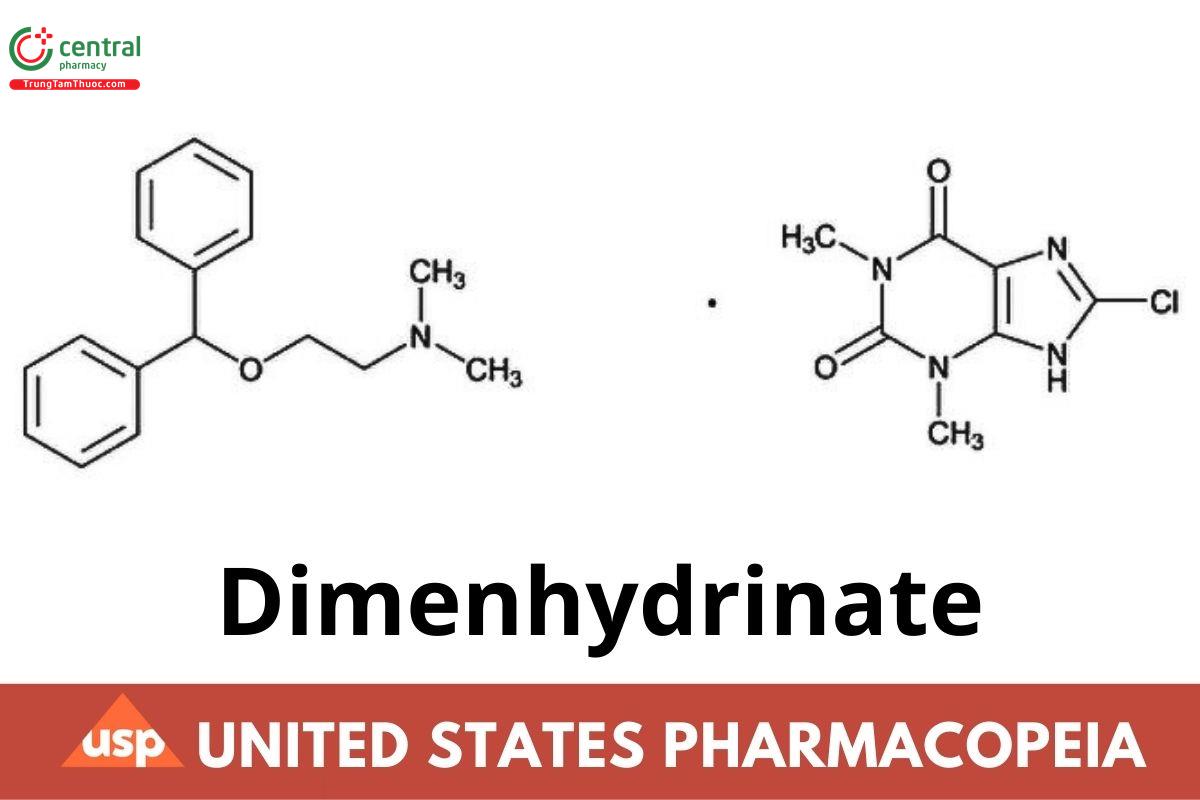

This article is compiled based on the United States Pharmacopeia (USP) – 2025 Edition
Issued and maintained by the United States Pharmacopeial Convention (USP)
C17H21NO · C7H7ClN4O2 469.96
1H-Purine-2,6-dione, 8-chloro-3,7-dihydro-1,3-dimethyl-, compd. with 2-(diphenylmethoxy)-N,N-dimethylethanamine (1:1);
8-Chlorotheophylline, compound with 2-(diphenylmethoxy)-N,N-dimethylethylamine (1:1) CAS RN®: 523-87-5; UNII: JB937PER5C
1 DEFINITION
Dimenhydrinate contains NLT 53.0% and NMT 55.5% of diphenhydramine (C17H21NO) and NLT 44.0% and NMT 47.0% of 8-chlorotheophylline (C7H7ClN4O2), calculated on the dried basis.
2 IDENTIFICATION
Change to read:
A. Spectroscopic Identification Tests 〈197〉, Infrared Spectroscopy: 197K or 197A
Add the following:
B. The retention time of the diphenhydramine peak in the Sample solution corresponds to that of the Standard solution, as obtained in the Assay, Procedure 1: Diphenhydramine.
Add the following:
C. The retention time of the 8-chlorotheophylline peak in the Sample solution corresponds to that of the Standard solution, as obtained in the Assay, Procedure 2: 8-Chlorotheophylline.
3 ASSAY
Change to read:
3.1 Procedure 1: Diphenhydramine
Solution A: 10.0 g/L (equivalent to 13.8 mL/L) of triethylamine in water; adjusted with phosphoric acid to a pH of 2.5
Solution B: Acetonitrile
Mobile phase: See Table 1.
Table 1
| Time (min) | Solution A (%) | Solution B (%) | Flow Rate (mL/min) |
| 0 | 82 | 18 | 1.2 |
| 2 | 82 | 18 | 1.2 |
| 15 | 50 | 50 | 1.2 |
| 20 | 20 | 80 | 2.0 |
| 32 | 20 | 80 | 2.0 |
Return to original conditions, and re-equilibrate the system for NLT 10 min.
Diluent: Acetonitrile and water (18:82)
System suitability solution: 0.114 mg/mL of USP Diphenhydramine Hydrochloride RS and 0.1 mg/mL each of USP Diphenhydramine Related Compound A RS, USP Theophylline RS, and USP Dimenhydrinate Related Compound E RS in Diluent. Sonicate to dissolve, if necessary.
Standard solution: 0.05 mg/mL of USP Diphenhydramine Hydrochloride RS in Diluent
Sample solution: 0.1 mg/mL of Dimenhydrinate in Diluent
Chromatographic system
- (See Chromatography 〈621〉, System Suitability.)
- Mode: LC
- Detector: UV 225 nm
- Column: 4.6-mm × 25-cm; 5-µm packing L1
- Column temperature: 30°
- Flow rate: See Table 1.
- Injection volume: 10 µL
System suitability
- Samples: System suitability solution and Standard solution
- [Note-See Table 2 for relative retention times.]
- Suitability requirements
- Resolution: NLT 1.5 between diphenhydramine related compound A and diphenhydramine, System suitability solution
- Tailing factor: NMT 2.0, Standard solution
- Relative standard deviation: NMT 1.0%, Standard solution
Analysis
Samples: Standard solution and Sample solution
Calculate the percentage of diphenhydramine (C₁₇H₂₁NO) in the portion of Dimenhydrinate taken:
Result = (rᵤ/rₛ) × (Cₛ/Cᵤ) × (Mr1/Mr2) × 100
rᵤ = peak response of diphenhydramine from the Sample solution
rₛ = peak response of diphenhydramine from the Standard solution
Cₛ = concentration of USP Diphenhydramine Hydrochloride RS in the Standard solution (mg/mL)
Cᵤ = concentration of Dimenhydrinate in the Sample solution (mg/mL)
Mr1 = molecular weight of diphenhydramine, 255.36
Mr2 = molecular weight of diphenhydramine hydrochloride, 291.82
Acceptance criteria: 53.0%–55.5% on the dried basis
Change to read:
3.2 Procedure 2: 8-Chlorotheophylline
3.3 Solution A, Solution B, Mobile phase, Diluent, Sample solution, and Chromatographic system: Proceed as directed in the Assay, Procedure 1: Diphenhydramine.
Standard solution: 0.05 mg/mL of USP 8-Chlorotheophylline RS in Diluent
System suitability
- Sample: Standard solution
- Suitability requirements
- Tailing factor: NMT 2.0
- Relative standard deviation: NMT 1.0%
Analysis
Samples: Sample solution and Standard solution
Calculate the percentage of 8-chlorotheophylline (C7H7ClN4O2) in the portion of Dimenhydrinate taken:
Result = (rᵤ/rₛ) × (Cₛ/Cᵤ) × 100
rᵤ = peak response of 8-chlorotheophylline from the Sample solution
rₛ = peak response of 8-chlorotheophylline from the Standard solution
Cₛ = concentration of USP 8-Chlorotheophylline RS in the Standard solution (mg/mL)
Cᵤ = concentration of Dimenhydrinate in the Sample solution (mg/mL)
Acceptance criteria: 44.0%–47.0% on the dried basis
4 IMPURITIES
4.1 Residue on Ignition 〈281〉: NMT 0.3%
Change to read:
4.2 Organic Impurities
Solution A, Solution B, Mobile phase, Diluent, System suitability solution, and Chromatographic system: Proceed as directed in the Assay, Procedure 1: Diphenhydramine.
Standard solution: 2.28 µg/mL of USP Diphenhydramine Hydrochloride RS in Diluent
Sensitivity solution: 0.57 µg/mL of USP Diphenhydramine Hydrochloride RS in Diluent, from the Standard solution
Sample solution: 1.0 mg/mL of Dimenhydrinate in Diluent
System suitability
- Samples: System suitability solution, Standard solution, and Sensitivity solution
- Suitability requirements
- Resolution: NLT 1.5 between diphenhydramine related compound A and diphenhydramine, System suitability solution
- Relative standard deviation: NMT 5.0%, Standard solution
- Signal-to-noise ratio: NLT 10, Sensitivity solution
Analysis
Samples: Standard solution and Sample solution
Calculate the percentage of each individual impurity in the portion of Dimenhydrinate taken:
Result = (rᵤ/rₛ) × (Cₛ/Cᵤ) × (Mr1/Mr2) × 100
rᵤ = peak response of each individual impurity from the Sample solution
rₛ = peak response of diphenhydramine from the Standard solution
Cₛ = concentration of USP Diphenhydramine Hydrochloride RS in the Standard solution (mg/mL)
Cᵤ = concentration of Dimenhydrinate in the Sample solution (mg/mL)
Mr1 = molecular weight of diphenhydramine, 255.36
Mr2 = molecular weight of diphenhydramine hydrochloride, 291.82
Acceptance criteria: See Table 2. The reporting threshold is 0.05%.
Table 2
| Name | Relative Retention Time | Acceptance Criteria, NMT (%) |
| Theophylline | 0.3 | 0.2 |
| 8-Chlorotheophylline | 0.47 | - |
| Dimenhydrinate related compound E | 0.7 | 0.15 |
| Diphenhydramine related compound A | 0.95 | 0.2 |
| Diphenhydramine | 1.0 | - |
| Any other individual impurity | - | 0.10 |
| Total impurities | - | 0.5 |
5 SPECIFIC TESTS
5.1 Loss on Drying 〈731〉
Analysis: Dry under vacuum over phosphorus pentoxide for 24 h.
Acceptance criteria: NMT 0.5%
6 ADDITIONAL REQUIREMENTS
6.1 Packaging and Storage
Preserve in well-closed containers.
Change to read:
6.2 USP Reference Standards 〈11〉
USP 8-Chlorotheophylline RS
8-Chloro-1,3-dimethyl-3,7-dihydro-1H-purine-2,6-dione.
C7H7ClN4O2 214.61
USP Dimenhydrinate RS
USP Dimenhydrinate Related Compound E RS
8-Chlorocaffeine;
8-Chloro-3,7-dihydro-1,3,7-trimethyl-1H-purine-2,6-dione.
C₈H₉ClN₄O₂ 228.64
USP Diphenhydramine Hydrochloride RS
USP Diphenhydramine Related Compound A RS
2-(Diphenylmethoxy)-N-methylethanamine hydrochloride.
C16H19NO·HCl 277.79
USP Theophylline RS

