
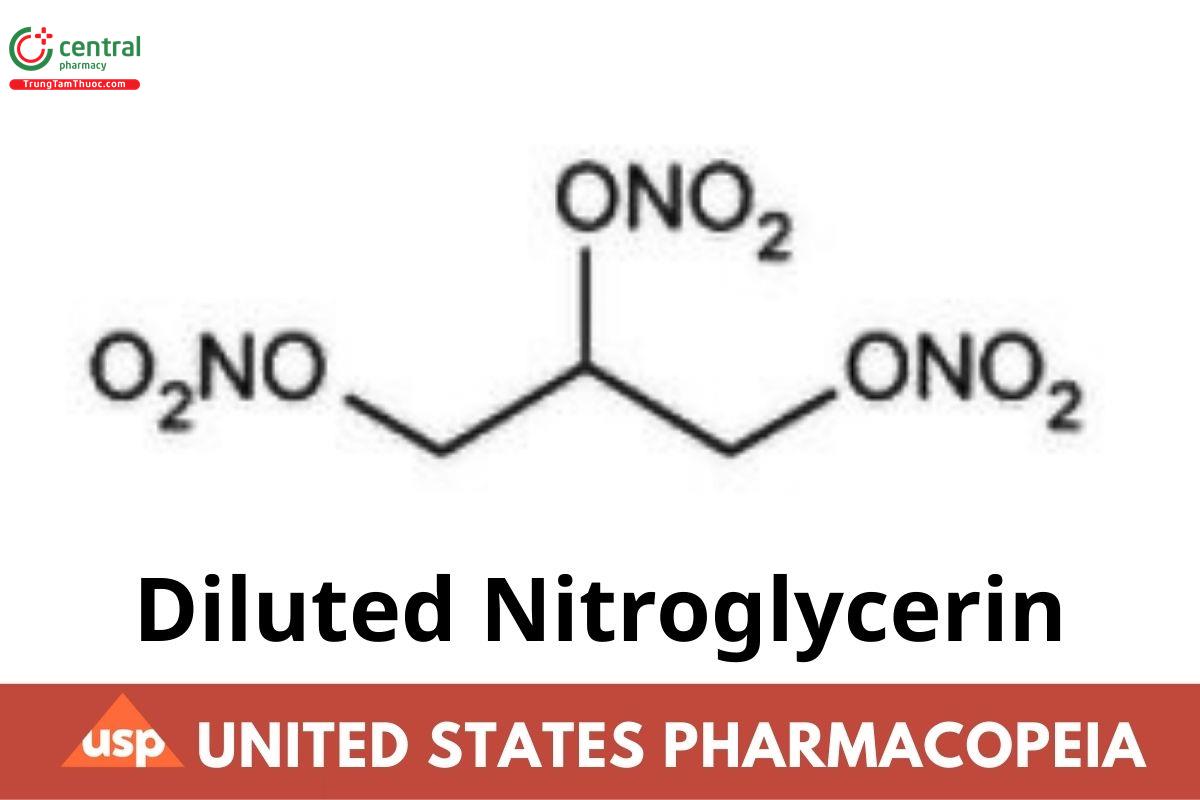
Diluted Nitroglycerin
If you find any inaccurate information, please let us know by providing your feedback here

Tóm tắt nội dung
This article is compiled based on the United States Pharmacopeia (USP) – 2025 Edition
Issued and maintained by the United States Pharmacopeial Convention (USP)
C₃H₅N₃O₉ 227.09
1,2,3-Propanetriol, trinitrate;
Nitroglycerin CAS RN®: 55-63-0; UNII: G59M7S0WS3.
1 DEFINITION
Diluted Nitroglycerin is a mixture of nitroglycerin (C₃H₅N₃O₉) with lactose, dextrose, alcohol, propylene glycol, or other suitable inert excipient to permit safe handling. It contains NLT 90.0% and NMT 110.0% of the labeled amount of C₃H₅N₃O₉. It usually contains NMT 10% of nitroglycerin (C₃H₅N₃O₉). [Caution-Taking into consideration the concentration and amount of nitroglycerin (C₃H₅N₃O₉) in Diluted Nitroglycerin, exercise appropriate precautions when handling this material. Nitroglycerin is a powerful explosive and can be detonated by percussion or excessive heat. Do not isolate nitroglycerin (C₃H₅N₃O₉).]
2 IDENTIFICATION
A. The RF value of the principal spot of Sample solution A corresponds to that of the Standard solution, as obtained in the Procedure for Organic Impurities.
B. The retention time of the Sample solution corresponds to that of the Standard solution, as obtained in the Assay.
3 ASSAY
3.1 Procedure
Mobile phase: Methanol and water (1:1)
Standard solution: 0.075 mg/mL of nitroglycerin from USP Diluted Nitroglycerin RS in Mobile phase
Sample solution: Transfer a portion of Diluted Nitroglycerin, equivalent to 7.5 mg of nitroglycerin, to a 100-mL volumetric flask, and dissolve in 75 mL of Mobile phase. If necessary, sonicate for 2 min or until the solid is totally dispersed, then shake by mechanical means for 30 min. Dilute with Mobile phase to volume, and filter.
Chromatographic system
- (See Chromatography 〈621〉, System Suitability.)
- Mode: LC
- Detector: UV 220 nm
- Column: 4.6-mm × 25-cm; packing L1. [Note-If necessary a short precolumn that contains packing L1 may be used.]
- Flow rate: 1 mL/min
- Injection size: 20 µL
System suitability
- Sample: Standard solution
- Suitability requirements
- Column efficiency: NLT 3000 theoretical plates
- Tailing factor: NMT 2.5 for the analyte peak
- Relative standard deviation: NMT 3.0%
Analysis
Samples: Standard solution and Sample solution
Calculate the percentage of C₃H₅N₃O₉ in the portion of Diluted Nitroglycerin taken:
Result = (rᵤ/rₛ) × (Cₛ/Cᵤ) × 100
rᵤ = peak response from the Sample solution
rₛ = peak response from the Standard solution
Cₛ = concentration of nitroglycerin in the Standard solution (mg/mL)
Cᵤ = nominal concentration of the Sample solution (mg/mL)
Acceptance criteria: 90.0%–110.0%
4 IMPURITIES
4.1 Organic Impurities
4.1.1 Procedure
Standard solution: 400 µg/mL of nitroglycerin from USP Diluted Nitroglycerin RS in methanol
Sample solution A: Prepare a clear solution containing 400 µg/mL of nitroglycerin from Diluted Nitroglycerin in methanol.
Sample solution B: 20 mg/mL of nitroglycerin in methanol from Diluted Nitroglycerin. Centrifuge a portion, if necessary, to obtain a clear liquid phase.
Chromatographic system
- (See Chromatography 〈621〉, Thin-Layer Chromatography.)
- Adsorbent: 0.25-mm layer of chromatographic silica gel mixture
- Application volume: 20 µL each of Sample solution A and Sample solution B; 5, 10, 15, and 20 µL of the Standard solution
- Developing solvent system: Toluene and ethyl acetate (4:1)
- Spray reagent: Diphenylamine in methanol (1 in 100)
Analysis
Samples: Standard solution, Sample solution A, and Sample solution B
Apply the Samples to a suitable thin-layer chromatographic plate. Develop the chromatograms in the Developing solvent system until the solvent front has moved three-fourths of the length of the plate. Remove the plate from the developing chamber, mark the solvent front, and allow the solvent to evaporate. Spray the plate with Spray reagent, and irradiate the plate with short- and long-wavelength UV light for 15 min.
Acceptance criteria: Any spot from Sample solution B, other than the principal spot, is not more intense than the spot from the 20-µL application of the Standard solution. Compare the intensities of any secondary spots observed from Sample solution B with those of the principal spots from the Standard solution (corresponding to 0.5%, 1.0%, 1.5%, and 2.0%, respectively): the sum of the intensities of the secondary spots from Sample solution B is NMT 3%. [Note-Nitrates of Glycerin typically have RF values of 0.21, 0.37, and 0.61 for mono-, di-, and tri-substituted glycerins, respectively.]
5 ADDITIONAL REQUIREMENTS
Packaging and Storage: Preserve in tight, light-resistant containers, and prevent exposure to excessive heat. Store at 25°, excursions permitted between 15° and 30°.
USP Reference Standards 〈11〉
USP Diluted Nitroglycerin RS

