
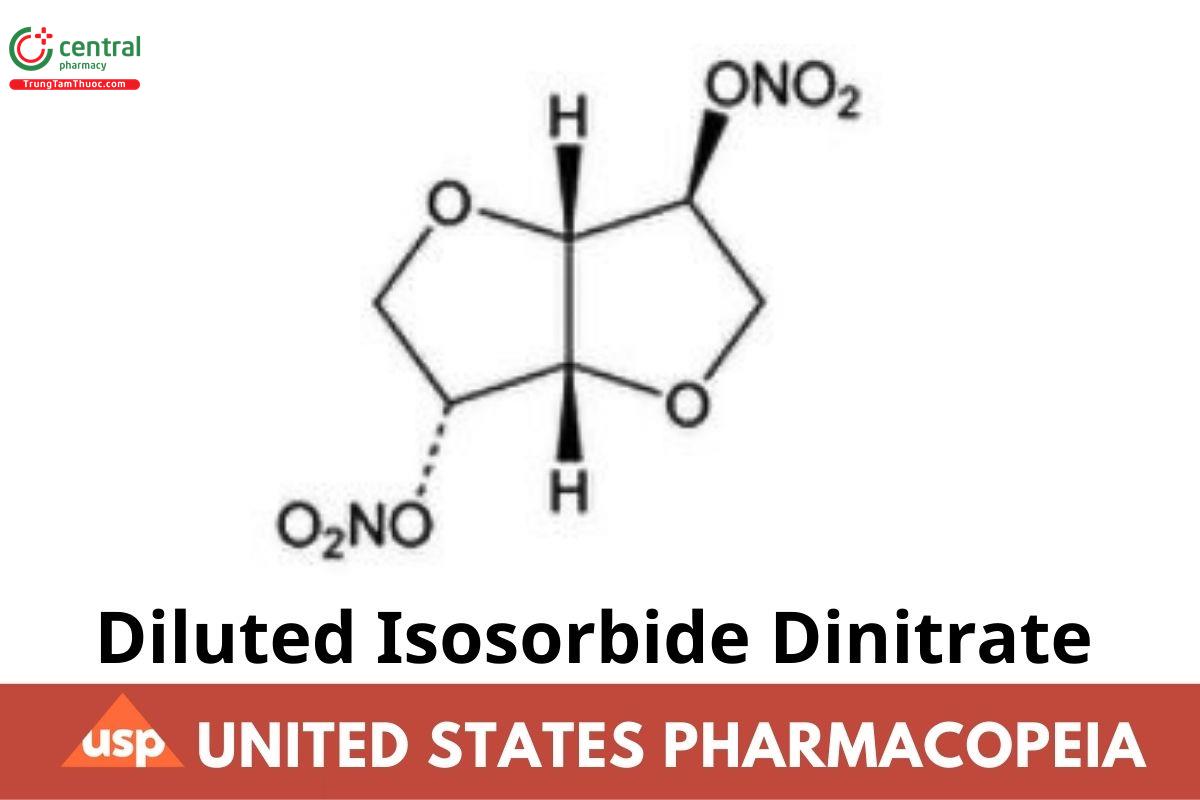
Diluted Isosorbide Dinitrate
If you find any inaccurate information, please let us know by providing your feedback here

Tóm tắt nội dung
This article is compiled based on the United States Pharmacopeia (USP) – 2025 Edition
Issued and maintained by the United States Pharmacopeial Convention (USP)
C₆H₈N₂O₈ 236.14
d-Glucitol, 1,4:3,6-dianhydro-, dinitrate;
1,4:3,6-Dianhydro-d-glucitol dinitrate CAS RN®: 87-33-2; UNII: IA7306519N.
1 DEFINITION
Diluted Isosorbide Dinitrate is a dry mixture of isosorbide dinitrate (C₆H₈N₂O₈) with Lactose, Mannitol, or suitable inert excipients to permit safe handling. It may contain up to 1.0% of a suitable stabilizer, such as Ammonium Phosphate. It contains NLT 95.0% and NMT 105.0% of the labeled amount of isosorbide dinitrate (C₆H₈N₂O₈). It usually contains approximately 25% of isosorbide dinitrate.
[Caution-Exercise proper precautions in handling undiluted isosorbide dinitrate, which is a powerful explosive and can be exploded by percussion or excessive heat. Only exceedingly small amounts should be isolated.]
2 IDENTIFICATION
2.1 A.
Sample solution: Transfer to a medium-porosity, sintered-glass filtering crucible a quantity of Diluted Isosorbide Dinitrate, equivalent to about 50 mg of isosorbide dinitrate, and pass three 5-mL portions of acetone through it. Evaporate the combined extracts at a temperature not exceeding 35°, with the aid of a gentle current of air, and dry the residue under vacuum over calcium chloride at room temperature for 16 h. Prepare a solution (1 in 40) of the residue so obtained, in chloroform.
Standard solution: A similar preparation from the residue obtained from USP Diluted Isosorbide Dinitrate RS.
Acceptance criteria: The IR absorption spectrum of the Sample solution, determined in a 0.1-mm cell, exhibits maxima only at the same wavelengths as that of the Standard solution.
2.2 B.
The retention time of the major peak of the Sample solution corresponds to that of the Standard solution, as obtained in the Assay.
3 ASSAY
3.1 Procedure
Solution A: Methanol and water (6:94)
Solution B: Methanol and water (50:50)
Mobile phase: See Table 1.
Table 1
| Time (min) | Solution A (%) | Solution B (%) |
| 0.0 | 100 | 0 |
| 2.5 | 100 | 0 |
| 18.0 | 60 | 40 |
| 18.1 | 0 | 100 |
| 20.5 | 0 | 100 |
| 21.0 | 100 | 0 |
| 26.0 | 100 | 0 |
Diluent: Methanol and water (15:85)
Standard solution: 0.25 mg/mL of isosorbide dinitrate prepared as follows. Transfer a suitable portion of USP Diluted Isosorbide Dinitrate RS, equivalent to 25 mg of isosorbide dinitrate, to a 100-mL volumetric flask. Add 10 mL of methanol and sonicate. Dilute with Diluent to 60% of the flask volume, and sonicate with occasional shaking until all solids dissolve. Dilute with Diluent to volume.
Sample solution: 0.25 mg/mL of isosorbide dinitrate prepared as follows. Transfer a suitable portion of Diluted Isosorbide Dinitrate, equivalent to 25 mg of isosorbide dinitrate, to a 100-mL volumetric flask. Add 10 mL of methanol and sonicate. Dilute with Diluent to 60% of the flask volume, and sonicate with occasional shaking until all solids are dissolved. Dilute with Diluent to volume.
Chromatographic system
- (See Chromatography 〈621〉, System Suitability.)
- Mode: LC
- Detector: UV 214 nm
- Column: 4.6-mm × 5-cm; 5-µm packing L1
- Column temperature: 30°
- Flow rate: 3 mL/min
- Injection volume: 75 µL
System suitability
- Sample: Standard solution
- Suitability requirements
- Tailing factor: NMT 2.0
- Relative standard deviation: NMT 1.0%
Analysis
Samples: Standard solution and Sample solution
Calculate the percentage of isosorbide dinitrate (C₆H₈N₂O₈) in the portion of Diluted Isosorbide Dinitrate taken:
Result = (rᵤ/rₛ) × (Cₛ/Cᵤ) × 100
rᵤ = peak response of isosorbide dinitrate from the Sample solution
rₛ = peak response of isosorbide dinitrate from the Standard solution
Cₛ = concentration of isosorbide dinitrate from USP Diluted Isosorbide Dinitrate RS in the Standard solution (mg/mL)
Cᵤ = concentration of isosorbide dinitrate in the Sample solution (mg/mL)
Acceptance criteria: 95.0%–105.0%
4 IMPURITIES
4.1 Organic Impurities
Solution A, Solution B, Mobile phase, Diluent, and Chromatographic system: Proceed as directed in the Assay.
Standard stock solution: 0.3 mg/mL of isosorbide dinitrate prepared as follows. Transfer a suitable portion of USP Diluted Isosorbide Dinitrate RS, equivalent to 30 mg of isosorbide dinitrate, to a 100-mL volumetric flask. Add 10 mL of methanol and sonicate. Dilute with Diluent to 60% of the flask volume, sonicate with occasional shaking, and dilute with Diluent to volume.
Standard solution: 7.5 µg/mL of isosorbide dinitrate from the Standard stock solution in Diluent
Sensitivity solution: 0.375 µg/mL of isosorbide dinitrate from the Standard solution in Diluent
Sample solution: 750 µg/mL of isosorbide dinitrate prepared as follows. Transfer a suitable quantity of Diluted Isosorbide Dinitrate, equivalent to 37.5 mg of isosorbide dinitrate, to a 50-mL volumetric flask. Add 5 mL of methanol, mix, and sonicate. Add Diluent to fill 60% of the flask volume, and sonicate with occasional shaking. Allow the solution to equilibrate to room temperature and dilute with Diluent to volume.
System suitability
- Samples: Standard solution and Sensitivity solution
- [Note-See Table 2 for relative retention times.]
- Suitability requirements
- Tailing factor: NMT 2.0, Standard solution
- Relative standard deviation: NMT 2.0%, Standard solution
- Signal-to-noise ratio: NLT 10, Sensitivity solution
Analysis
Samples: Standard solution and Sample solution
Calculate the percentage of each impurity in the portion of Diluted Isosorbide Dinitrate taken:
Result = (rᵤ/rₛ) × (Cₛ/Cᵤ) × (1/F) × 100
rᵤ = peak response of each impurity from the Sample solution
rₛ = peak response of isosorbide dinitrate from the Standard solution
Cₛ = concentration of isosorbide dinitrate from USP Diluted Isosorbide Dinitrate RS in the Standard solution (µg/mL)
Cᵤ = concentration of isosorbide dinitrate in the Sample solution (µg/mL)
F = relative response factor (see Table 2)
Acceptance criteria: See Table 2. Reporting threshold: 0.05%.
Table 2
| Name | Relative Retention Time | Relative Response Factor | Acceptance Criteria, NMT (%) |
| Isosorbide mononitrate related compound Aᵃ | 0.15 | 0.61 | 0.15 |
| Isosorbide mononitrateᵇ | 0.21 | 0.61 | 0.15 |
| Isosorbide dinitrate | 1.0 | - | - |
| Any individual unspecified impurity | - | 1.0 | 0.10 |
| Total impurities | - | - | 1.0 |
ᵃ 1,4:3,6-Dianhydro-d-glucitol 2-nitrate.
ᵇ 1,4:3,6-Dianhydro-d-glucitol 5-nitrate.
5 SPECIFIC TESTS
5.1 Loss on Drying 〈731〉
Analysis: Dry under vacuum over calcium chloride at room temperature for 16 h.
Acceptance criteria: NMT 1.0%
6 ADDITIONAL REQUIREMENTS
Packaging and Storage: Preserve in tight containers.
USP Reference Standards 〈11〉
USP Diluted Isosorbide Dinitrate RS

