
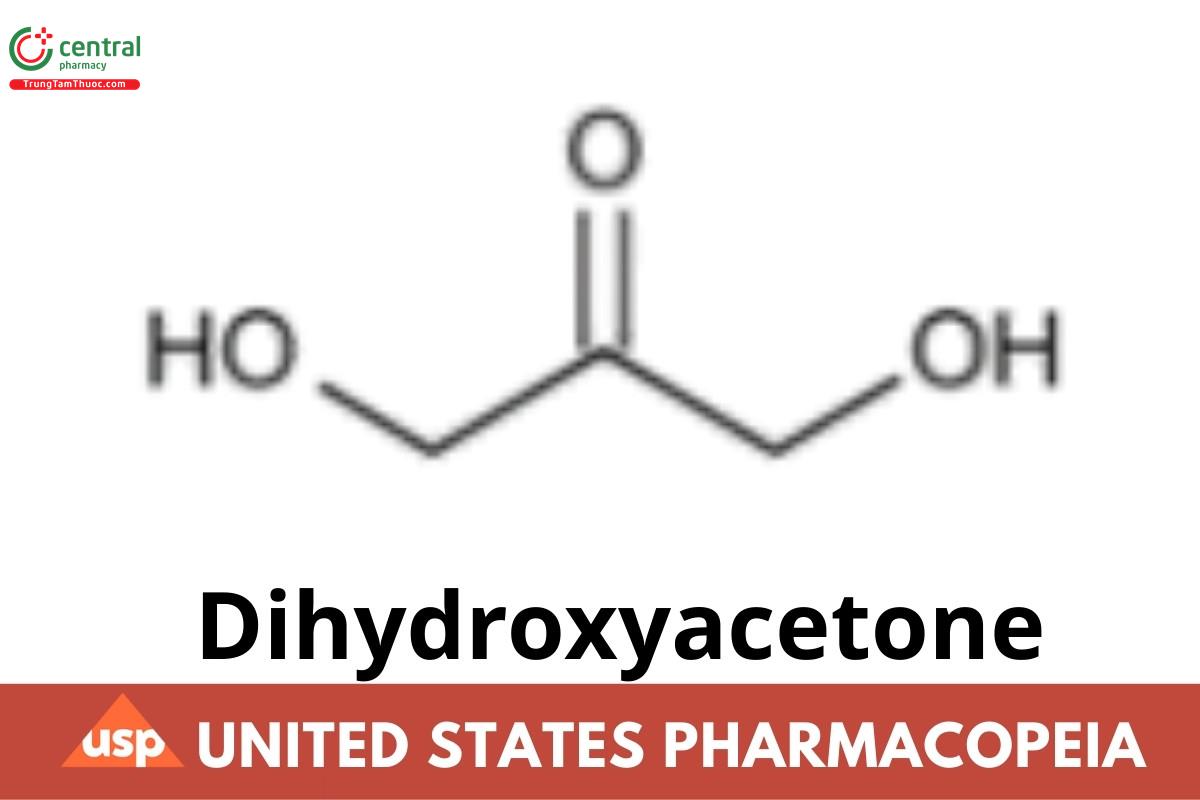
Dihydroxyacetone
If you find any inaccurate information, please let us know by providing your feedback here

Tóm tắt nội dung
This article is compiled based on the United States Pharmacopeia (USP) – 2025 Edition
Issued and maintained by the United States Pharmacopeial Convention (USP)
1 DEFINITION
Dihydroxyacetone contains NLT 98.0% and NMT 102.0% of dihydroxyacetone (C3H6O3), calculated on the anhydrous basis.
2 IDENTIFICATION
A. Spectroscopic Identification Tests 〈197〉, Infrared Spectroscopy: 197K
B. The R value of the principal spot of the Sample solution corresponds to that of the Standard solution, as obtained in the test for Organic F
Impurities.
3 ASSAY
3.1 Procedure
Sample solution: Dissolve 0.1 g of Dihydroxyacetone in 20 mL of water, add 20 mL of 0.1 M periodic acid, and allow to stand at room temperature in the dark for 20 min. Add 3 g of sodium bicarbonate, 20 mL of 0.6 M potassium iodide, and 3 mL of starch TS.
Analysis: Titrate with 0.05 M sodium arsenite VS. Perform a blank titration, and make any necessary corrections. Each mL of 0.05 M sodium arsenite is equivalent to 4.504 mg of dihydroxyacetone (C3H6O3).
Acceptance criteria: 98.0%–102.0% on the anhydrous basis
4 IMPURITIES
4.1 Residue on Ignition 〈281〉: NMT 0.1%
Change to read:
4.2 Iron 〈241〉, Procedures, Procedure 1 (CN 1-Jun-2023) : NMT 0.002%
4.3 Organic Impurities
Glycerin solution: 0.25 mg/mL of glycerin in methanol
Standard solution: 50 mg/mL of USP Dihydroxyacetone RS in methanol
Sample solution: 50 mg/mL of Dihydroxyacetone in methanol
Chromatographic system
(See Chromatography 〈621〉, Thin-Layer Chromatography.)
Mode: TLC
Adsorbent: 0.25-mm layer of chromatographic silica gel mixture
Application volume: 1 µL
Developing solvent system: Acetone and water (19:1)
Spray reagent: Toluene, saturated solution of lead tetraacetate in glacial acetic acid, and 1% solution of dichlorouorescein in alcohol (190:5:1)
Analysis
Samples: Glycerin solution, Standard solution, and Sample solution
Spray the plate with Spray reagent, and dry the plate for 5 min at 105°. Examine the plate under short-wavelength UV light, and compare the intensities of the glycerin spot observed in the Sample solution with that of the principal spot of the Glycerin solution. Acceptance criteria: 0.5%; the glycerin spot of the Sample solution is not larger or more intense than the principal spot of the Glycerin solution, and no other secondary spots are observed in the Sample solution.
5 SPECIFIC TESTS
5.1 pH 〈791〉
Sample solution: 50 mg/mL in water
Acceptance criteria: 4.0–6.0
5.2 Water Determination, Method I〈921〉: NMT 0.2%
5.3 Limit of Protein
Sample solution: 250 mg/mL of Dihydroxyacete in water. Transfer 100 µL of this solution to a 5-mL volumetric ask, dilute with brilliant blue G TS to volume, and mix.
Instrumental conditions
Mode: UV
Analytical wavelength: 595 nm
Blank: 100 µL of water and 5 mL of brilliant blue G TS
Analysis: Determine the absorbance of the Sample solution.
Acceptance criteria: NMT 0.400

