
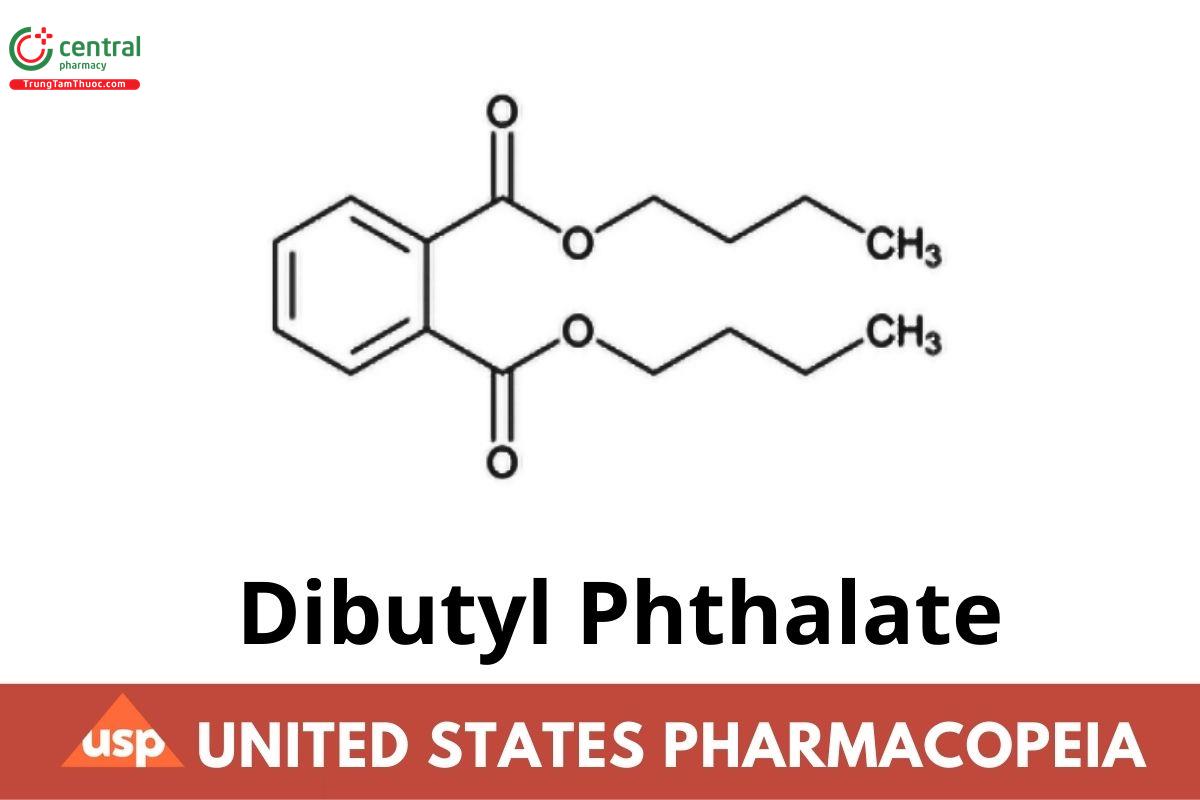
Dibutyl Phthalate
If you find any inaccurate information, please let us know by providing your feedback here

Tóm tắt nội dung
This article is compiled based on the United States Pharmacopeia (USP) – 2025 Edition
Issued and maintained by the United States Pharmacopeial Convention (USP)
DOWNLOAD PDF HERE
1 DEFINITION
Dibutyl Phthalate contains NLT 99.0% and NMT 101.0% of dibutyl phthalate (C16H22O4).
2 IDENTIFICATION
Change to read
A. Spectroscopic Identification Tests 〈197〉, Infrared Spectroscopy: 197F. (CN 1-May-2020) On undried specimen
B. It meets the requirements in Specific Tests for Refractive Index 〈831〉.
3 ASSAY
Procedure
Sample: 0.75 g
Titrimetric system
(See Titrimetry 〈541〉.)
Mode: Residual titration
Titrant: 0.5 N alcoholic potassium hydroxide VS
Back-titrant: 0.5 N hydrochloric acid VS
Endpoint detection: Visual
Analysis: Transfer the Sample to a flask, add 25.0 mL of Titrant, attach a reflux condenser to the flask, and boil in a water bath for 1 h. Add 1 mL of phenolphthalein TS. Titrate immediately with Back-titrant. Perform a blank determination. Each mL of Titrant is equivalent to 69.59 mg of dibutyl phthalate (C16H22O4).
Acceptance criteria: 99.0%–101.0%
4 IMPURITIES
4.1 Residue on Ignition 〈281〉
Sample: 1.0 g
Acceptance criteria: NMT 0.1%
4.2 Related Compounds
Internal standard solution: 3 mg/mL of dibenzyl in methylene chloride
Sample stock solution: 100 mg/mL of Dibutyl Phthalate in methylene chloride
Sample solution A: Dilute 5.0 mL of Sample stock solution with methylene chloride to 10 mL.
Sample solution B: Add 5.0 mL of Sample stock solution, 1.0 mL of Internal standard solution, and dilute with methylene chloride to 10 mL.
Standard solution: Add 1.0 mL of Sample solution A, 10.0 mL of Internal standard solution, and dilute with methylene chloride to 100 mL.
Chromatographic system
(See Chromatography 〈621〉, System Suitability.)
Mode: GC
Detector: Flame ionization
Column: 4-mm × 1.5-m; packed with 3% liquid phase G3 on support S1A
Temperatures
Column: 190°
Injection port: 225°
Detector: 225°
Carrier gas: Nitrogen
Flow rate: 30 mL/min
Run time: Three times the retention time of dibutyl phthalate
Injection volume: 1 μL
System suitability
Samples: Sample solution A and Standard solution
Suitability requirements
[Note—The elution order is the internal standard peak followed by the dibutyl phthalate peak.]
Resolution: NLT 12 between the internal standard and the dibutyl phthalate peak, Standard solution
Additional requirements: Verify that there is no peak with the same retention time as the internal standard in Sample solution A. If such a peak is observed, make any necessary correction for factors of dilution, and then determine the area due to the interfering component that must be subtracted from the area of the internal standard peak appearing in the chromatogram recorded for Sample solution B.
Analysis
Samples: Sample solution B and Standard solution
Calculate the peak area ratio of dibutyl phthalate to the internal standard for the Standard solution. Calculate the peak area ratio of the sum of all peaks, excluding the main peak, the solvent peak, and the internal standard peak, to the internal standard peak for Sample solution B.
Acceptance criteria: NMT 1.0%; the ratio for Sample solution B is NMT the ratio for the Standard solution.
5 SPECIFIC TESTS
Specific Gravity 〈841〉: 1.043–1.048 at 20°
Refractive Index 〈831〉: 1.490–1.495 at 20°
Acidity
Sample: 20.0 g
Analysis: Mix the Sample with 50 mL of alcohol that previously has been neutralized to a phenolphthalein endpoint. Add 0.2 mL of
phenolphthalein TS, and titrate with 0.1 N sodium hydroxide VS.
Acceptance criteria: NMT 0.50 mL is required to change the color of the indicator.
Water Determination, Method I 〈921〉: NMT 0.2%
Appearance
Sample: Dibutyl Phthalate (neat)
Standard solution: Prepared immediately before use by mixing 2.4 mL of ferric chloride CS and 0.6 mL of cobaltous chloride CS with dilute hydrochloric acid (10 mg/mL) to make 10 mL, and diluting 5 mL of this solution with dilute hydrochloric acid (10 mg/mL) to make 100 mL
Analysis: Compare the Sample and the Standard solution by viewing the substance and the solution downward in matched color-comparison tubes against a white surface (see Color and Achromicity 〈631〉).
Acceptance criteria: The Sample is clear and not more intensely colored than the Standard solution.
6 ADDITIONAL REQUIREMENTS
Packaging and Storage: Preserve in tight containers. No storage requirements specified.
USP Reference Standards 〈11〉
USP Dibutyl Phthalate RS

