
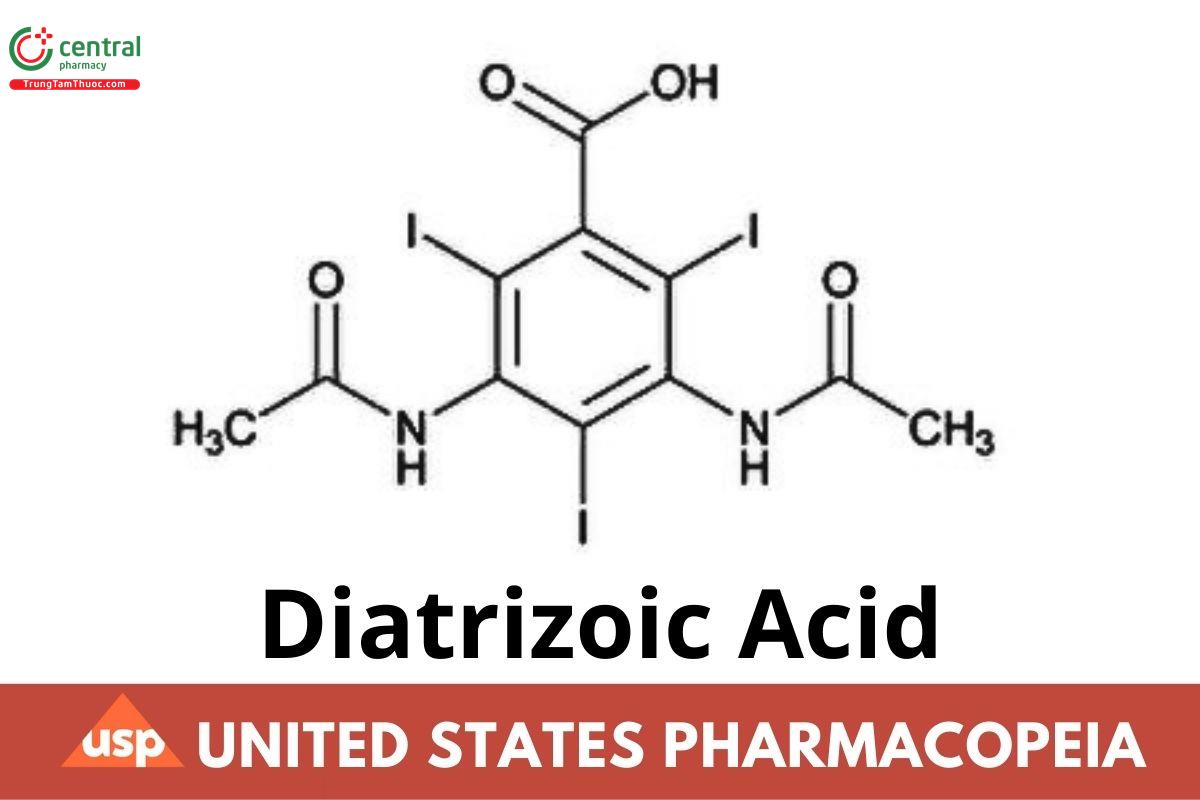
Diatrizoic Acid
If you find any inaccurate information, please let us know by providing your feedback here

Tóm tắt nội dung
This article is compiled based on the United States Pharmacopeia (USP) – 2025 Edition
Issued and maintained by the United States Pharmacopeial Convention (USP)
C₁₁H₉I₃N₂O₄ (anhydrous) 613.91
C₁₁H₉I₃N₂O₄·2H₂O 649.95
Benzoic acid, 3,5-bis(acetylamino)-2,4,6-triiodo-;
3,5-Diacetamido-2,4,6-triiodobenzoic acid CAS RN®: 117-96-4.
Dihydrate CAS RN®: 50978-11-5.
1 DEFINITION
Diatrizoic Acid is anhydrous or contains two molecules of water of hydration. It contains NLT 98.0% and NMT 102.0% of diatrizoic acid (C₁₁H₉I₃N₂O₄), calculated on the anhydrous basis.
2 IDENTIFICATION
2.1 A. Thin-Layer Chromatographic Identification Test 〈201〉
Solution A: Sodium hydroxide in methanol (0.8 in 1000)
Standard solution: 1 mg/mL in Solution A
Sample solution: 1 mg/mL in Solution A
Developing solvent system: Chloroform, methanol, and ammonium hydroxide (20:10:2)
Analysis: Use short-wavelength UV light to locate the spots.
Acceptance criteria: Meets the requirements
2.2 B.
Sample: 500 mg
Analysis: Heat the Sample in a suitable crucible.
Acceptance criteria: Violet vapors are evolved.
3 ASSAY
3.1 Procedure
Sample: 300 mg
Titrimetric system
- (See Titrimetry 〈541〉.)
- Mode: Direct titration
- Titrant: 0.05 N silver nitrate VS
- Endpoint detection: Visual
Analysis: Transfer the Sample to a glass-stoppered, 125-mL conical flask, add 30 mL of 1.25 N sodium hydroxide and 500 mg of powdered zinc, connect the flask to a reflux condenser, and reflux the mixture for 1 h. Cool the flask to room temperature, rinse the condenser with 20 mL of water, disconnect the flask from the condenser, and filter the mixture. Rinse the flask and the filter thoroughly, adding the rinsings to the filtrate. Add 5 mL of glacial acetic acid and 1 mL of tetrabromophenolphthalein ethyl ester TS. Titrate the Sample with Titrant until the yellow precipitate just turns green. Each mL of Titrant is equivalent to 10.23 mg of diatrizoic acid (C₁₁H₉I₃N₂O₄).
Acceptance criteria: 98.0%-102.0% on the anhydrous basis
4 IMPURITIES
4.1 Residue on Ignition 〈281〉
NMT 0.1%
4.2 Free Aromatic Amine
Standard stock solution: Dissolve a suitable quantity of USP Diatrizoic Acid Related Compound A RS in 0.1 N sodium hydroxide. Use 0.2 mL of 0.1 N sodium hydroxide for each 5.0 mg of Standard, and dilute with water to obtain 500 µg/mL.
Standard solution: Transfer 4 mL of water, 10 mL of 0.1 N sodium hydroxide, and 1.0 mL of a Standard stock solution to a 50-mL volumetric flask.
Sample solution: Transfer 1.0 g to a 50-mL volumetric flask, and add 12.5 mL of water and 2.5 mL of 0.1 N sodium hydroxide.
Blank: Transfer 5 mL of water and 10 mL of 0.1 N sodium hydroxide to a 50-mL volumetric flask.
Analysis
Treat each flask as follows. Add 25 mL of Dimethyl sulfoxide, insert the stopper, and mix by swirling gently. Chill in an ice bath in the dark for 5 min. In conducting the following steps, keep the flasks in the ice bath and in the dark as much as possible until all of the reagents have been added.
Slowly add 2 mL of hydrochloric acid, and allow to stand for 5 min. Add 2 mL of sodium nitrite solution (20 mg/mL), and allow to stand for 5 min. Add 1 mL of sulfamic acid solution (80 mg/mL), shake, and allow to stand for 5 min. [Note-Considerable pressure is produced.] Add 2 mL of a solution (1 mg/mL) of N-(1-naphthyl)-ethylenediamine dihydrochloride in dilute propylene glycol (700 mg/mL). Remove the flasks from the ice bath and from storage in the dark, and allow to stand in a water bath at 22°–25° for 10 min. Shake gently and occasionally during this period, releasing the pressure by loosening the stopper. Dilute with water to volume.
Instrumental conditions
- (See Ultraviolet-Visible Spectroscopy 〈857〉.)
- Mode: Vis
- Analytical wavelength: 465 nm
- Cell: 1 cm
Analysis
Within 5 min from the time of diluting the solutions in all three flasks to 50 mL, concomitantly determine the absorbances of the solutions.
Acceptance criteria: 0.05%; the absorbance of the Sample solution is NMT that of the Standard solution.
5 SPECIFIC TESTS
5.1 Water Determination, Method I 〈921〉
NMT 1.0% (anhydrous form), and between 4.5% and 7.0% (hydrous form)
5.2 Iodine and Iodide
Sample solution: Suspend 10.0 g in 10 mL of water, and add in small portions, with stirring, 1.5 mL of sodium hydroxide solution (400 mg/mL). When the solution is complete, adjust to a pH between 7.0 and 7.5 with a dilute solution (8 mg/mL) of sodium hydroxide or hydrochloric acid, and dilute with water to 20 mL.
Analysis: Dilute 4.0 mL of Sample solution with 20 mL of water in a 50-mL centrifuge tube provided with a stopper, add 5 mL of toluene and 5 mL of 2 N sulfuric acid, shake, and centrifuge: the toluene layer shows no red color. Add 1 mL of sodium nitrite solution (20 mg/mL), shake, and centrifuge.
Acceptance criteria: NMT 0.02% of iodide; any red color in the toluene layer is not darker than that obtained when a mixture of 2.0 mL of potassium iodide solution (0.25 mg/mL) and 22 mL of water is substituted for the solution under test.
6 ADDITIONAL REQUIREMENTS
Packaging and Storage: Preserve in well-closed containers. Store at room temperature.
Labeling: Label it to indicate whether it is anhydrous or hydrous.
USP Reference Standards 〈11〉
- USP Diatrizoic Acid RS
- USP Diatrizoic Acid Related Compound A RS
5-Acetamido-3-amino-2,4,6-triiodobenzoic acid.
C₉H₇I₃N₂O₃ 571.88

