
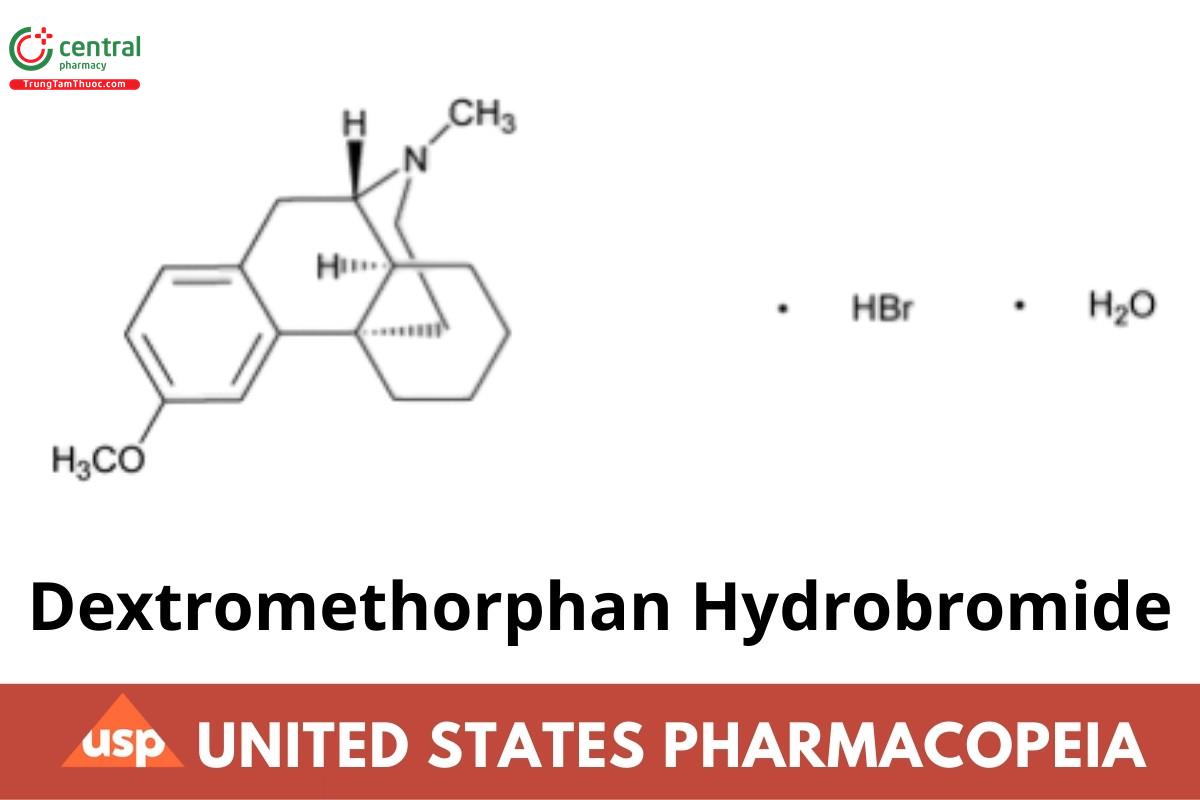
Dextromethorphan Hydrobromide
If you find any inaccurate information, please let us know by providing your feedback here

Tóm tắt nội dung
This article is compiled based on the United States Pharmacopeia (USP) – 2025 Edition
Issued and maintained by the United States Pharmacopeial Convention (USP)
1 DEFINITION
Dextromethorphan Hydrobromide contains NLT 98.0% and NMT 102.0% of dextromethorphan hydrobromide (C18H25NO . HBr), calculated on the anhydrous basis.
2 IDENTIFICATION
Change to read:
2.1 A. Spectroscopic Identification Tests 〈197〉, Infrared Spectroscopy: 197K (CN 1-May-2020)
Sample: Dry under vacuum over silica for 4 h.
Acceptance criteria: Meets the requirements
2.2 B.
Buffer: 1.54 g of ammonium acetate in 1 L of water, adjusted with phosphoric acid to a pH of 4.1
Mobile phase: Methanol and Buffer (90:10)
Diluent: Methanol and water (90:10)
System suitability solution: 10 µg/mL of levomethorphan from USP Levomethorphan Solution RS and 10 mg/mL of USP Dextromethorphan Hydrobromide RS in Diluent
Standard solution: 10 µg/mL of USP Dextromethorphan Hydrobromide RS in Diluent
Sample solution: 10.0 mg/mL of Dextromethorphan Hydrobromide in Diluent
Chromatographic system
(See Chromatography 〈621〉, System Suitability.)
Mode: LC
Detector: 225 nm
Column: 4.6-mm × 25-cm; 5-µm packing L88
Flow rate: 1 mL/min
Injection volume: 4 µL
System suitability
Samples: System suitability solution and Standard solution
[Note—The relative retention times for dextromethorphan and levomethorphan are 1.0 and 1.28, respectively.] Suitability requirements
Resolution: NLT 2.0 between dextromethorphan and levomethorphan, System suitability solution
Relative standard deviation: NMT 5.0% for dextromethorphan, Standard solution
Analysis
Samples: Standard solution and Sample solution
Calculate the percentage of levomethorphan in the portion of Dextromethorphan Hydrobromide taken:
Result = (ru/rs) × (Cs/Cu) × (Mr1/Mr2) × 100
ru = peak response of levomethorphan from the Sample solution
rs = peak response of dextromethorphan from the Standard solution
Cs = concentration of USP Dextromethorphan Hydrobromide RS in the Standard solution (mg/mL)
Cu = concentration of Dextromethorphan Hydrobromide in the Sample solution (mg/mL)
Mr1 = molecular weight of dextromethorphan, 271.40
Mr2 = molecular weight of dextromethorphan hydrobromide, 352.32
Acceptance criteria: NMT 0.10%
3 ASSAY
3.1 Procedure
Mobile phase: 0.007 M Docusate sodium and 0.007 M ammonium nitrate in acetonitrile and water (70:30), ltered and degassed. Dissolve the docusate sodium in the acetonitrile and water mixture before adding the ammonium nitrate. Adjust the solution with glacial acetic acid to a pH of 3.4.
Standard stock solution: 1 mg/mL of USP Dextromethorphan Hydrobromide RS in water
Standard solution: 0.1 mg/mL of USP Dextromethorphan Hydrobromide RS from Standard stock solution in Mobile phase Sample stock solution: 1 mg/mL of Dextromethorphan Hydrobromide in water
Sample solution: 0.1 mg/mL of Dextromethorphan Hydrobromide from Sample stock solution in Mobile phase
Chromatographic system
(See Chromatography 〈621〉, System Suitability.)
Mode: LC
Detector: UV 280 nm
Column: 4.6-mm × 25-cm; 5-µm packing L1
Flow rate: 1 mL/min
Injection volume: 20 µL
System suitability
Sample: Standard solution
Suitability requirements
Tailing factor: NMT 2.5
Relative standard deviation: NMT 2.0%
Analysis
Samples: Standard solution and Sample solution
Calculate the percentage of dextromethorphan hydrobromide (C18H25NO . HBr) in the portion of Dextromethorphan Hydrobromide taken:
Result = (ru/rs) × (Cs/Cu) × 100
ru = peak response from the Sample solution
rs = peak response from the Standard solution
Cs = concentration of USP Dextromethorphan Hydrobromide RS in the Standard solution (mg/mL)
Cu = concentration of Dextromethorphan Hydrobromide in the Sample solution (mg/mL)
Acceptance criteria: 98.0%–102.0% on the anhydrous basis
4 IMPURITIES
4.1 Residue on Ignition 〈281〉: NMT 0.1%
4.2 Limit of Phenolic Compounds
Sample: 5 mg of Dextromethorphan Hydrobromide
Analysis: To the Sample add 1 drop of 3 N hydrochloric acid, 1 mL of water, and 2 drops of ferric chloride TS. Add 2 drops of potassium ferricyanide TS, and observe after 2 min.
Acceptance criteria: No blue-green color develops.
4.3 Limit of N,N-Dimethylaniline
Standard solution: Transfer 50 mg of N,N-dimethylaniline to a 100-mL volumetric ask. Add 70.0 mL of water, insert the stopper tightly, shake for 20 min using a mechanical wrist-action shaker or equivalent, and dilute with water to volume. Transfer 1.0 mL to a 100-mL volumetric ask, and dilute with water to volume. Transfer 1.0 mL of the resulting solution to a 25-mL volumetric ask, and add 19 mL of water. Sample solution: Transfer 500 mg of Dextromethorphan Hydrobromide to a 25-mL volumetric ask. Add 19 mL of water and 1 mL of 3 N hydrochloric acid. Dissolve by warming on a steam bath, and cool.
Analysis: Add 2 mL of 1 N acetic acid and 1 mL of sodium nitrite solution (1 in 100) to the Sample solution, and dilute with water to volume. This solution shows no more color than the straw yellow to greenish yellow color of the Standard solution similarly treated. Acceptance criteria: NMT 0.001% of N,N-dimethylaniline
5 SPECIFIC TESTS
5.1 pH 〈791〉
Sample solution: 10 mg/mL
Acceptance criteria: 5.2–6.5
5.2 Water Determination 〈921〉, Method I, Method Ia: 3.5%–5.5%
6 ADDITIONAL REQUIREMENTS
6.1 Packaging and Storage: Preserve in tight containers.
6.2 USP Reference Standards 〈11〉
USP Dextromethorphan Hydrobromide RS
USP Levomethorphan Solution RS
3-Methoxy-17-methylmorphinan.
C18H25NO 271.40
This solution contains 0.1 mg/mL of levomethorphan in methanol.

