
Desoximetasone
If you find any inaccurate information, please let us know by providing your feedback here
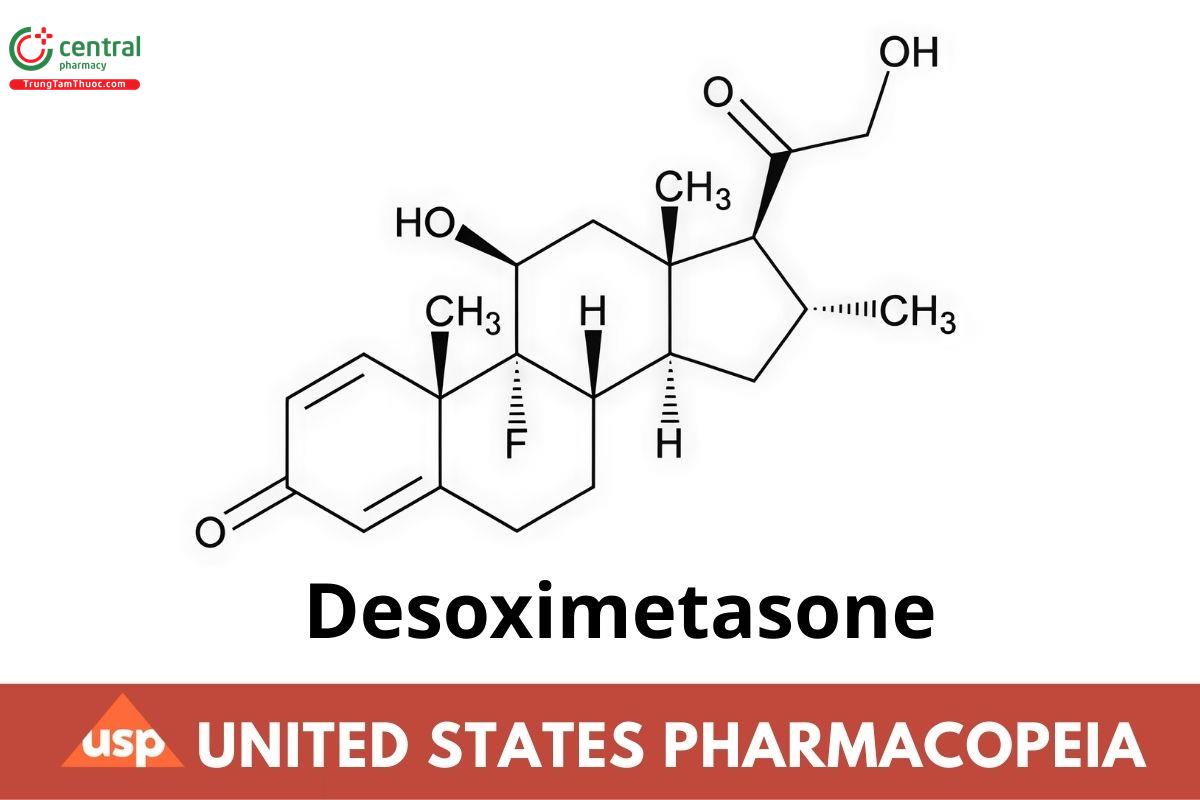

This article is compiled based on the United States Pharmacopeia (USP) – 2025 Edition
Issued and maintained by the United States Pharmacopeial Convention (USP)
C22H29FO4 376.46
Pregna-1,4-diene-3,20-dione, 9-fluoro-11,21-dihydroxy-16-methyl-, (113,16α);
9-Fluoro-118,21-dihydroxy-16a-methylpregna-1,4-diene-3,20-dione CAS RN®: 382-67-2; UNII: 4E07GXB7AU.
1 DEFINITION
Desoximetasone contains NLT 97.0% and NMT 103.0% of desoximetasone (C22H29FO4), calculated on the dried basis.
2 IDENTIFICATION
2.1 Change to read:
A. SPECTROSCOPIC IDENTIFICATION TESTS (197), Infrared Spectroscopy: 197K ▲(CN 1-MAY-2020) ▲or (197A) ▲(USP 1-DEC-2019)
2.2 Delete the following:
2.2.1 B. THIN-LAYER CHROMATOGRAPHY
Diluent: Chloroform and alcohol (3:1)
Standard solution: 10 mg/mL of USP Desoximetasone RS in Diluent
Sample solution: 10 mg/mL of desoximetasone in Diluent
2.2.2 Chromatographic system
Mode: TLC
Adsorbent: 0.25-mm layer of chromatographic silica gel mixture
Application volume: 20 µL
Developing solvent system: Chloroform and ethyl acetate (1:1)
Spray reagent: 200 mg/mL of p-toluenesulfonic acid in alcohol
2.2.3 Analysis
Samples: Standard solution and Sample solution
Allow the spots to dry, and develop the chromatogram in a saturated chamber containing the Developing solvent system. Allow the solvent front to move 10 cm beyond the application point. After drying, examine the plate under UV light at 254 nm. Spray the dried plate with Spray reagent.
Acceptance criteria: The major spot from the Sample solution corresponds in R, value (0.25) and appearance to that obtained from the Standard solution. ▲(USP 1-Dec-2019)
2.3 Add the following:
B. The retention time of the major peak of the Sample solution corresponds to that of the Standard solution, as obtained in the Assay ▲(USP 1-Dec-2019)
3 ASSAY
Change to read:
3.1 PROCEDURE
Buffer: 1.36 g/L of monobasic. potassium phosphate
Solution A: Acetonitrile, tetrahydrofuran, and Buffer (23.3:1.5:75). Adjust with 10% phosphoric acid to a pH of 4.0.
Solution B: Acetonitrile and Buffer (49.6:50). Adjust with 10% phosphoric acid to a pH of 4.0.
Mobile phase: See Table 1.
Table 1
| Time (min) | Solution A (%) | Solution B (%) |
| 0 | 95 | 5 |
| 25 | 5 | 95 |
| 30 | 5 | 95 |
| 31 | 95 | 5 |
| 35 | 95 | 5 |
System suitability stock solution: 0.12 mg/mL of USP Desoximetasone Related Compound A RS prepared as follows. Transfer a suitable amount of USP Desoximetasone Related Compound A RS to a suitable volumetric flask. Add about 1 mL of tetrahydrofuran and swirl to dissolve. Dilute with Solution A to volume. Sonication may be used to aid dissolution..
System suitability solution: 1 mg/mL of USP Desoximetasone RS and 1.2 µg/mL of USP Desoximetasone Related Compound A RS prepared as follows. Transfer a suitable amount of USP Desoximetasone RS to a suitable volumetric flask. Add about 1 mL of tetrahydrofuran and swirl to dissolve. Add 1% of the flask volume of the System suitability stock solution and dilute with Solution A to volume. Sonication may be used to aid dissolution.
Standard solution: 0.1 mg/mL of USP Desoximetasone RS prepared as follows. Transfer a suitable amount of USP Desoximetasone RS to a suitable volumetric flask. Add about 1 mL of tetrahydrofuran and swirl to dissolve. Dilute with Solution A to volume. Sonication may be used to aid dissolution.
Sample solution: 0.1 mg/mL of Desoximetasone prepared as follows. Transfer a suitable amount of Desoximetasone to a suitable volumetric flask. Add about 1 mL of tetrahydrofuran and swirl to dissolve. Dilute with Solution A to volume. Sonication may be used to aid dissolution.
3.1.1 Chromatographic system
(See Chromatography (621), System Suitability.)
Mode: LC
Detector: UV 240 nm
Column: 4.6-mm x 15-cm; 3.5-µm packing 11
Flow rate: 1.2 mL/min
Injection volume: 20 µL
3.1.2 System suitability
Samples: System suitability solution and Standard solution
[NOTE-See Table 2 for the relative retention times.]
3.1.3 Suitability requirements
Resolution: NLT 1.5 between desoximetasone and desoximetasone related compound A, System suitability solution
Relative standard deviation: NMT 1.10%, Standard solution
3.1.4 Analysis
Samples: Standard solution and Sample solution
Calculate the percentage of desoximetasone (C22H29FO4) in the portion of Desoximetasone taken: 29
Result = (rU/rS) x (CS/CU) × 100
rU = peak response from the Sample solution r_{u} = 1
rS = peak response from the Standard solution r_{s} = 1
CS = concentration of USP Desoximetasone RS in the Standard solution (mg/mL)
CU = concentration of Desoximetasone in the Sample solution (mg/mL)
▲ (USP 1-Dec-2019)
Acceptance criteria: 97.0%-103.0% on the dried basis
4 IMPURITIES
4.1 RESIDUE ON IGNITION (281): NMT 0.2%
4.2 Add the following:
4.2.1 ORGANIC IMPURITIES
Buffer, Solution A, Solution B, Mobile phase, System suitability solution, and Chromatographic system: Proceed as directed in the Assay.
Standard solution: 0.001 mg/mL of USP Desoximetasone RS prepared as follows. Transfer a suitable amount of USP Desoximetasone RS to a suitable volumetric flask. Add about 1 mL of tetrahydrofuran and swirl to dissolve. Dilute with Solution A to volume. Sonication may be used to aid dissolution.
Sensitivity solution: 0.2 µg/mL of USP Desoximetasone RS in Solution A from the Standard solution
Sample solution: 1 mg/mL of Desoximetasone prepared as follows. Transfer a suitable amount of Desoximetasone to a suitable volumetric flask. Add about 1 mL of tetrahydrofuran and swirl to dissolve. Dilute with Solution A to volume. Sonication may be used to aid dissolution.
4.2.2 System suitability
Samples: System suitability solution, Standard solution, and Sensitivity solution
[NOTE-See Table 2 for the relative retention times.]
4.2.3 Suitability requirements
Resolution: NLT 1.5 between desoximetasone and desoximetasone related compound A, System suitability solution
Relative standard deviation: NMT 5.0%, Standard solution
Signal-to-noise ratio: NLT 10, Sensitivity solution
4.2.4 Analysis
Samples: Standard solution and Sample solution
Calculate the percentage of each individual impurity in the portion of Desoximetasone taken:
Result = (rU/rS) x (CS/CU) × 100
rU = peak response of each individual impurity from the Sample solution
rS = peak response of desoximetasone from the Standard solution
CS = concentration of USP Desoximetasone RS in the Standard solution (mg/mL)
CU = concentration of Desoximetasone in the Sample solution (mg/mL)
Acceptance criteria: See Table 2. The reporting threshold is 0.02%.
Table 2
| Name | Relative Retention Time | Acceptance Criteria, NMT (%) |
| Desoximetasone diacetala | 0.88 | 0.15 |
| Desoximetasone | 1.00 | — |
| Desoximetasone related compound A | 1.10 | 0.15 |
| Desoximetasone acidb | 1.18 | 0.15 |
| Any other individual unspecified impurity | — | 0.10 |
| Total impurities | — | 0.5▲(USP 1-Dec-2019) |
a 9-Fluoro-113,21,21-trihydroxy-16α-methylpregna-1,4-diene-3,20-dione.
b 9-Fluoro-11ẞ-hydroxy-16α-methyl-3-oxoandrosta-1,4-diene-178-carboxylic acid.
5 SPECIFIC TESTS
5.1 Delete the following:
MELTING RANGE OR TEMPERATURE (741): 206-218°; but the range between beginning and end of melting does not exceed 4° ▲(USP 1-Dec-2019)
5.2 Change to read:
5.2.1 OPTICAL ROTATION (781S), Procedures, Specific Rotation
Sample solution: 5 mg/mL of Desoximetasone in alcohol ▲(USP 1-Dec-2019)
Acceptance criteria: 4 + 123 deg to +129° ▲(USP 1-Dec-2019)
5.2.2 LOSS ON DRYING (731).
Analysis: Dry at 105° to constant weight.
Acceptance criteria: NMT 1.0%
6 ADDITIONAL REQUIREMENTS
PACKAGING AND STORAGE: Preserve in well-closed containers.
Change to read:
USP REFERENCE STANDARDS (11)
USP Desoximetasone RS
USP Desoximetasone Related Comgound A RS
Dihydrodesoximetasone;
9-Fluoro-118,21-dihydroxy-16a-methylpregna-4-ene-3,20-dione.
C22H31FO4 378.48 ▲(USP 1-Dec-2019)

