
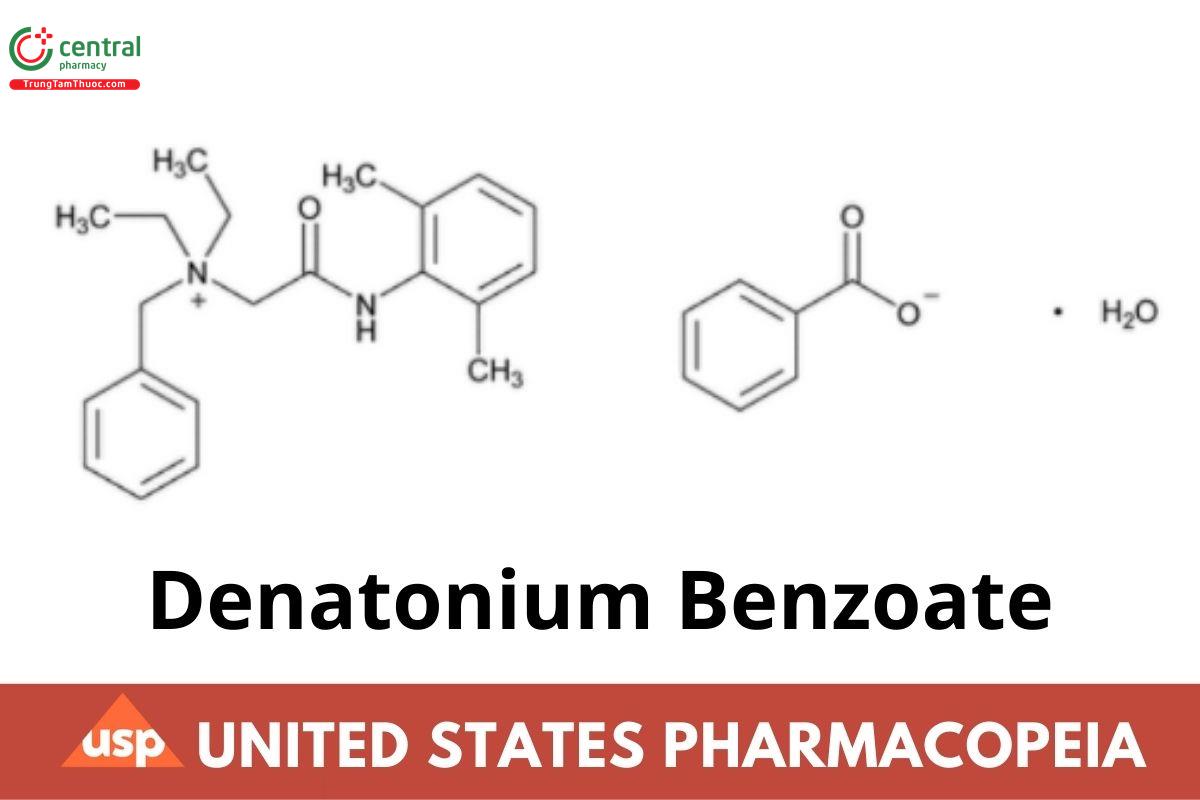
Denatonium Benzoate
If you find any inaccurate information, please let us know by providing your feedback here

Tóm tắt nội dung
This article is compiled based on the United States Pharmacopeia (USP) – 2025 Edition
Issued and maintained by the United States Pharmacopeial Convention (USP)
C28H34N2O3 H2O 464.60
C28H34N2O3 446.59
Benzenemethanaminium, N-[2-[(2,6-dimethylphenyl)amino]-2-oxoethyl]-N,N-diethyl-, benzoate, monohydrate;
Benzyldiethyl [(2,6-xylylcarbamoyl)methyl]ammonium benzoate monohydrate CAS RN®: 86398-53-0.
Anhydrous CAS RN®: 3734-33-6.
1 DEFINITION
Denatonium Benzoate, dried at 105° for 2 h , contains one molecule of water of hydration or is anhydrous. When dried at 105° for 2 h, it contains NLT 99.5% and NMT 101.0% of denatonium benzoate (C28H34N2O3).
2 IDENTIFICATION
Change to read:
2.1 A. SPECTROSCOPIC IDENTIFICATION TESTS (197), Infrared Spectroscopy: 197K (CN 1-MAY-2020)
Change to read:
2.2 B. SPECTROSCOPIC IDENTIFICATION TESTS (197), Ultraviolet-Visibl Ultraviolet-Visible Spectroscopy: 197U (CN 1-MAY-2020)
Analytical wavelength: 263 nm
Sample solution: 100 µg/mL
Medium: Water
Acceptance criteria: Absorptivities, calculated on the dried basis, do not differ by more than 3.0%.
2.3 C.
Sample: 150 mg
Analysis: Dissolve the Sample in 10 mL of water, and add 15 mL of trinitrophenol TS.
Acceptance criteria: A yellow precipitate is formed.
2.4 D.
Sample: 100 mg
Analysis: Dissolve the Sample in 10 mL of water, and add 20 mL of 2 N sulfuric acid and 15 mL of ammonium reineckate TS. Mix, filter through a sintered-glass crucible using gentle suction, and wash thoroughly with water. Remove as much water as possible with suction, and then dry in an oven at 105° for 1 h.
Acceptance criteria: The denatonium reineckate so obtained melts at about 170° (see Melting Range or Temperature (741)).
3 ASSAY
3.1 PROCEDURE
Sample: 900 mg, previously dried
Blank: 50 mL of glacial acetic acid
Titrimetric system
(See Titrimetry (541).)
Mode: Direct titration
Titrant: 0.1 N perchloric acid VS
Endpoint detection: Visual
Analysis: Dissolve the Sample in 50 mL of glacial acetic acid, and add 1 drop of crystal violet TS. Titrate with Titrant to a green endpoint.
Perform a blank determination, and make any necessary correction.
Calculate the percentage of denatonium benzoate (C28H34N2O3) in the portion of sample taken:
Result = {[(VS - VB) x N x F]/W) x 100
VS = Titrant volume consumed by the Sample (mL)
VB = Titrant volume consumed by the Blank (mL)
N = actual normality of the Titrant (mEq/mL)
F = equivalency factor, 446.6 mg/mEq
W = Sample weight (mg)
Acceptance criteria: 99.5%-101.0% on the dried basis
4 IMPURITIES
RESIDUE ON IGNITION (281): NMT 0.1%
CHLORIDE AND SULFATE, Chloride (221)
Standard solution: 0.10 mL of 0.020 N hydrochloric acid
Sample soluton: Dissolve 350 mg in 9 mL of water, add 1 mL of nitric acid, and filter.
Analysis: Use 1.0 mL of the Sample solution, and proceed as directed in the chapter
Acceptance criteria: 0.2%; the Sample solution shows no more chloride than the Standard solution.
5 SPECIFIC TESTS
MELTING RANGE OR TEMPERATURE (741): 163°-170°, on a dried specimen
PH (791)
Sample solution: 30 mg/mL
Acceptance criteria: 6.5-7.5
LOSS ON DRYING (731)
Analysis: Dry at 105° for 2 h.
Acceptance criteria
Monohydrate form: 3.5%-4.5%
Anhydrous form: NMT 1.0%
6 ADDITIONAL REQUIREMENTS
PACKAGING AND STORAGE: Preserve in tight containers.
LABELING: Label it to indicate whether it is hydrous or anhydrous.
USP REFERENCE STANDARDS (11)
USP Denatonium Benzoate RS

