
Demecarium Bromide
If you find any inaccurate information, please let us know by providing your feedback here

Tóm tắt nội dung
This article is compiled based on the United States Pharmacopeia (USP) – 2025 Edition
Issued and maintained by the United States Pharmacopeial Convention (USP)
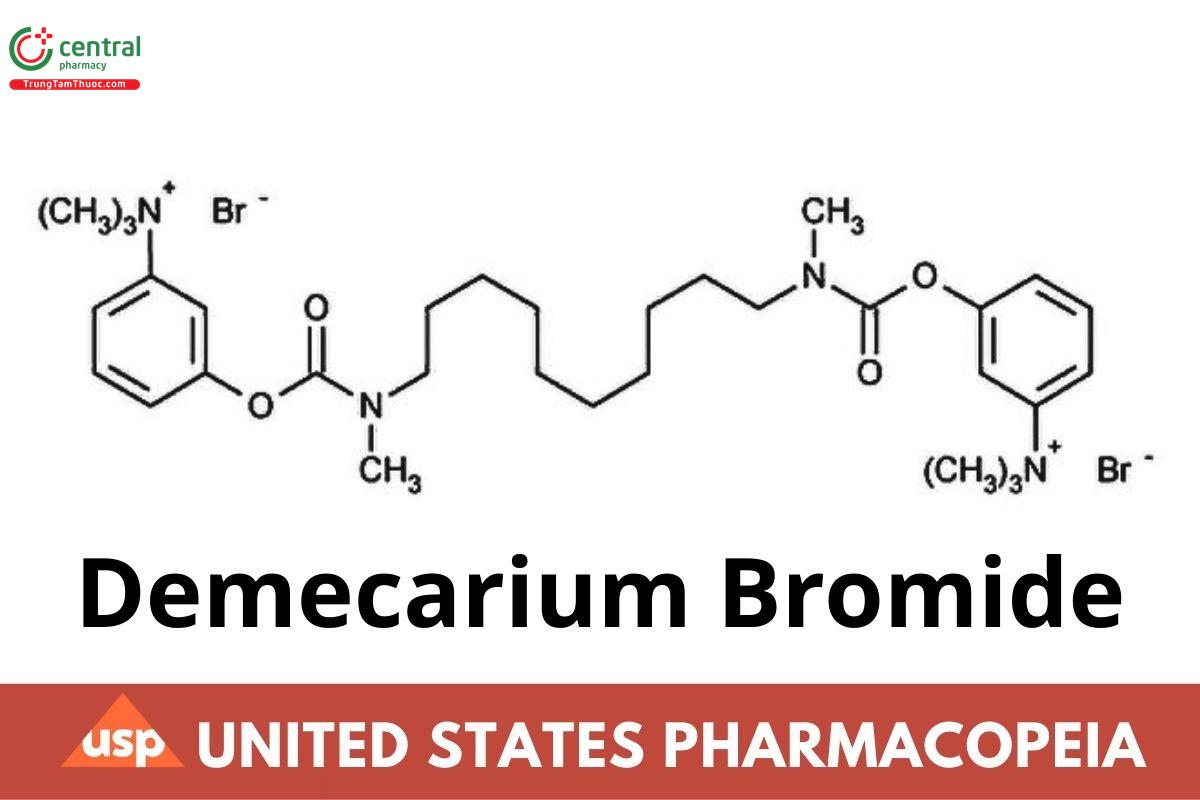
C32H52Br2N4O4 716.59
Benzenaminium, 3,3′-[1,10-decanediylbis[(methylimino)carbonyloxy]]bis[N,N,N-trimethyl]-, dibromide.
(m-Hydroxyphenyl)trimethylammonium bromide decamethylenebis[methylcarbamate] (2:1) CAS RN®: 56-94-0; UNII: 61D5V4OKTP.
Demecarium Bromide contains not less than 95.0 percent and not more than 100.5 percent of C32H52Br2N4O4, calculated on the anhydrous basis.
1 Packaging and storage
Preserve in tight, light-resistant containers.
2 USP Reference standards 〈11〉
USP Demecarium Bromide RS
3 Identification
Change to read:
A: Spectroscopic Identification Tests 〈197〉, Infrared Spectroscopy: 197K
B: Dissolve about 100 mg in 50 mL of 1 N sodium hydroxide, and reflux for 15 minutes. Cool, and add 3 mL of the refluxed solution to 25 mL of saturated sodium bicarbonate solution. Add, with mixing, 4 mL of N,N-dimethyl-p-phenylenediamine dihydrochloride solution (1.5 in 10,000) and 2 mL of sodium hypochlorite solution (1.5 in 20,000): a violet-blue color is produced.
C: Dissolve about 50 mg in 20 mL of water, add 10 mL of a 1 in 50 solution of ammonium reineckate in methanol, and allow to stand for 30 minutes with occasional swirling: a pink reineckate of demecarium forms, and it melts between 131° and 136°, with decomposition.
D: A solution of it responds to the tests for Bromide 〈191〉.
4 pH 〈791〉
between 5.0 and 7.0, in a solution (1 in 100).
5 Water Determination, Method I 〈921〉
not more than 2.0%.
6 Residue on ignition 〈281〉
not more than 0.1%.
7 Limit of m-trimethylammoniophenol bromide
Control solution-Dissolve 100 mg of m-dimethylaminophenol in 10 mL of alcohol in a 1000-mL volumetric flask, dilute with water to volume, and mix. Pipet 1 mL of this solution into a 500-mL volumetric flask, dilute with water to volume, and mix.
Test solution-Transfer 100 mg of Demecarium Bromide to a 100-mL volumetric flask, add water to volume, and mix.
Procedure-Pipet 25 mL of the Test solution into a glass-stoppered, 50-mL centrifuge tube, and pipet 25 mL of the Control solution into a second, similar tube. To each tube add 3 mL of pH 7.0 phosphate buffer (see under Solutions in the section Reagents, Indicators, and Solutions), 1 mL of N,N-dimethyl-p-phenylenediamine dihydrochloride solution (1.5 in 10,000), 5 mL of isobutyl alcohol, and 1 mL of sodium hypochlorite solution (1.5 in 20,000). Insert the stoppers in the tubes, shake the mixtures for 5 minutes, and centrifuge: any blue color produced in the upper layer obtained from the Test solution is not more intense than that obtained from the Control solution.
8 Assay
Dissolve about 0.8 g of Demecarium Bromide, accurately weighed, in a mixture of 75 mL of glacial acetic acid and 15 mL of mercuric acetate TS, warming slightly, if necessary, to effect solution. Add 2 drops of crystal violet TS, and titrate with 0.1 N perchloric acid VS. Perform a blank determination, and make any necessary correction. Each mL of 0.1 N perchloric acid is equivalent to 35.83 mg of C32H52Br2N4O4.

