
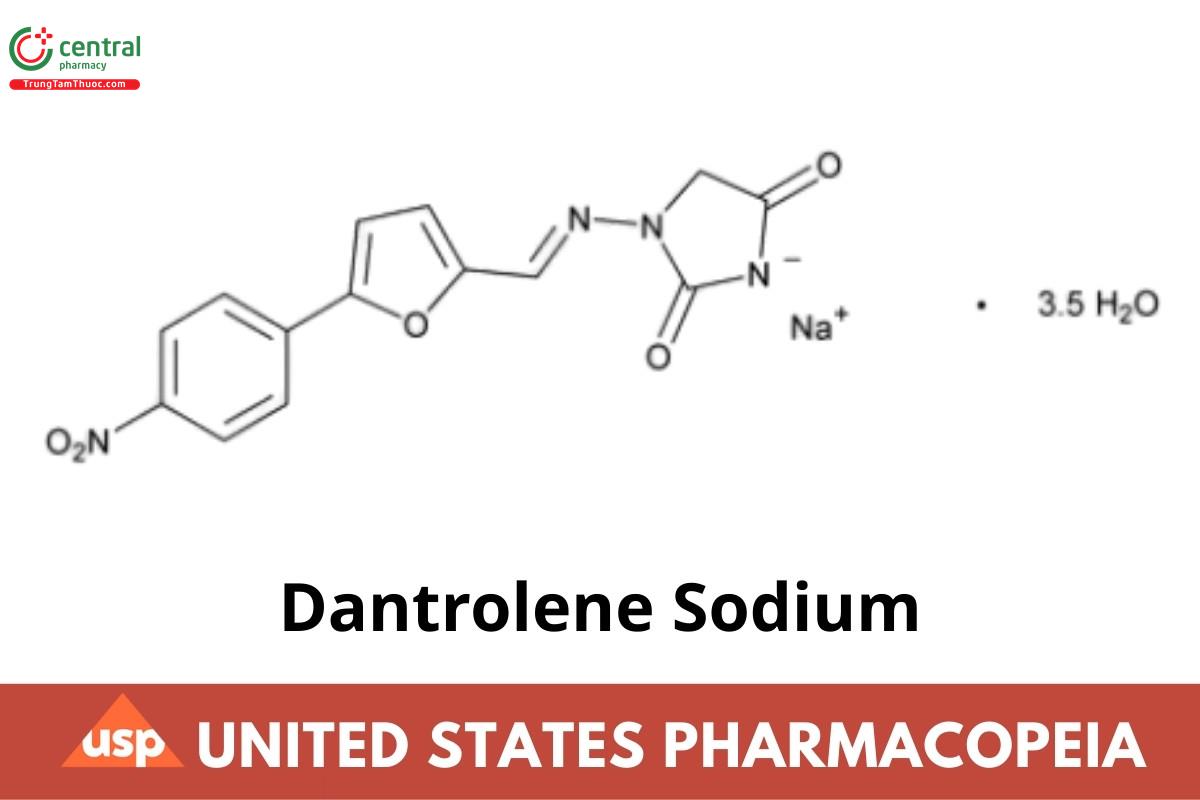
Dantrolene Sodium
If you find any inaccurate information, please let us know by providing your feedback here

Tóm tắt nội dung
This article is compiled based on the United States Pharmacopeia (USP) – 2025 Edition
Issued and maintained by the United States Pharmacopeial Convention (USP)
1 DEFINITION
Dantrolene Sodium contains NLT 90.0% and NMT 96.0% of dantrolene (C14H10N4O5), the free acid form of Dantrolene Sodium, calculated on the anhydrous basis.
2 IDENTIFICATION
Change to read:
A. Spectroscopic Identification Tests 〈197〉, Infrared Spectroscopy: 197K (CN 1-May-2020)
B. The retention time of the major peak of the Sample solution corresponds to that of the Standard solution, as obtained in the Assay.
C. Identification Tests—General 〈191〉, Sodium
Sample solution: To 0.1 g of Dantrolene Sodium, add 20 mL of water and 2 drops of acetic acid, shake well, and pass the resulting solution through a suitable lter. Use 2 mL of the ltrate.
Analysis
Sample: Sample solution
Acceptance criteria: Meets the requirements
D.
Solution A: Dissolve 2.7 g of methoxyphenylacetic acid in 6 mL of tetramethylammonium hydroxide TS, and add 20 mL of dehydrated alcohol. Solution B: 158 mg/mL of ammonium carbonate in water
Sample solution: To 0.1 g of Dantrolene Sodium, add 20 mL of water and 2 drops of acetic acid, shake well, and pass the resulting solution through a suitable lter. Use the ltrate.
Analysis
Sample: Sample solution
Part 1: To 0.5 mL of the Sample solution in a suitable container, add 1.5 mL of Solution A, and cool in ice water for 30 min. Part 2: Transfer the container from Part 1 to a water bath at 20°, and stir for 5 min.
Part 3: Add 1 mL of ammonia TS to the container from Part 2.
Part 4: Add 1 mL of Solution B to the container from Part 3.
Acceptance criteria: The requirements for Part 1, Part 2, Part 3, and Part 4 must all be met.
Part 1: A voluminous, white, crystalline precipitate is formed.
Part 2: The precipitate does not disappear.
Part 3: The precipitate dissolves completely.
Part 4: No precipitate is formed.
3 ASSAY
3.1 Procedure
Buffer: Dissolve 3.85 g of ammonium acetate in 1.0 L of water; adjusted with glacial acetic acid to a pH of 4.5 ± 0.1. Solution A: Acetonitrile, Buffer, and water (10:20:70)
Solution B: Acetonitrile and Buffer (80:20)
Mobile phase: See Table 1.
Table 1
Time (min) | Solution A (%) | Solution B (%) |
| 0 | 90 | 10 |
| 10 | 60 | 40 |
| 20 | 10 | 90 |
| 25 | 10 | 90 |
| 25.1 | 90 | 10 |
| 35 | 90 | 10 |
Diluent: Acetonitrile and water (50:50)
System suitability stock solution A: 1.25 mg/mL of USP Dantrolene Sodium RS prepared as follows. Transfer a suitable amount of USP Dantrolene Sodium RS to an appropriate volumetric ask. Dissolve in 5% of the total ask volume of dimethylformamide. Add 5% of the total ask volume of glacial acetic acid, and dilute with acetone to volume.
System suitability stock solution B: 0.125 mg/mL each of USP Dantrolene Related Compound B RS and USP Dantrolene Related Compound C RS prepared as follows. Transfer suitable amounts of USP Dantrolene Related Compound B RS and USP Dantrolene Related Compound C RS to an appropriate volumetric ask. Dissolve in 5% of the total ask volume of dimethylformamide. Add 5% of the total ask volume of glacial acetic acid, and dilute with acetone to volume.
System suitability solution: 125 µg/mL of USP Dantrolene Sodium RS from System suitability stock solution A and 2.5 µg/mL each of USP Dantrolene Related Compound B RS and USP Dantrolene Related Compound C RS from System suitability stock solution B in Diluent Standard stock solution: 1.0 mg/mL of USP Dantrolene RS prepared as follows. Transfer a suitable amount of USP Dantrolene RS to an appropriate volumetric ask. Dissolve in 5% of the total ask volume of dimethylformamide. Add 5% of the total ask volume of glacial acetic acid, and dilute with acetone to volume.
Standard solution: 100 µg/mL of USP Dantrolene RS from Standard stock solution in Diluent
Sample stock solution: 1.25 mg/mL of Dantrolene Sodium prepared as follows. Transfer a suitable amount of Dantrolene Sodium to an appropriate volumetric ask. Dissolve in 5% of the total ask volume of dimethylformamide. Add 5% of the total ask volume of glacial acetic acid, and dilute with acetone to volume.
Sample solution: 125 µg/mL of Dantrolene Sodium from Sample stock solution in Diluent
Chromatographic system
(See Chromatography 〈621〉, System Suitability.)
Mode: LC
Detector: UV 365 nm
Column: 4.6-mm × 15-cm; 5-µm packing L1
Flow rate: 2 mL/min
Injection volume: 20 µL
System suitability
Samples: System suitability solution and Standard solution
[Note—The relative retention times for dantrolene related compound B, dantrolene, and dantrolene related compound C are 0.68, 1.0, and 1.24, respectively.]
Suitability requirements
Resolution: NLT 8 between dantrolene related compound C and dantrolene, System suitability solution
Tailing factor: NMT 1.5, Standard solution
Relative standard deviation: NMT 1.0%, Standard solution
Analysis
Samples: Standard solution and Sample solution
Calculate the percentage of dantrolene (C14H10N4O5) in the portion of Dantrolene Sodium taken:
Result = (ru/rs) × (Cs/Cu) × 100
ru = peak response of dantrolene from the Sample solution
rs = peak response of dantrolene from the Standard solution
Cs = concentration of USP Dantrolene RS in the Standard solution (µg/mL)
Cu = concentration of Dantrolene Sodium in the Sample solution (µg/mL)
Acceptance criteria: 90.0%–96.0% on the anhydrous basis
4 IMPURITIES
4.1 Limit of Dantrolene Related Compound A
Mobile phase: Acetonitrile and water (80:20)
Standard stock solution: 17.5 µg/mL of USP Dantrolene Related Compound A RS and 50 µg/mL of USP Dantrolene Sodium RS in dimethylformamide
Standard solution: 0.35 µg/mL of USP Dantrolene Related Compound A RS and 1 µg/mL of USP Dantrolene Sodium RS from Standard stock solution in acetonitrile
Sample stock solution: 1.25 mg/mL of Dantrolene Sodium prepared as follows. Transfer a suitable amount of Dantrolene Sodium to an appropriate volumetric ask. Dissolve in 5% of the total ask volume of dimethylformamide. Add 5% of the total ask volume of glacial acetic acid, and dilute with acetone to volume.
Sample solution: 175 µg/mL of Dantrolene Sodium from Sample stock solution in acetonitrile
Chromatographic system
(See Chromatography 〈621〉, System Suitability.)
Mode: LC
Detector: UV 365 nm
Column: 4.6-mm × 15-cm; 5-µm packing L1
Flow rate: 1 mL/min
Injection volume: 20 µL
System suitability
Sample: Standard solution
[Note—The dantrolene peak elutes at void volume at approximately 1.5 min.]
Suitability requirements
Tailing factor: NMT 1.5 for dantrolene related compound A
Relative standard deviation: NMT 5% for dantrolene related compound A
Analysis
Samples: Standard solution and Sample solution
Calculate the percentage of dantrolene related compound A in the portion of Dantrolene Sodium taken:
Result = (ru/rs) × (Cs/Cu) × 100
ru = peak response of dantrolene related compound A from the Sample solution
rs = peak response of dantrolene related compound A from the Standard solution
Cs = concentration of USP Dantrolene Related Compound A RS in the Standard solution (µg/mL)
Cu = concentration of Dantrolene Sodium in the Sample solution (µg/mL)
Acceptance criteria: NMT 0.15%
4.2 Organic Impurities
Mobile phase, Diluent, System suitability stock solution B, System suitability solution, Sample solution, and Chromatographic system: Proceed as directed in the Assay.
Standard solution A: Use the Standard solution from the Assay.
Standard solution B: 0.25 µg/mL each of USP Dantrolene Related Compound B RS and USP Dantrolene Related Compound C RS from System suitability stock solution B in Diluent
System suitability
Samples: System suitability solution and Standard solution A
[Note—The relative retention times for dantrolene related compound B, dantrolene, and dantrolene related compound C are 0.68, 1.0, and 1.24, respectively.]
Suitability requirements
Resolution: NLT 8 between dantrolene related compound C and dantrolene, System suitability solution
Tailing factor: NMT 1.5, Standard solution A
Relative standard deviation: NMT 1.0%, Standard solution A
Analysis
Samples: Sample solution and Standard solution B
Calculate the percentage of dantrolene related compound B and dantrolene related compound C in the portion of Dantrolene Sodium taken:
Result = (ru/rs) × (Cs/Cu) × 100
ru = peak response of dantrolene related compound B or dantrolene related compound C from the Sample solution
rs = peak response of dantrolene related compound B or dantrolene related compound C from Standard solution B
Cs = concentration of USP Dantrolene Related Compound B RS or USP Dantrolene Related Compound C RS in Standard solution B (µg/mL)
Cu = concentration of Dantrolene Sodium in the Sample solution (µg/mL)
Acceptance criteria
Dantrolene related compound B: NMT 0.50%
Dantrolene related compound C: NMT 0.30%
5 SPECIFIC TESTS
Water Determination 〈921〉, Method Ia: 14.5%–17.0%
6 ADDITIONAL REQUIREMENTS
Packaging and Storage: Preserve in tight, light-resistant containers. Store at room temperature.
USP Reference Standards 〈11〉
USP Dantrolene RS
1-({[5-(4-Nitrophenyl)furan-2-yl]methylene}amino)imidazolidine-2,4-dione.
C H N O 314.25
14 10 4 5
USP Dantrolene Sodium RS
USP Dantrolene Related Compound A RS
1,2-Bis{[5-(4-nitrophenyl)furan-2-yl]methylene}hydrazine;
Also known as 5-(4-Nitrophenyl)furaldehyde azine.
C14H10N4O5 430.38
USP Dantrolene Related Compound B RS
N-Carbamoyl-N-({[5-(4-nitrophenyl)furan-2-yl]methylene}amino)glycine;
Also known as 5-(4-Nitrophenyl)-2-furaldehyde-2-carboxymethyl semicarbazone.
C14H12N4O6 332.27
USP Dantrolene Related Compound C RS
5-(4-Nitrophenyl)furan-2-carbaldehyde.
C11H7NO4 217.18

