
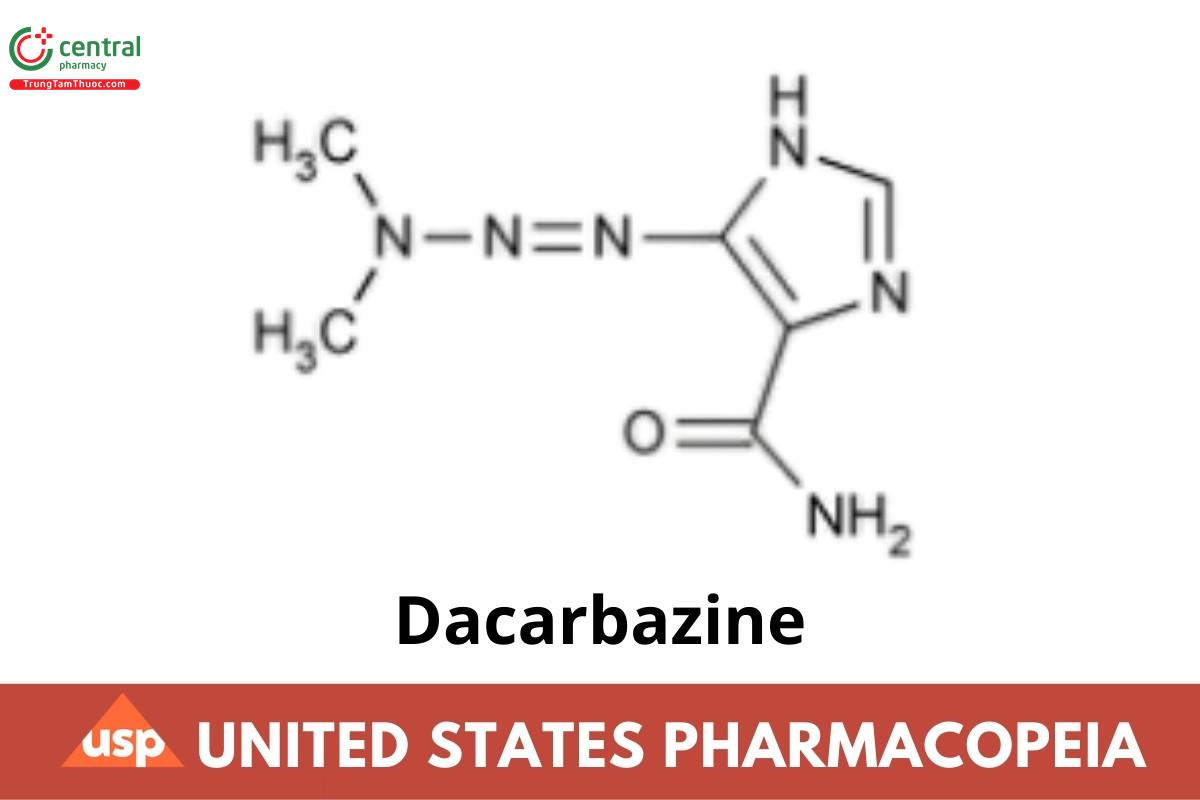
Dacarbazine
If you find any inaccurate information, please let us know by providing your feedback here

Tóm tắt nội dung
This article is compiled based on the United States Pharmacopeia (USP) – 2025 Edition
Issued and maintained by the United States Pharmacopeial Convention (USP)
DOWNLOAD PDF HERE
1 DEFINITION
Dacarbazine contains NLT 97.0% and NMT 102.0% of dacarbazine (C6H10N6O).
[CAUTION-Great care should be taken in handling Dacarbazine, as it is a potent cytotoxic agent.]
2 IDENTIFICATION
A. SPECTROSCOPIC IDENTIFICATION TESTS (197), Infrared Spectroscopy: 197A or 197K
B. The retention time of the major peak of the Sample solution corresponds to that of the Standard solution, as obtained in the Assay.
3 ASSAY
3.1 PROCEDURE
Protect solutions containing dacarbazine from light and store at 2°-8°.
Solution A: 4.1 g/L of sodium acetate in water. Adjust with phosphoric acid to a pH of 7.0.
Solution B: 4.1 g/L of sodium acetate in water. Adjust with phosphoric acid to a pH of 5.5. Mix acetonitrile and this solution (25:75).
Mobile phase: See Table 1. Return to original conditions, and equilibrate the system for 10 min.
Table 1
| Time (min) | Solution A (%) | Solution B (%) |
| 0 | 100 | 0 |
| 10 | 100 | 0 |
| 20 | 5 | 95 |
| 23 | 5 | 95 |
| 25 | 100 | 0 |
| 35 | 100 | 0 |
Diluent: 0.1 mg/mL of citric acid in water
Standard solution: 0.1 mg/mL of USP Dacarbazine RS in Diluent
Sample solution: 0.1 mg/mL of Dacarbazine in Diluent
Chromatographic system
(See Chromatography (621), System Suitability.)
Mode: LC
Detector: UV 250 nm
Column: 4.6-mm x 25-cm; 5-µm packing 11
Autosampler temperature: 2"-8"
Flow rate: 1.0 mL/min
Injection volume: 20 µL
System suitability
Sample: Standard solution
Suitability requirements
Tailing factor: NMT 1.5
Relative standard deviation: NMT 0.73%
Analysis
Samples: Standard solution and Sample solution
Calculate the percentage of dacarbazine (C6H10N6O) in the portion of Dacarbazine taken:
Result = (ru/rs) × (Cs/Cu) × 100
ru = peak response from the Sample solution
rs = peak response from the Standard solution
Cs = concentration of USP Dacarbazine RS in the Standard solution (mg/mL)
Cu = concentration of Dacarbazine in the Sample solution (mg/mL)
Acceptance criteria: 97.0%-102.0%
3.2 IMPURITIES
3.3 RESIDUE ON IGNITION (281): NMT 0.1%
Change to read:
ORGANIC IMPURITIES
Protect solutions containing dacarbazine and its related compounds from light and store at 2°-8°.
Solution A, Solution B, Mobile phase, and Chromatographic system: Proceed as directed in the Assay.
Diluent: 4.0 mg/mL of citric acid in water
Standard stock solution: Use the Standard solution, prepared as directed in the Assay.
Standard solution: 4.0 µg/mL of USP Dacarbazine RS prepared as follows. Transfer a suitable amount of Standard stock solution into a volumetric flask and dilute with water.
Dacarbazine related compound A standard solution: 0.04 mg/mL of USP Dacarbazine Related Compound A RS in water. Sonicate to ensure complete dissolution.
Dacarbazine related compound B standard solution: 0.04 mg/mL of USP Dacarbazine Related Compound B RS in water. Sonicate to ensure complete dissolution.
Sensitivity solution: 2.0 µg/mL of USP Dacarbazine RS in water from Standard solution
Sample solution: 4.0 mg/mL of Dacarbazine in Diluent. Sonicate to ensure complete dissolution.
System suitability
Samples: Dacarbazine related compound A standard solution, Dacarbazine related compound B standard solution, and Sensitivity solution
Suitability requirements
Relative standard deviation 1: NMT 5.0%, Dacarbazine related compound A standard solution
Relative standard deviation 2: NMT 5.0%, Dacarbazine related compound B standard solution
Signal-to-noise ratio: NLT (ERR 1-Dec-2021) 10, Sensitivity solution
Analysis
Samples: Standard solution, Dacarbazine related compound A standard solution, Dacarbazine related compound B standard solution, and Sample solution
Calculate the percentage of 5-aminoimidazole-4-carboxamide (free base of USP Dacarbazine Related Compound A RS) in the portion of Dacarbazine taken:
Result = (ru/rs) x (Cs/Cu) x (Mr1/Mr2) x 100
ru = peak response of 5-aminoimidazole-4-carboxamide from the Sample solution
rs = peak response of dacarbazine related compound A from the Dacarbazine related compound A standard solution S
Cs = concentration of USP Dacarbazine Related Compound A RS in the Dacarbazine related compound A standard solution (mg/mL)
Cu = concentration of Dacarbazine in the Sample solution (mg/mL)
Mr1 = molecular weight of 5-aminoimidazole-4-carboxamide, 126.12
Mr2 = molecular weight of USP Dacarbazine Related Compound A RS, 162.58
Calculate the percentage of 2-azahypoxanthine (anhydrous) (anhydrous form of USP Dacarbazine Related Compound B RS) in the portion of Dacarbazine taken:
Result = (ru/rs) x (Cs/Cu) × 100
ru = peak response of 2-azahypoxanthine (anhydrous) from the Sample solution
rs = peak response of dacarbazine related compound B from the Dacarbazine related compound B standard solution
Cs = concentration of USP Dacarbazine Related Compound B RS in the Dacarbazine related compound B standard solution (mg/mL)
Cu = concentration of Dacarbazine in the Sample solution (mg/mL)
Calculate the percentage of each individual unspecified impurity in the portion of Dacarbazine taken:
Result = (ru/rs) x (Cs/Cu) × 100
ru = peak response of each unspecified impurity from the Sample solution
rs = peak response of dacarbazine from the Standard solution S
Cs = concentration of USP Dacarbazine RS in the Standard solution (mg/mL)
Cu = concentration of Dacarbazine in the Sample solution (mg/mL)
Acceptance criteria: See Table 2. The reporting threshold is 0.05%.
Table 2
| Name | Relative Retention Time | Acceptance Criteria, NMT (%) |
| 5-Aminoimidazole-4-carboxamide | 0.28 | 1.0 |
| 2-Azahypoxanthine (anhydrous) | 0.45 | 1.0 |
| Dacarbazine | 1.0 | _ |
| Any individual unspecified impurity | _ | 0.10 |
| Total impurities | _ | 2.0 |
a It is the free base of USP Dacarbazine Related Compound A RS (C4H6N4O).
b It is the anhydrous form of USP Dacarbazine Related Compound B RS (C4H3N5O).
3.4 LIMIT OF DIMETHYLAMINE
System suitability stock solution A: 20 mg/mL of dimethylamine in water prepared as follows. Transfer USP Dimethylamine Solution RS into a suitable volumetric flask and dilute with water to volume.
System suitability stock solution B: 20 mg/mL of triethylamine in water
System suitability solution: System suitability stock solution A and System suitability stock solution B (1:1). Transfer 5 µL of this solution into a 20-mL headspace vial by syringe through the cap septum.
Standard solution: 10 mg/mL of dimethylamine in water prepared as follows. Transfer USP Dimethylamine Solution RS into a suitable volumetric flask and dilute with water to volume.
Standard: Transfer 5 µL of Standard solution into a 20-mL headspace vial by syringe through the cap septum (0.05 mg).
Sample: Transfer 100 mg of Dacarbazine into a 20-mL headspace vial, cap and seal. Add 5 µL of water by syringe through the cap septum.
Chromatographic system
(See Chromatography (621), System Suitability.)
Mode: GC
Detector:
Flame ionization
Column: 30-m x 0.53-mm 1.0-µm coating of phase G50
Temperatures
Injection port: 210°
Detector: 300°
Column: See Table 3.
Table 3
| Initial Temperature (°) | Temperature Ramp (°/min) | Final Temperature (°) | Hold Time at Final Temperature (min) |
| 35 | 0 | 35 | 8 |
| 35 | 40 | 200 | 1 |
Headspace operating parameters: [NOTE-Headspace operating parameters can be modified in order to optimize the performance.]
Temperatures
Oven: 100°
Loop: 110°
Transfer line: 120"
Times
Vial equilibration: 10 min
Pressurization: 0.5 min
Loop fill: 0.25 min
Loop equilibration: 0.05 min
Injection: 0.5 min
Loop size: 1.0 mL
Carrier gas: Helium
Flow rate: 2 mL/min
Injection type: Split, split ratio 25:1
System suitability
Samples: Standard and System suitability solution
Suitability requirements
Resolution: NLT 1.0 between the dimethylamine and triethylamine peaks, System suitability solution
Tailing factor: NMT 2.0, Standard
Relative standard deviation: NMT 15.0%, Standard
Analysis
Samples: Standard and Sample
Calculate the percentage of dimethylamine in the portion of Dacarbazine taken:
Result = (ru/rs) x (Ws/Wu) x 100
ru = peak response of dimethylamine from the Sample
rs = peak response of dimethylamine from the Standard
Ws = weight of dimethylamine in the Standard (mg)
Wu = weight of Dacarbazine in the Sample (mg)
Acceptance criteria: NMT 0.05%
4 ADDITIONAL REQUIREMENTS
PACKAGING AND STORAGE: Preserve in tight, light-resistant containers, in a refrigerator.
USP REFERENCE STANDARDS (11)
USP Dacarbazine RS
USP Dacarbazine Related Compound A. RS
5-Aminoimidazole-4-carboxamide hydrochloride.
C4H6N4O . HCI 162.58
USP Dacarbazine Related Compound B RS
2-Azahypoxanthine monohydrate.
C4H3N5O . H2O 155.12
USP Dimethylamine Solution RS
40% of dimethylamine in water
(CH3)2NH 45.09

