
Clorazepate Dipotassium
If you find any inaccurate information, please let us know by providing your feedback here
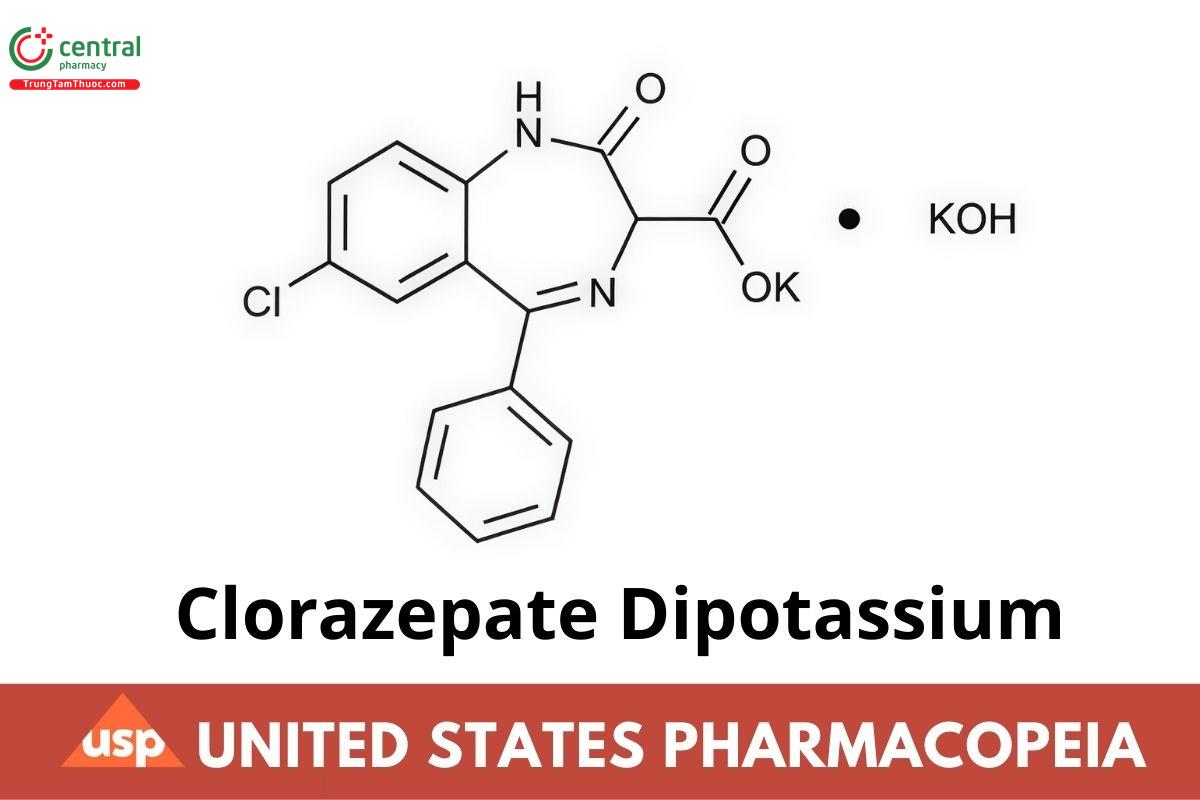

This article is compiled based on the United States Pharmacopeia (USP) – 2025 Edition
Issued and maintained by the United States Pharmacopeial Convention (USP)
C16H11CIK2N2O4 408.92
1H-1,4-Benzodiazepine-3-carboxylic acid, 7-chloro-2,3-dihydro-2-oxo-5-phenyl-, potassium salt compound with potassium hydroxide (1:1).
Potassium 7-chloro-2,3-dihydro-2-oxo-5-phenyl-1H-1,4-benzodiazepine-3-carboxylate compound with potassium hydroxide (1:1) CAS RN: 57109-90-7; UNII: 63FN7G03XY.
> > Clorazepate Dipotassium contains not less than 98.5 percent and not more than 101.5 percent of C16H11CIK2N2O4 , calculated on the dried basis.
Packaging and storage-Preserve under nitrogen in tight, light-resistant containers.
1 USP REFERENCE STANDARDS (11)-
USP 2-Amino-5-chlorobenzophenone RS C13H10CINO 231.68
USP Nordazepam RS
7-Chloro-1,3-dihydro-5-phenyl-2H-1,4-benzodiazepin-2-one.
C15H11CIN2O 270.72
USP Clorazepate Dipotassium RS
2 Identification-
Change to read:
A:Spectroscopic Identification Tests (197), Infrared Spectroscopy: 197M ▲(CN 1-May-2020)
Change to read:
B: Spectroscopic Identification Tests (197), Ultraviolet-Visible Spectroscopy: 197U ▲(CN 1-May-2020)
Solution: 7 µg per mL.
Medium: sodium hydroxide solution (1 in 2500).
LOSS ON DRYING (731)-Dry it in vacuum at 60° for 1 hour: it loses not more than 0.5% of its weight.
3 Related compounds-
3.1 TEST 1-
Phosphate buffer solution-Dissolve about 13.8 g of monobasic sodium phosphate in 500 mL of water, adjust with 2.5 N sodium hydroxide to a pH of 8.0, and mix.
Mobile phase-Prepare a filtered and degassed mixture of water, acetonitrile, and Phosphate buffer solution (5:4:1). Make adjustments if necessary (see System Suitability under Chromatography (621)).
Internal standard solution-Dissolve about 5 mL of 2,6-dimethylaniline in 50 mL of hexane, and carefully add dropwise hydrochloric acid to precipitate the amine hydrochloride. Filter through a sintered-glass funnel, wash the solid precipitate with hexane, and allow the precipitate to dry. Transfer about 50 mg of the dried precipitate of 2,6-dimethylaniline hydrochloride to a 100-mL volumetric flask, add 10.0 mL of Phosphate buffer solution and 40 mL of water, and dilute with acetonitrile to volume.
Standard solution—Dissolve an accurately weighed quantity of USP Nordazepam RS in acetonitrile, and dilute quantitatively, and stepwise if necessary, with acetonitrile to obtain a solution having a known concentration of about 75 μg per mL. Transfer 4.0 mL of this solution to a 50-mL conical flask, add 4.0 ml of 0.7 M potassium carbonate, 2.0 mL of Internal standard solution, and 15.0 mL of water. Insert a stopper, and mix.
Test solution-Transfer an accurately weighed quantity of about 50 mg of Clorazepate Dipotassium to a 50-mL conical flask. Add 4.0 mL of 0.7 M potassium carbonate, and start stirring the solution. Add 2 mL of Internal standard solution and 19.0 mL of water. Stop stirring about 5 minutes after the addition of the 0.7 M potassium carbonate solution. [NOTE-Prepare fresh immediately before each injection.]
Chromatographic system (see CHROMATOGRAPHY (621))-The liquid chromatograph is equipped with a 232-nm detector and a 3.9-mm x 30-cm column that contains packing L1. The flow rate is about 1.0 mL per minute. Chromatograph the Standard solution, and record the peak responses as directed for Procedure: the relative retention time for 2,6-dimethylaniline is about 0.8 and 1.0 for nordazepam; the relative standard deviation of the peak area ratio of nordazepam to 2,6-dimethylaniline for replicate injections is not more than 2.0%.
Procedure-Separately inject equal volumes (about 20 µL) of the Standard solution and the Test solution into the chromatograph, record the chromatograms, and measure the peak areas. Calculate the percentage of nordazepam in the portion of Clorazepate Dipotassium taken by the formula:
2500(C/W) (R/RS)
in which C is the concentration, in mg per mL, of USP Nordazepam RS in the Standard solution; W is the weight, in mg, of Clorazepate Dipotassium taken to prepare the Test solution, R is the peak area ratio of any impurity to 2,6-dimethylaniline obtained from the Test solution; and RS is the peak area ratio of nordazepam to 2,6-dimethylaniline obtained from the Standard solution: not more than 0.5% of nordazepam is found and not more than 0.1% of any individual impurity is found.
3.2 TEST 2-
Diluent-Prepare a mixture of 0.001 N sodium hydroxide and acetonitrile (1:1).
Mobile phase-Prepare a filtered and degassed mixture of water, acetonitrile, and a 1 M solution of tetrabutylammonium hydroxide in methanol (110:90:1), adjust with phosphoric acid to a pH of 7.7, and mix. Make adjustments if necessary (see System Suitability under Chromatography (621)).
Standard solution-Dissolve an accurately weighed quantity of USP 2-Amino-5-chlorobenzophenone RS in Diluent, and dilute quantitatively, and stepwise if necessary, with Diluent, to obtain a solution having a known concentration of about 0.0026 mg per mL..
Test solution-Transfer about 300 mg of Clorazepate Dipotassium, accurately weighed, to a glass test tube. Add 10.0 ml. of Diluent, and vigorously mix on a vortex mixer for about 90 seconds. [NOTF-Prepare fresh immediately before each injection.]
Chromatographic system (see CHROMATOGRAPHY (621))-The liquid chromatograph is equipped with a 238-nm detector and a 3.9-mm x 30-cm column that contains packing L1. The flow rate is about 2 mL per minute. Chromatograph the Standard solution, and record the peak column that contains packing L1. The flow rate is about 2 mL per minute. Chromatograph the Standard solution, and record the peak responses as directed for Procedure: the relative standard deviation of the peak height for replicate injections is not more than 3.0%.
Procedure-Separately inject equal volumes (about 20 µL) of the Standard solution and the Test solution into the chromatograph, record the chromatograms, and measure the peak responses. Calculate the percentage of each impurity in the portion of Clorazepate Dipotassium taken by the formula:
1000(C / W)(r / rS)
in which C is the concentration, in mg per ml, of USP 2-Amino-5-chlorobenzophenone RS in the Standard solution; W is the weight, in mg, of sample taken; rS is the peak height of each impurity obtained from the Test solution, and rS is the peak height of 2-amino-5-chlorobenzophenone obtained from the Standard solution: not more than 0.1% of 2-amino-5-chlorobenzophenone is found, not more than 0.1% of any other individual impurity is found, and not more than 1.0% of total impurities in Test 1 and Test 2 is found.
Assay-Transfer about 150 mg of Clorazepate Dipotassium, accurately weighed, to a 250-mL beaker, add 100 mL of glacial acetic acid, and stir until dissolved. Titrate with 0.1 N perchloric acid VS, determining the endpoint potentiometrically, using a glass electrode and a calomel electrode containing a 1 in 100 solution of lithium perchlorate in glacial acetic acid. Perform a blank determination (see Titrimetry (541)), and make any necessary correction. Each ml. of 0.1 N perchloric acid is equivalent to 13.63 mg of C16H11CIK2N2O4

