
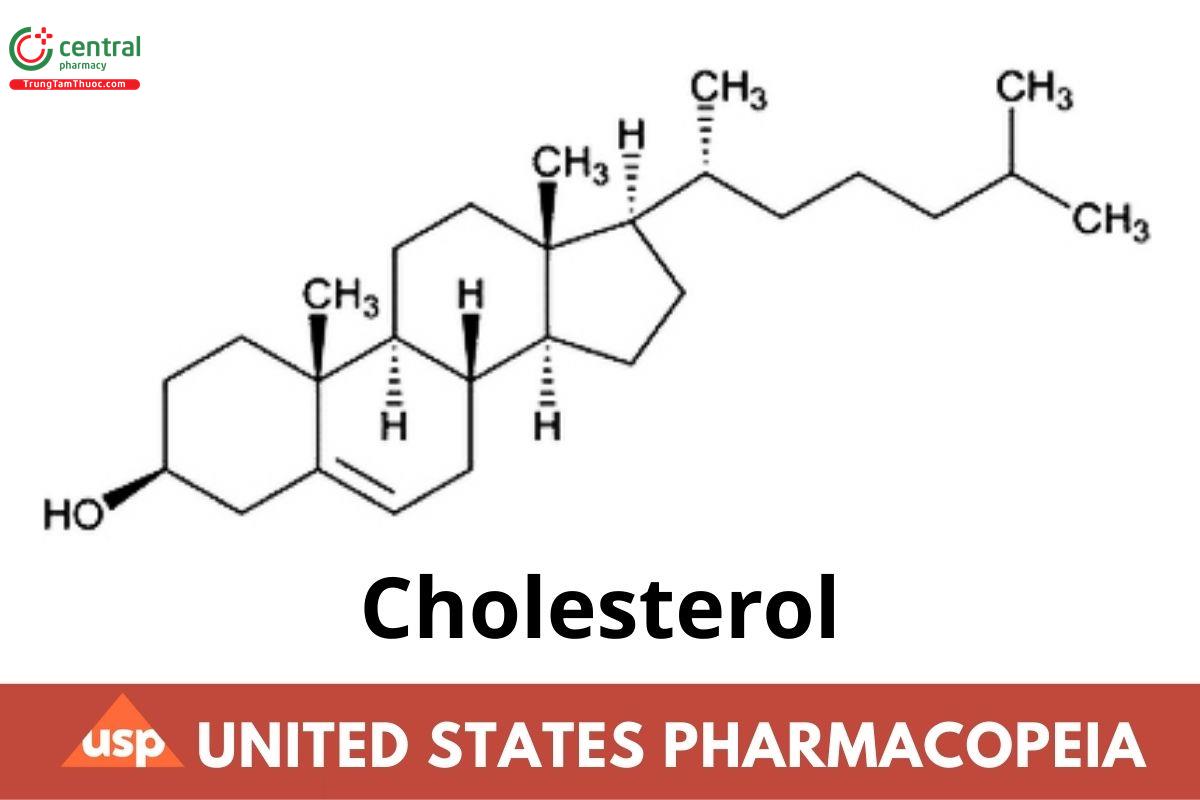
Cholesterol
If you find any inaccurate information, please let us know by providing your feedback here

Tóm tắt nội dung
This article is compiled based on the United States Pharmacopeia (USP) – 2025 Edition
Issued and maintained by the United States Pharmacopeial Convention (USP)
C27H46O 386.65
Cholest-5-en-3-ol, (3β)-;
Cholest-5-en-3β-ol CAS RN: 57-88-5
1 DEFINITION
Cholesterol is a steroid alcohol containing NLT 95.0% and NMT 102.0% of cholest-5-en-3ẞ-ol (C27H46O), calculated on the dried basis. It may contain suitable antioxidants.
2 IDENTIFICATION
A. SPECTROSCOPIC IDENTIFICATION TESTS (197), Infrared Spectroscoру: 1974 ог 197K
B. It meets the requirements of the test for Optical Rotation (781S), Procedures, Specific Rotation.
C. It meets the requirements of the test for Melting Range or Temperature (741).
3 ASSAY
PROCEDURE
Standard solution: 1.0 mg/mL of USP Cholesterol RS and 1.0 mg/mL of pregnenolone isobutyrate (internal standard) in heptane
Sample solution: 1.0 mg/mL of Cholesterol and 1.0 mg/mL of pregnenolone isobutyrate (internal standard) in heptane
Chromatographic system
(See Chromatography (621), System Suitability.)
Mode: GC
Detector: Flame ionization
Column: 0.25-mm x 30-m capillary bonded with a 0.25-µm layer of phase G2
Temperatures
Injection port: 285°
Column: 275°
Detector: 300°
Carrier gas: Helium
Flow rate: 2.0 mL/min
Injection volume: 1.0 µL
Injection type: Split ratio, 25:1
Liner: Cup splitter liner (4 mm x 6.3 x 78.5) with deactivated glass wool
System suitability
Sample: Standard solution
[NOTE-The relative retention times for pregnenolone isobutyrate and cholesterol are 1.0 and 1.2, respectively.]
Suitability requirements
Resolution: NLT 10 between pregnenolone isobutyrate and cholesterol
Relative standard deviation: NMT 2.0% for the peak response ratio of cholesterol to the internal standard
Analysis
Samples: Standard solution and Sample solution
Calculate the percentage of cholesterol in the portion of sample taken:
Result = (Ru /Rs ) × (Cs /Cu ) × 100
Ru = peak response ratio of cholesterol to the internal standard (peak response of cholesterol/peak response of the internal standard) from the Sample solution
Rs = peak response ratio of cholesterol to the internal standard (peak response of cholesterol/peak response of the internal standard) from the Standard solution
Cs = concentration of USP Cholesterol RS in the Standard solution (mg/mL)
Cu = concentration of Cholesterol in the Sample solution (mg/mL)
Acceptance criteria: 95.0%–102.0% on the dried basis
4 IMPURITIES
RESIDUE ON IGNITION (281): NMT 0.1%
LIMIT OF RELATED STEROLS AND OTHER ORGANIC IMPURITIES
Internal standard solution: 0.02 mg/mL of pregnenolone isobutyrate (internal standard) in heptane
System suitability solution: 0.02 mg/mL of USP Cholesterol RS, 0.04 mg/mL of desmosterol, and 0.02 mg/mL of lathosterol in Internal
standard solution
Sample solution: 2.0 mg/mL of Cholesterol in Internal standard solution
Chromatographic system: Proceed as directed in the Assay.
System suitability
Sample: System suitability solution
[NOTE-See Table 1 for the relative retention times.]
Table 1
| Name | Relative Retention Time |
| Pregnenolone isobutyrate (internal standard) | 1.00 |
| Cholesterol | 1.23 |
| Desmosterol (cholesta-5,24-dien-3ẞ-ol) | 1.31 |
| Lathosterol (5a-cholest-7-en-3ẞ-ol) | 1.34 |
Suitability requirements
Resolution: NLT 2.0 between desmosterol and lathosterol
Relative standard deviation: NMT 5.0% for peak response ratio of desmosterol to the internal standard
Analysis
Samples: System suitability solution and Sample solution
Three more related sterols may be observed (see Table 2).
Table 2
| Name | Relative Retention Time |
| Pregnenolone isobutyrate (internal standard) | 1.00 |
| β-Cholestanol (5α-cholestan-3β-ol, dihydrocholesterol) | 1.24 |
| 24-Dehydrolathosterol (5α-cholesta-7,24-dien-3β-ol) | 1.42 |
| 4-Methylcholest-5-en-3β-ol | 1.51 |
Calculate the percentage of desmosterol or lathosterol in the portion of Cholesterol taken:
Result = (Ru1 /Rs1 ) × (Cs1 /Cu ) × 100
Ru1 = peak response ratio of desmosterol or lathosterol to the internal standard (peak response of desmosterol or lathosterol/peak response of the internal standard) from the Sample solution
Rs1 = peak response ratio of desmosterol or lathosterol to the internal standard (peak response of desmosterol or lathosterol/peak response of the internal standard) from the System suitability solution
Cs1 = concentration of desmosterol or lathosterol in the System suitability solution (mg/mL)
Cu = concentration of Cholesterol in the Sample solution (mg/mL)
Calculate the percentage of β-cholestanol, 24-dehydrolathosterol, 4-methylcholest-5-en-3β-ol, or any other unspecied organic impurity in the portion of Cholesterol taken:
Result = (Ru2 /Rs2 ) × (Cs2 /Cu ) × 100
Ru2 = peak response ratio of β-cholestanol, 24-dehydrolathosterol, 4-methylcholest-5-en-3β-ol, or any other unspecied impurity to the internal standard (peak response of β-cholestanol, 24-dehydrolathosterol, 4-methylcholest-5-en-3β-ol, or any other unspecied impurity/peak response of the internal standard) from the Sample solution
Rs2 = peak response ratio of cholesterol to the internal standard (peak response of cholesterol/peak response of the internal standard) from the System suitability solution
Cs2 = concentration of USP Cholesterol RS in the System suitability solution (mg/mL)
Cu = concentration of Cholesterol in the Sample solution (mg/mL)
Acceptance criteria: See Table 3. Disregard peaks less than 0.05% for any unspecied impurities and any peaks due to solvent.
Table 3
| Name | Acceptance Criteria (%) |
| β-Cholestanol (5α-cholestan-3β-ol, dihydrocholesterol) | ≤0.6 |
| Desmosterol | ≤4 |
| Lathosterol | ≤2 |
| 24-Dehydrolathosterol (5α-cholesta-7,24-dien-3β-ol) | ≤0.2 |
| 4-Methylcholest-5-en-3β-ol | ≤0.5 |
| Total impurities including related sterols | ≤5 |
5 SPECIFIC TESTS
Melting Range or Temperature 〈741〉: 147°–150°
Optical Rotation 〈781S〉, Procedures, Specific Rotation
Sample solution: 20 mg/mL, undried, in dioxane
Acceptance criteria: -34° to 38°
Change to read:
5.1 ACIDITY
Sample: 1.0 g
Analysis: Dissolve the Sample in 10 mL of ether in a small flask, add 10.0 mL of 0.10 N sodium hydroxide, and shake for about 1 min. Heat gently to expel the ether, then boil for 5 min, Cool, dilute with 10 mL of water, add phenolphthalein TS, and titrate with 0.10 N sulfuric acid until the pink color just disappears, stirring the solution vigorously throughout the titration. Perform a blank determination (see Titrimetry (541) (CN 1-Aug-2024)).
Acceptance criteria: The difference between the number of mL of 0.10 N sulfuric acid consumed in the blank and the number of mL consumed in the Sample is NMT 0.3 mL.
LOSS ON DRYING (731)
Analysis: Dry under vacuum at 60° for 4 h.
Acceptance criteria: NMT 0.3%
5.2 SOLUBILITY IN ALCOHOL
Sample: 500 mg
Analysis: Dissolve the Sample in 50 mL of warm alcohol in a stoppered flask or cylinder, and allow to stand at room temperature for 2 h.
Acceptance criteria: No deposit or turbidity is formed.
6 ADDITIONAL REQUIREMENTS
PACKAGING AND STORAGE: Preserve in well-closed, light-resistant containers.
LABELING: Label it to indicate whether cholesterol is derived from animal, synthetic, or vegetable sources. For animal-derived sources, indicate the species and tissue used (for example, bovine brain and spinal cord, wool fat, or chicken eggs). Indicate the names and amounts of any added antioxidants.
USP REFERENCE STANDARDS (11)
USP Cholesterol RS

