
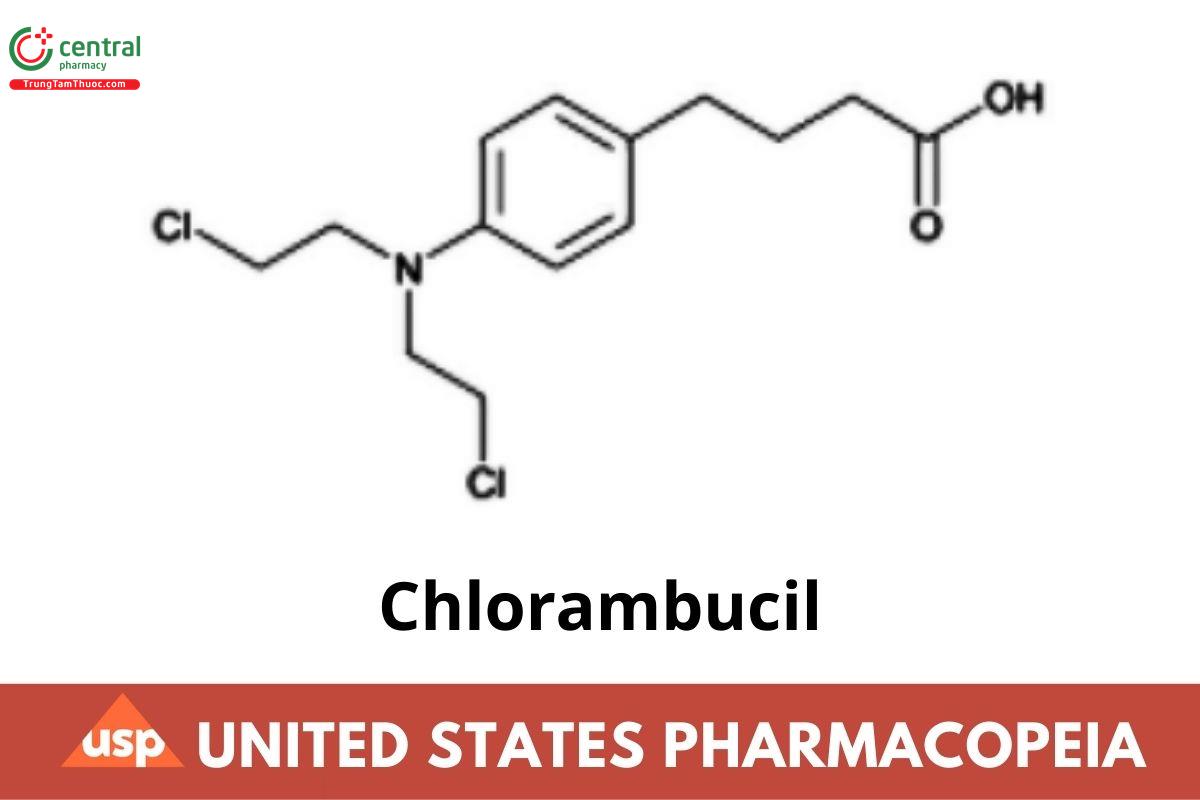
Chlorambucil
If you find any inaccurate information, please let us know by providing your feedback here

Tóm tắt nội dung
This article is compiled based on the United States Pharmacopeia (USP) – 2025 Edition
Issued and maintained by the United States Pharmacopeial Convention (USP)
C14H19Cl2NO2 304.21
Benzenebutanoic acid, 4-[bis(2-chloroethyl)amino]-;
4-[p-[Bis(2-chloroethyl)amino]phenyl]butyric acid CAS RN®: 305-03-3; UNII: 18D0SL7309.
1 DEFINITION
Chlorambucil contains NLT 98.0% and NMT 101.0% of chlorambucil (C14H19Cl2NO2), calculated on the anhydrous basis.
[Caution—Great care should be taken to prevent inhaling particles of Chlorambucil and exposing the skin to it.]
2 IDENTIFICATION
Change to read:
A. Spectroscopic Identification Tests 〈197〉, Infrared Spectroscopy: 197S (CN 1-May-2020)
Sample solution: 8 mg/mL in carbon disulfide
Cell: 1 mm
Acceptance criteria: Meets the requirements
B.
Sample solution: Dissolve 50 mg of Chlorambucil in 5 mL of acetone, and dilute with water to 10 mL.
Analysis: To the Sample solution add 1 drop of 2 N sulfuric acid, then add 4 drops of silver nitrate TS.
Acceptance criteria: No opalescence is observed immediately (absence of chloride ion). Warm the solution on a steam bath: opalescence develops (presence of ionizable chlorine).
3 ASSAY
Procedure
Sample: 200 mg of Chlorambucil
Titrimetric system
Mode: Direct titration
Titrant: 0.1 N sodium hydroxide VS
Endpoint detection: Visual
Analysis: Dissolve the Sample in 10 mL of acetone, add 10 mL of water, and titrate with Titrant, using phenolphthalein TS as the indicator. Each mL of 0.1 N sodium hydroxide is equivalent to 30.42 mg of chlorambucil (C14H19Cl2NO2).
Acceptance criteria: 98.0%–101.0% on the anhydrous basis
4 SPECIFIC TESTS
Melting Range or Temperature 〈741〉: 65°–69°
Water Determination, Method I〈921〉: NMT 0.5%
5 ADDITIONAL REQUIREMENTS
Packaging and Storage: Preserve in tight, light-resistant containers.
USP Reference Standards 〈11〉
USP Chlorambucil RS

