
Chloral Hydrate
If you find any inaccurate information, please let us know by providing your feedback here
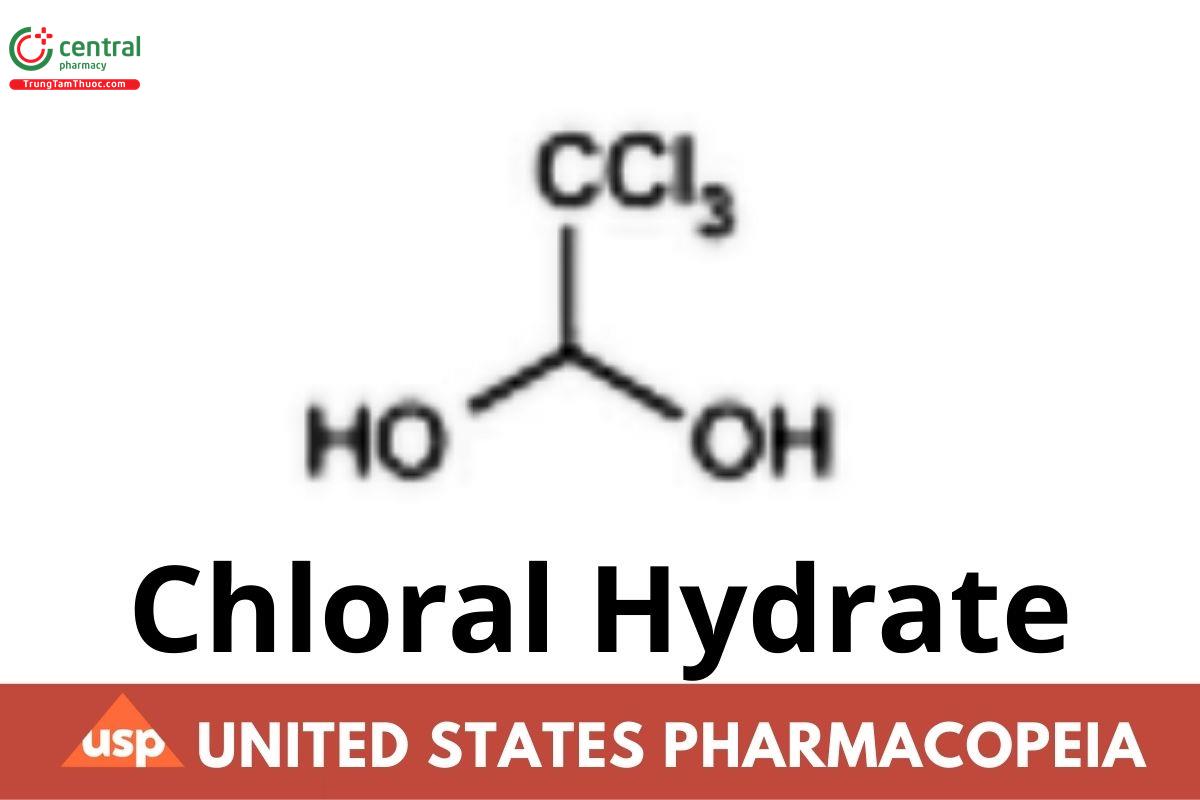

This article is compiled based on the United States Pharmacopeia (USP) – 2025 Edition
Issued and maintained by the United States Pharmacopeial Convention (USP)
C2H3Cl3O2 165.40
1,1-Ethanediol, 2,2,2-trichloro-.
Chloral hydrate CAS RN®: 302-17-0; UNII: 418M5916WG.
Chloral Hydrate contains not less than 99.5 percent and not more than 102.5 percent of C2H3Cl3O2.
Packaging and storage—Preserve in tight containers.
Identification—Transfer to a 125-mL conical ask a portion of a solution in water equivalent to about 1 mg of chloral hydrate, and add water to bring the volume to about 10 mL. Add 10 mL of 1-ethylquinaldinium iodide solution (15 in 1000), which has been filtered through a 0.45-µm filter. Add 60 mL of isopropyl alcohol, 5 mL of an aqueous 0.1 M monoethanolamine solution, and 15 mL of water. Mix, and heat in a water bath at 60° for 15 minutes: a blue color develops.
Acidity—A 1 in 20 solution in alcohol does not at once redden moistened blue litmus paper.
Residue on ignition 〈281〉: not more than 0.1%.
Chloride 〈221〉—To a 1 in 10 solution in alcohol add a few drops of silver nitrate TS: any opalescence produced does not exceed that of a control containing 0.10 mL of 0.020 N hydrochloric acid (0.007%).
Readily carbonizable substances 〈271〉—Shake 500 mg, at intervals of 5 minutes during 1 hour, with 5 mL of sulfuric acid in a glass-stoppered cylinder that previously has been rinsed with sulfuric acid, and transfer the mixture to a comparison vessel: the mixture has no more color than Matching Fluid P.
Assay—Dissolve about 4 g of Chloral Hydrate, accurately weighed, in 10 mL of water, add 30.0 mL of 1 N sodium hydroxide VS, and allow the mixture to stand for 2 minutes. Add a few drops of phenolphthalein TS, and titrate the residual alkali at once with 1 N sulfuric acid VS. Each mL of 1 N sodium hydroxide corresponds to 165.4 mg of C2H3Cl3O2

