
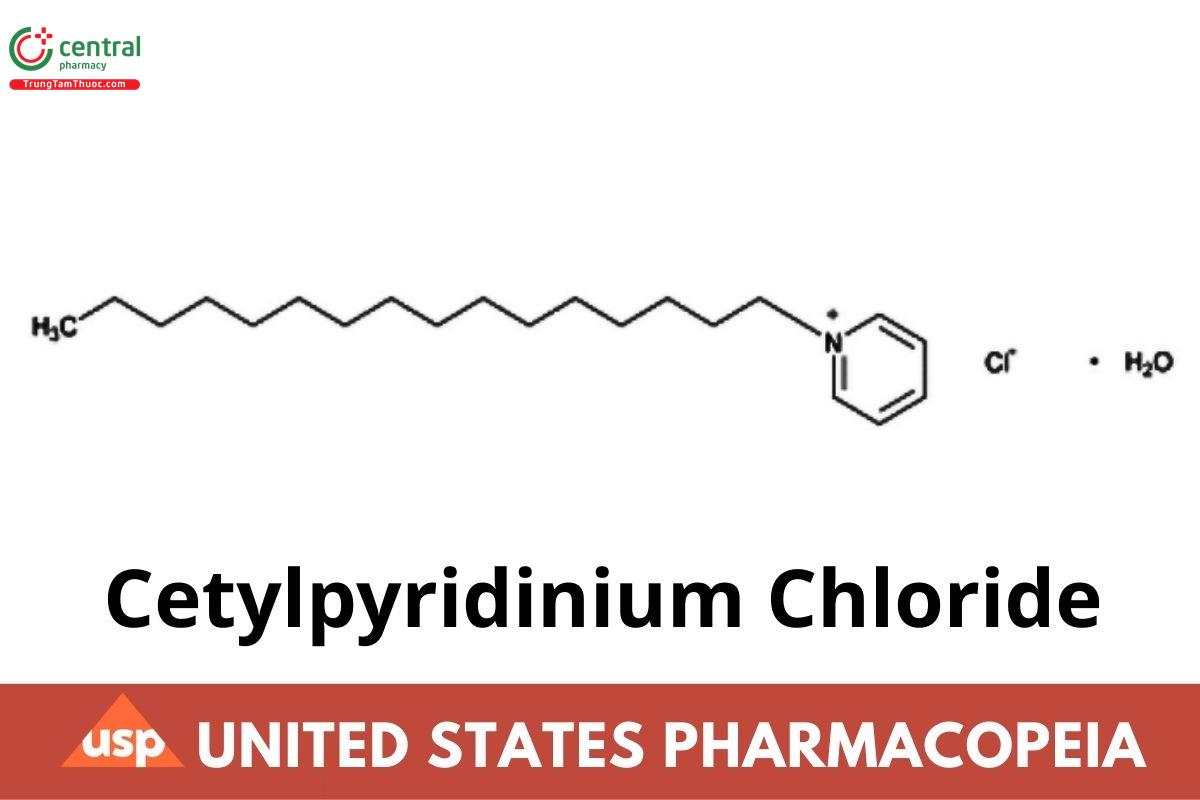
Cetylpyridinium Chloride
If you find any inaccurate information, please let us know by providing your feedback here

Tóm tắt nội dung
This article is compiled based on the United States Pharmacopeia (USP) – 2025 Edition
Issued and maintained by the United States Pharmacopeial Convention (USP)
C21H38ClN.H2O 358.00
C21H38ClN 339.99
Pyridinium, 1-hexadecyl-, chloride, monohydrate;
1-Hexadecylpyridinium chloride monohydrate CAS RN®: 6004-24-6.
Anhydrous CAS RN®: 123-03-5.
1 DEFINITION
Cetylpyridinium Chloride contains NLT 98.0% and NMT 102.0% of cetylpyridinium chloride (C21H38ClN), calculated on the anhydrous basis.
2 IDENTIFICATION
A. Spectroscopic Identification Tests 〈197〉, Infrared Spectroscopy: 197K
B. The retention time of the major peak of the Sample solution corresponds to that of the Standard solution, as obtained in the Assay. C. Identification Tests—General 〈191〉, Chemical Identification Tests, Chloride
Sample solution: 2 mg/mL in water
Acceptance criteria: A 10-mL portion of the Sample solution meets the requirements of test A, except that when silver nitrate TS is added, turbidity is produced rather than a curdy white precipitate.
3 ASSAY
Procedure
Use 0.1% trifluoroacetic acid–rinsed glassware and silanized vials for all solutions containing cetylpyridinium chloride, as cetylpyridinium may react with the surface.
Solution A: Triuoroacetic acid and water (1:999)
Solution B: Acetonitrile and triuoroacetic acid (999:1)
Mobile phase: Solution A and Solution B (62.5:37.5)
Standard solution: 0.25 mg/mL of USP Cetylpyridinium Chloride RS in Solution A
Sample solution: 0.25 mg/mL of Cetylpyridinium Chloride in Solution A
Chromatographic system
(See Chromatography 〈621〉, System Suitability.)
Mode: LC
Detector: UV 258 nm
Column: 2.1-mm × 10-cm; 5-µm packing L78
Column temperature: 40°
Flow rate: 0.6 mL/min
Injection volume: 2 µL
System suitability
Sample: Standard solution
Suitability requirements
Tailing factor: NMT 1.5
Relative standard deviation: NMT 0.73%
Analysis
Samples: Standard solution and Sample solution
Calculate the percentage of cetylpyridinium chloride (C21H38ClN) in the portion of Cetylpyridinium Chloride taken:
Result = (rU/rS) × (CS/CU) × 100
rU = peak response from the Sample solution
rS = peak response from the Standard solution
CS = concentration of USP Cetylpyridinium Chloride RS in the Standard solution (mg/mL)
CU = concentration of Cetylpyridinium Chloride in the Sample solution (mg/mL)
Acceptance criteria: 98.0%–102.0% on the anhydrous basis
4 IMPURITIES
Residue on Ignition 〈281〉: NMT 0.2% on the anhydrous basis
Change to read:
Organic Impurities
Use 0.1% trifluoroacetic acid–rinsed glassware and silanized vials for all solutions containing cetylpyridinium chloride, as cetylpyridinium may react with the surface.
Solution A, Solution B, Mobile phase, and Chromatographic system: Proceed as directed in the Assay.
Sensitivity solution: 1 µg/mL of USP Cetylpyridinium Chloride RS in Solution A (USP 1-May-2021)
Standard solution: 2.5 µg/mL of USP Cetylpyridinium Chloride RSand 0.0125 mg/mL each of USP Myristylpyridinium Chloride RS and USP Stearylpyridinium Chloride RS (USP 1-May-2021) in Solution A
Sample solution: 2.5 mg/mL of Cetylpyridinium Chloride in Solution A
System suitability
Samples: Sensitivity solution (USP 1-May-2021) and Standard solution
Suitability requirements
Relative standard deviation: NMT 2.0%,Standard solution
Signal-to-noise ratio: NLT 10, Sensitivity solution
Analysis
Samples: Standard solution and Sample solution
Calculate the percentage of myristylpyridinium chloride and stearylpyridinium chloride in the portion of Cetylpyridinium Chloride taken:
Result = (rU/rS) × (CS/CU) × 100
rU = peak response of myristylpyridinium or stearylpyridinium from the Sample solution
rS = peak response of myristylpyridinium or stearylpyridinium from the Standard solution
CS = concentration of USP Myristylpyridinium Chloride RS or USP Stearylpyridinium Chloride RS in the Standard solution (mg/mL)
CU = concentration of Cetylpyridinium Chloride in the Sample solution (mg/mL)
Calculate the percentage of each unspecified impurity in the portion of Cetylpyridinium Chloride taken:
Result = (rU/rS) × (CS/CU) × 100
rU = peak response of each unspecified impurity from the Sample solution
rS = peak response of cetylpyridinium from the Standard solution
CS = concentration of USP Cetylpyridinium Chloride RS in in the Standard solution (mg/mL)
CU = concentration of Cetylpyridinium Chloride in the Sample solution (mg/mL)
Acceptance criteria: See Table 1. The reporting threshold is 0.05%.
Table 1
| Name | Relative Response Time | Acceptance Criteria, NMT (%) |
| Myristylpyridinium | 0.53 | 0.45 |
| Cetylpyridinium | 1.0 | - |
| Stearylpyridinium | 2.1 | 0.15 |
| Any unspecified impurity | - | 0.1 |
| Total impurities | - | 1.0 |
5 SPECIFIC TESTS
Acidity
Sample: 500 mg
Analysis: Dissolve the Sample in 50 mL of water, add phenolphthalein TS, and titrate with 0.020 N sodium hydroxide. Acceptance criteria: NMT 2.5 mL is required for neutralization.
Water Determination 〈921〉, Method I: 4.5%–5.5%
6 ADDITIONAL REQUIREMENTS
Packaging and Storage: Preserve in well-closed containers.
Change to read:
USP Reference Standards 〈11〉
USP Cetylpyridinium Chloride RS
USP Myristylpyridinium Chloride RS
1-Tetradecylpyridinium chloride.
C19H34ClN 311.94
USP Stearylpyridinium Chloride RS
1-Octadecylpyridinium chloride.
C23H42ClN 368.0

