
Cetyl Palmitate
If you find any inaccurate information, please let us know by providing your feedback here
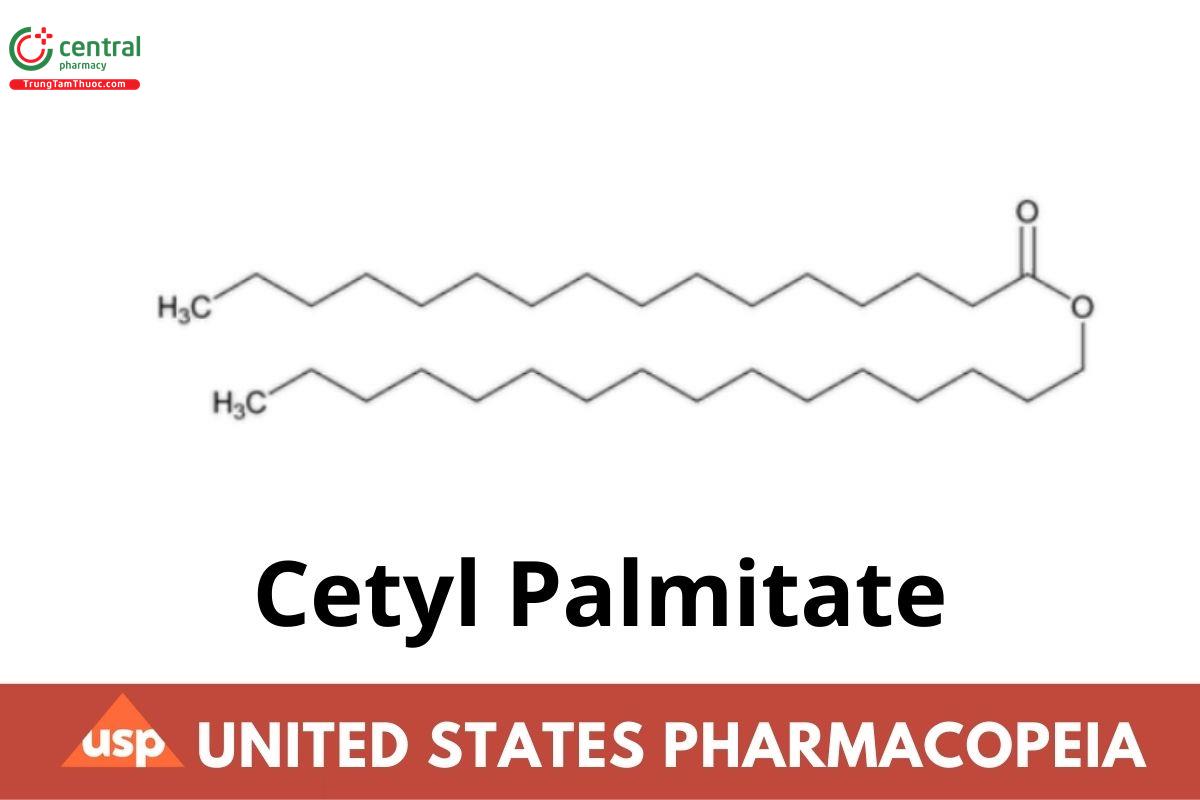

This article is compiled based on the United States Pharmacopeia (USP) – 2025 Edition
Issued and maintained by the United States Pharmacopeial Convention (USP)
DOWNLOAD PDF HERE
1 DEFINITION
Cetyl Palmitate contains NLT 90.0% and NMT 103.0% of cetyl palmitate (C H O ). It consists of esters of cetyl alcohol and saturated high molecular weight fatty acids, principally palmitic acid.
2 IDENTIFICATION
A. Spectroscopic Identification Tests 〈197〉, Infrared Spectroscopy: 197F
Sample: Use a thin film of melted test specimen.
Acceptance criteria: Meets the requirements
B. Chromatographic Identity
Analysis: Proceed as directed in the Assay.
Acceptance criteria: The retention time of the cetyl palmitate peak from the Sample solution corresponds to that of the Standard solution, as obtained in the Assay.
3 ASSAY
Procedure
Diluent: n-Hexane
System suitability solution: 1 mg/mL of USP Cetyl Esters Wax RS in Diluent
Standard solution: 1 mg/mL of USP Cetyl Palmitate RS in Diluent
Sample solution: 1 mg/mL of Cetyl Palmitate in Diluent
Chromatographic system
(See Chromatography 〈621〉, System Suitability.)
Mode: GC
Detector: Flame ionization
Column: 0.53-mm × 10-m fused-silica capillary; 2.65-μm layer of phase G2
Temperatures
Injector: 350°
Detector: 350°
Column: See Table 1.
Table 1
| Initial Temperature (°) | Temperature Ramp (°/min) | Final Temperature (°) | Hold Time at Final Temperature (min) |
| 100 | 20 | 300 | 15 |
Carrier gas: Helium
Flow rate: 6.5 mL/min
Injection volume: 1 μL
Injection type: Split, split ratio 10:1
Run time: 25 min
System suitability
Sample: System suitability solution
[Note—For relative retention times, see Table 2.]
Table 2
| Component | Relative Retention Times |
| Fatty esters with carbon-chain length of carbon number 28 | 0.79 |
| Fatty esters with carbon-chain length of carbon number 30 | 0.87 |
| Fatty esters with carbon-chain length of carbon number 32 that consists chiefly of Cetyl Palmitate | 1.00 |
| Fatty esters with carbon-chain length of carbon number 34 | 1.18 |
Suitability requirements
Resolution: NLT 2.0 between fatty esters with carbon-chain length of carbon number 32 and fatty esters with carbon-chain length of carbon number 34, System suitability solution
Analysis
Samples: Standard solution and Sample solution
Calculate the percentage of cetyl palmitate (fatty esters with carbon-chain length carbon number 32) in the portion of Cetyl Palmitate taken:
Result = (rU/rS) × (CS/CU) × 100
rU= peak response of cetyl palmitate from the Sample solution
rS= peak response of cetyl palmitate from the Standard solution
CS= concentration of USP Cetyl Palmitate RS in the Standard solution (mg/mL)
CU= concentration of Cetyl Palmitate in the Sample solution (mg/mL)
Acceptance criteria: 90.0%–103.0%
4 IMPURITIES
Residue on Ignition 〈281〉: NMT 0.05%
Change to read:
Limit of Fatty Alcohols, Fatty Acids, and Fatty esters
System suitability solution, Sample solution, and Chromatographic system: Proceed as directed in the Assay.
System suitability
Sample: System suitability solution
[Note—For relative retention times, see Table 3.]
Table 3
| Component | Relative Retention Times |
| Cetyl alcohol | 0.46 |
| Palmitic acid | 0.49 |
| Fatty esters with carbon-chain length of carbon number 28 | 0.79 |
| Fatty esters with carbon-chain length of carbon number 30 | 0.87 |
| Fatty esters with carbon-chain length of carbon number 32 that consist chiefly of Cetyl Palmitate | 1.00 |
| Fatty esters with carbon-chain length of carbon number 34 | 1.18 |
Suitability requirements
Resolution: NLT 2.0 between fatty esters with carbon-chain length of carbon number 32 and fatty esters with carbon-chain length of carbon number 34, System suitability solution
Analysis
Samples: System suitability solution and Sample solution
Identify cetyl alcohol, palmitic acid, and each of the fatty esters in the Sample solution based on those in the System suitability solution
(Table 3).
Calculate the percentage of cetyl alcohol, palmitic acid, and each of the fatty esters in the portion of Cetyl Palmitate taken:
Result = (rU/rT) × 100
rU= peak area of cetyl alcohol, palmitic acid, and each of the fatty esters from the Sample solution
rT= sum of the total peak areas from the Sample solution, except for the peak areas from solvent
Acceptance criteria: See Table 4.
Table 4
| Component | Acceptance Criteria, NMT (%) |
| Cetyl alcohol | 2.6 |
| Palmitic acid | 0.65 |
| Fatty esters with carbon-chain length of carbon number 28 | 0.5 (RB 1-Jul-2024) |
| Fatty esters with carbon-chain length of carbon number 30 | 2.0 (RB 1-Jul-2024) |
| Fatty esters with carbon-chain length of carbon number 34 | 1.5 |
| Any individual unidentifled impurity | 0.25 |
| Sum of fatty alcohols, fatty acids, fatty esters with carbon-chain length of carbon number 28, 30, and 34, and unidentified impurities | 10.0 |
5 SPECIFIC TESTS
Melting Range or Temperature 〈741〉, Procedures, Procedure for Class II: 46°–53°
Fats and Fixed Oils 〈401〉, Procedures, Acid Value: NMT 1
Fats and Fixed Oils 〈401〉, Procedures, Hydroxyl Value: NMT 6
Fats and Fixed Oils 〈401〉, Procedures, Iodine Value: NMT 1
Fats and Fixed Oils 〈401〉, Procedures, Saponification Value: 110–130
Loss on Drying 〈731〉
Analysis: Dry at 105° for 1 h.
Acceptance criteria: NMT 3.0%
6 ADDITIONAL REQUIREMENTS
Packaging and Storage: Preserve in tight containers at controlled room temperature, and avoid exposure to excessive heat.
USP Reference Standards 〈11〉
USP Cetyl Palmitate RS
USP Cetyl Esters Wax RS

