
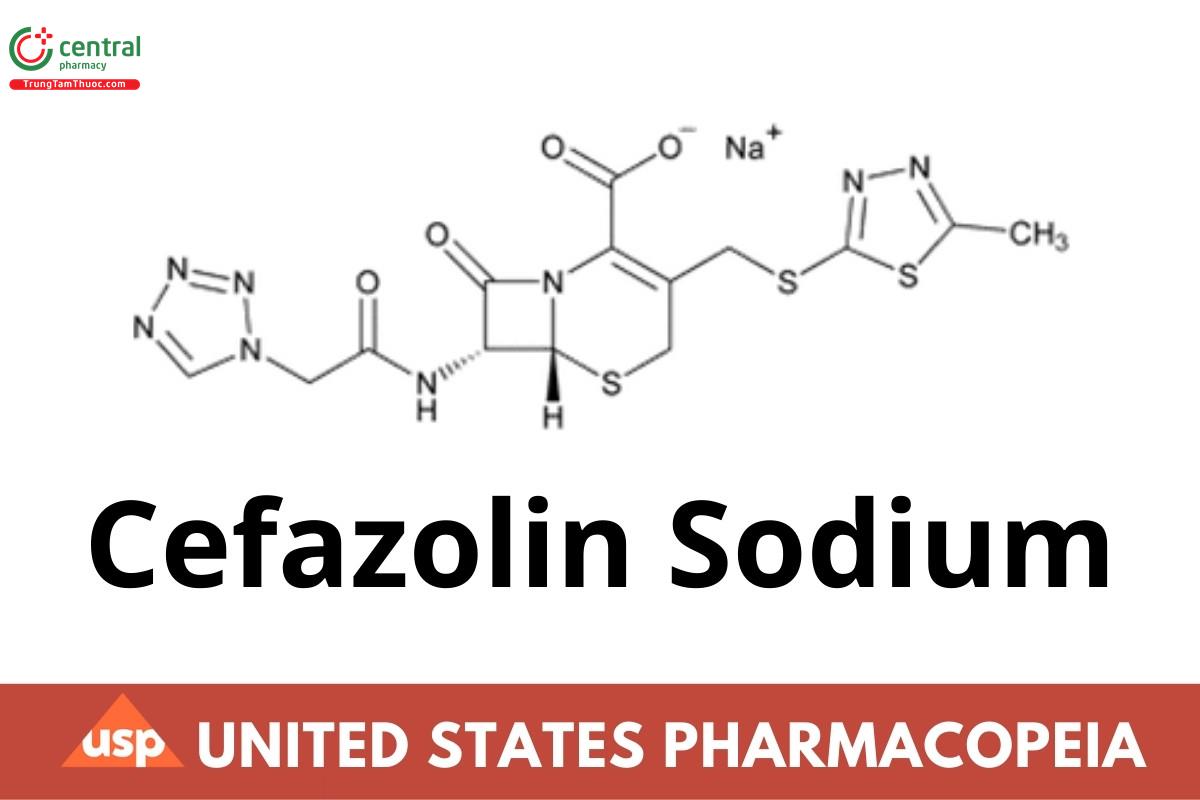
Cefazolin Sodium
If you find any inaccurate information, please let us know by providing your feedback here

Tóm tắt nội dung
This article is compiled based on the United States Pharmacopeia (USP) – 2025 Edition
Issued and maintained by the United States Pharmacopeial Convention (USP)
1 DEFINITION
Cefazolin Sodium has a potency equivalent to NLT 89.1% and NMT 110.1% of cefazolin sodium (C14H13N8NaO4S3), calculated on the anhydrous basis.
2 IDENTIFICATION
Change to read:
A. SPECTROSCOPIC IDENTIFICATION TESTS 〈197〉 , Infrared Spectroscopy: 197A or 197K (CN 1-May-2020)
Solution A: Acetone and water (9:1) Standard: USP Cefazolin RS Sample: 150 mg
Analysis: Dissolve the Sample in 5 mL of water, add 0.5 mL of 2 N acetic acid, swirl, and allow to stand for 10 min in an ice bath. Filter the precipitate, and rinse with 1–2 mL of water. Dissolve in Solution A, evaporate the solvent almost to dryness, and dry in an oven at 60° for 30 min.
Acceptance criteria: Meets the requirements
B. The retention time of the major peak of the Sample solution corresponds to that of the Standard solution, as obtained in the Assay.
C. IDENTIFICATION TESTS—GENERAL 〈191〉 , Chemical Identification Tests, Sodium : Meets the requirements
3 ASSAY
3.1 PROCEDURE
Protect all solutions containing cefazolin from light.
Buffer A: 0.9 g/L of anhydrous dibasic sodium phosphate and 1.3 g/L of citric acid in water
Buffer B: 5.7 g/L of anhydrous dibasic sodium phosphate and 3.6 g/L of monobasic potassium phosphate in water Mobile phase: Acetonitrile and Buffer A (1:9). Pass through a suitable filter.
Standard solution: 50 µg/mL of USP Cefazolin RS in Buffer B Sample solution: 50 µg/mL of Cefazolin Sodium in Buffer B Chromatographic system
(See Chromatography 〈621〉, System Suitability.) Mode: LC
Detector: UV 254 nm
Column: 3.9-mm × 30-cm; 10-µm packing L1 Flow rate: 2 mL/min
Injection volume: 10 µL
System suitability
Sample: Standard solution Suitability requirements
Tailing factor: NMT 1.5
Relative standard deviation: NMT 2.0% Analysis
Samples: Standard solution and Sample solution
Calculate the percentage of cefazolin sodium (C14H13N8NaO4S3) in the portion of Cefazolin Sodium taken:
Result = (ru/rs) × (Cs/Cu) × (Mr1/Mr2) × P × 100
ru = peak response of cefazolin from the Sample solution
rs = peak response of cefazolin from the Standard solution
Cs = concentration of USP Cefazolin RS in the Standard solution (mg/mL)
Cu = concentration of Cefazolin Sodium in the Sample solution (mg/mL)
Mr1 = molecular weight of cefazolin sodium, 476.49
Mr2 = molecular weight of cefazolin, 454.51
P = potency of USP Cefazolin RS (mg/mg) Acceptance criteria: 89.1%–110.1% on the anhydrous basis
4 IMPURITIES
4.1 ORGANIC IMPURITIES
Protect all solutions containing cefazolin from light. Solution A: 6.8 g/L of monobasic potassium phosphate
Solution B: 6.8 g/L of monobasic potassium phosphate adjusted with 10% sodium hy droxide to a pH of 6.8 before final dilution
Solution C: Acetonitrile and Solution A (1:1) Mobile phase: See Table 1.
Table 1
| Time (min) | Solution B (%) | Solution C (%) |
| 0 | 98 | 2 |
| 7 | 98 | 2 |
| 15 | 85 | 15 |
| 30 | 80 | 20 |
| 35 | 80 | 20 |
| 45 | 50 | 50 |
| 50 | 50 | 50 |
| 55 | 98 | 2 |
| 65 | 98 | 2 |
Blank: Solution B
System suitability stock solution: 2 mg/mL of USP Cefazolin RS in 0.05 M sodium hy droxide. Set the solution aside at room temperature for 5 min. [NOTE—The cefazolin epimer is formed upon treatment of cefazolin with sodium hydroxide.]
System suitability solution: System suitability stock solution and Solution B (1:24)
Standard solution: 25 µg/mL of USP Cefazolin RS in Solution B. Use this solution promptly after preparation. Sample solution: 2.5 mg/mL of Cefazolin Sodium in Solution B. Use this solution promptly after preparation.
Chromatographic system
(See Chromatography 〈621〉, System Suitability.) Mode: LC
Detector: UV 210 and 254 nm
Column: 4.6-mm × 25-cm; 5-µm packing L1 Column temperature: 30°
Flow rate: 1.5 mL/min Injection volume: 20 µL
4.1.1 System suitability
Sample: System suitability solution Suitability requirements
Resolution: NLT 8.0 between cefazolin and cefazolin epimer at 254 nm
4.1.2 Analysis
Samples: Blank, Standard solution, and Sample solution
Calculate the percentage of tetrazolylacetic acid and tetrazolylacetamide acetal in the portion of Cefazolin Sodium taken:
Result = (ru(210)/rs(254)) × (Cs/Cu) × (1/F) × 100
ru(210) = peak response of tetrazolylacetic acid or tetrazolylacetamide acetal at 210 nm from the Sample solution
rs(254) = peak response of cefazolin at 254 nm from the Standard solution
Cs = concentration of USP Cefazolin RS in the Standard solution (mg/mL)
Cu = concentration of Cefazolin Sodium in the Sample solution (mg/mL)
F = relative response factor (see Table 2)
Calculate the percentage of each impurity other than tetrazolylacetic acid and tetrazolylacetamide acetal in the portion of Cefazolin Sodium taken:
Result = (ru(254)/rs(254)) × (Cs/Cu) × (1/F) × 100
ru(254) = peak response of each impurity other than tetrazolylacetic acid and tetrazolylacetamide acetal at 254 nm from the Sample solution.
rs(254) = peak response of cefazolin at 254 nm from the Standard solution
Cs = concentration of USP Cefazolin RS in the Standard solution (mg/mL)
Cu = concentration of Cefazolin Sodium in the Sample solution (mg/mL)
F = relative response factor (see Table 2)
Acceptance criteria: See Table 2. Disregard peaks corresponding to those in the Blank.
Table 2
a 2-(1H-Tetrazol-1-yl)acetic acid.
b N-(2,2-Dihydroxyethyl)-2-(1H-tetrazol-1-yl)acetamide.
c The identification of this impurity is tentative. The names of the most likely compounds are listed in footnotes d and e.
d (R)-2-[2-(1H-Tetrazol-1-yl)acetamido]-2-[(R)-7-oxo-2,4,5,7-tetrahydro-1H-furo[3,4-d][1,3]thiazin-2-yl]acetic acid.
e (6R,7R)-7-[2-(1H-Tetrazol-1-yl)acetamido]-3-(hydroxymethyl)-8-oxo-5-thia-1-azabicyclo[4.2.0]oct-2-ene-2-carboxylic acid.
f 5-Methyl-1,3,4-thiadiazole-2-thiol (MMTD).
g (6R,7R)-3-(Acetoxymethyl)-7-amino-8-oxo-5-thia-1-azabicyclo[4.2.0]oct-2-ene-2-carboxylic acid (7-ACA).
h (6R,7R)-7-[2-(1H-Tetrazol-1-yl)acetamido]-3-methyl-8-oxo-5-thia-1-azabicyclo[4.2.0]oct-2-ene-2-carboxylic acid.
i N-{(5aR,6R)-1,7-Dioxo-1,3,4,5a,6,7-hexahydroazeto[2,1-b]furo[3,4-d][1,3]thiazin-6-yl}-2-(1H-tetrazol-1-yl)acetamide.
j (6R,7R)-7-[2-(1H-Tetrazol-1-yl)acetamido]-3-(acetoxymethyl)-8-oxo-5-thia-1-azabicyclo[4.2.0]oct-2-ene-2-carboxylic acid.
k (6R,7R)-7-Amino-3-[(5-methyl-1,3,4-thiadiazol-2-ylthio)methyl]-8-oxo-5-thia-1-azabicyclo[4.2.0]oct-2-ene-2-carboxylic acid.
l Three isomers of this impurity may not be fully resolved by this method. The limit applies to the sum of the isomers, which are as follows: Cefazolin open-ring delta-3: (2R)-2-{(R)-[2-(1H-tetrazol-1-yl)acetamido (carboxy)methyl}-5-[(5-methyl-1,3,4-thiadiazol-2-ylthio)methyl]-3,6- dihydro-2H-1,3-thiazine-4-carboxylic acid. Cefazolin open-ring delta-2: (2R)-2-{(R)-[2-(1H-tetrazol-1-yl)acetamido](carboxy)methyl}-5-[(5- methyl-1,3,4-thiadiazol-2-ylthio)methyl]-3,4-dihydro-2H-1,3-thiazine-4-carboxylic acid. Cefazolin open-ring delta-4: (2R)-2-{(R)-[2-(1H-tetrazol- 1-yl)acetamido](carboxy)methyl}-5-[(5-methyl-1,3,4-thiadiazol-2-ylthio)methyl]-5,6-dihydro-2H-1,3-thiazine-4-carboxylic acid.
m (6R,7S)-7-[2-(1H-Tetrazol-1-yl)acetamido]-3-[(5-methyl-1,3,4-thiadiazol-2-ylthio)methyl]-8-oxo-5-thia-1-azabicyclo[4.2.0]oct-2-ene-2- carboxylic acid.
n (6R,7R)-3-((5-Methyl-1,3,4-thiadiazol-2-ylthio)methyl)-8-oxo-7-pivalamido-5-thia-1-azabicyclo[4.2.0]oct-2-ene-2-carboxylic acid.
5 SPECIFIC TESTS
OPTICAL ROTATION 〈781S〉 , Procedures, Specific Rotation Sample solution: 55 mg/mL, in 0.1 M sodium bicarbonate Acceptance criteria: −10° to −24°
PH 〈791〉
Sample solution: 100 mg/mL of cefazolin Acceptance criteria: 4.0–6.0
WATER DETERMINATION 〈921〉 , Method I : NMT 6.0%
STERILITY TESTS 〈71〉 , Test for Sterility of the Product to Be Examined, Membrane Filtration: Where the label states that Cefazolin Sodium is sterile, it meets the requirements.
BACTERIAL ENDOTOXINS TEST 〈85〉: Where the label states that Cefazolin Sodium is sterile or must be subjected to further processing during the preparation of injectable dosage forms, it contains NMT 0.15 USP Endotoxin Units/mg of cefazolin.
6 ADDITIONAL REQUIREMENTS
PACKAGING AND STORAGE: Preserve in tight containers.
LABELING: Where it is intended for use in preparing injectable dosage forms, the label states that it is sterile or must be subjected to further processing during the preparation of injectable dosage forms.
USP REFERENCE STANDARDS 〈11〉
USP Cefazolin RS

