
Calcium Lactate
If you find any inaccurate information, please let us know by providing your feedback here

Tóm tắt nội dung
This article is compiled based on the United States Pharmacopeia (USP) – 2025 Edition
Issued and maintained by the United States Pharmacopeial Convention (USP)
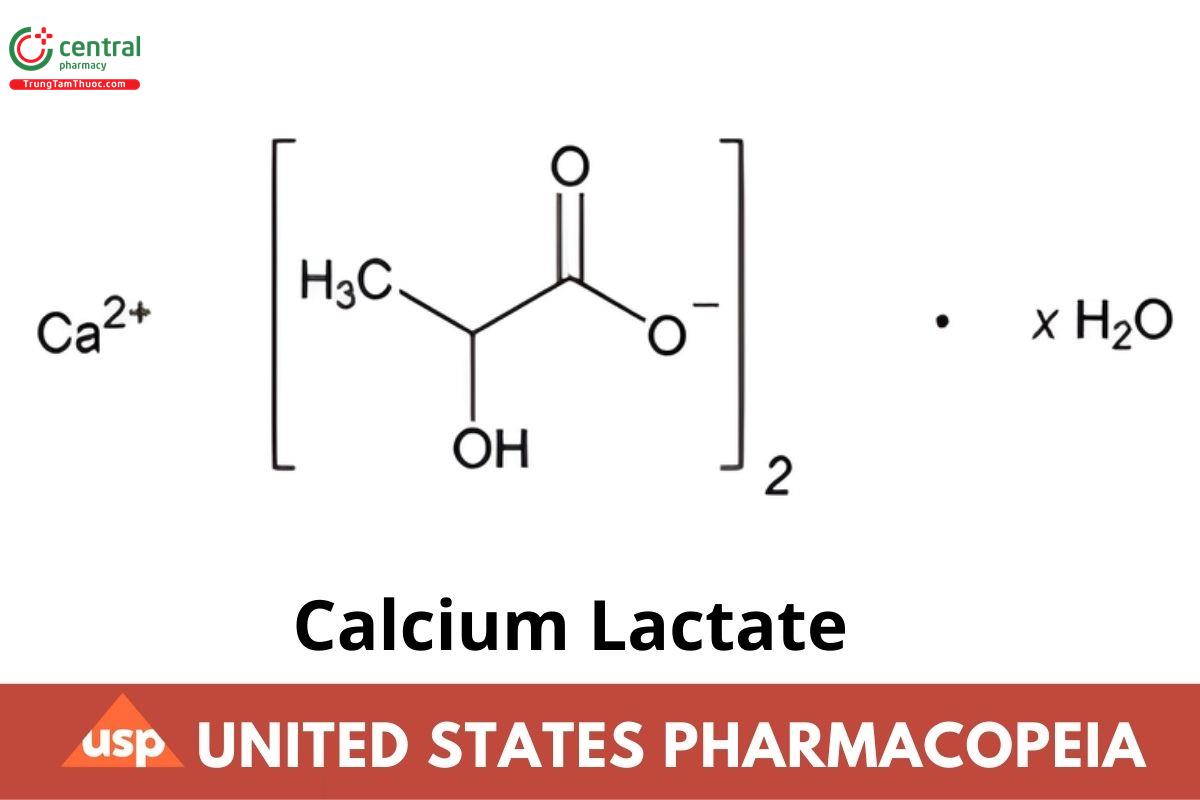
C6H10CaO6.5H₂O 308.30
C6H10CaO6 218.22
Propanoic acid, 2-hydroxy-, calcium salt (2:1), hydrate;
Calcium lactate (ERR 1-Apr-2023) hyd hydrate CAS RN®: 41372-22-9.
Calcium lactate (ERR 1-Apr-2023) рег pentahydrate CAS RN®: 5743-47-5.
Anhydrous CAS RN®: 814-80-2; UNII: 2URQ2N32W3.
1 DEFINITION
Calcium Lactate contains NLT 98.0% and NMT 101.0% of calcium lactate (C6H10CaO6), calculated on the dried basis.
2 IDENTIFICATION
A. IDENTIFICATION TESTS GENERAL, Calcium (191): Meets the requirements
B. SPECTROSCOPIC IDENTIFICATION TESTS (197), Infrared Spectroscopy: 197K
3 ASSAY
PROCEDURE
Titrimetric system
(See Titrimetry (541).)
Mode: Direct titration
Titrant: 0.05 M edetate disodium VS
Endpoint detection: Visual
Result = {[(VS-VB) x Mx F]/W} x 100
VS = Titrant volume consumed by the Sample (mL)
VB = Titrant volume consumed by the Blank (mL)
M =Titrant molarity (mM/mL)
F = equivalency factor, 218.2 mg/mM
W = Sample weight (mg)
Acceptance criteria: 98.0%-101.0% on the dried basis
4 IMPURITIES
LIMIT OF MAGNESIUM AND ALKALI SALTS
Sample: 1.0 g Calcium Lactate
Analysis: Mix the Sample with 40 mL of water, carefully add 1 mL of hydrochloric acid, and heat the solution to boiling. Rapidly add 40 mL of oxalic acid TS, and stir vigorously until precipitation is well established. Add immediately to the warm mixture 2 drops of methyl red TS and then 6 N ammonium hydroxide, dropwise, until the mixture is just alkaline. Cool to room temperature, transfer to a 100-mL graduated cylinder, dilute with water to 100 mL, mix, and allow to stand for 4 h or overnight. Filter, and to 50 mL of the clear filtrate in a platinum dish add 0.5 mL of sulfuric acid. Evaporate the mixture on a steam bath to a small volume. Carefully heat over a free ame to dryness, and continue heating to complete decomposition and volatilization of ammonium salts. Finally, ignite the residue to constant weight.
Acceptance criteria: NMT 1.0%: The weight of the residue does not exceed 5.0 mg.
Volatile Fatty Acid
Sample solution: Stir 500 mg of Calcium Lactate with 1 mL of sulfuric acid, and warm.
Acceptance criteria: The mixture does not emit an odor of volatile fatty acid.
5 SPECIFIC TESTS
5.1 Acidity
Sample solution: 50 mg/mL
Analysis: Titrate 20 mL of Sample solution with 0.10 N sodium hydroxide, using phenolphthalein TS as the indicator.
Acceptance criteria: NMT 0.50 mL is required for neutralization, equivalent to NMT 0.45% as lactic acid.
5.2 Loss on Drying 〈731〉
Sample: 1–2 g
Analysis: Distribute the Sample evenly in a suitable weighing dish to a depth of NMT 3 mm, and dry at 120° for 4 h.
Acceptance criteria: See Table 1.
6 ADDITIONAL REQUIREMENTS
Packaging and Storage: Preserve in tight containers.
Labeling: The label indicates whether it is the dried form or is hydrous; if the latter, the label indicates the degree of hydration. Where the quantity of Calcium Lactate is indicated in the labeling of any solution containing Calcium Lactate, this shall be understood to be in terms of calcium lactate pentahydrate (C6H10CaO6.5H₂O).
USP Reference Standards 〈11〉
USP Calcium Lactate RS

