
Cabergoline
If you find any inaccurate information, please let us know by providing your feedback here
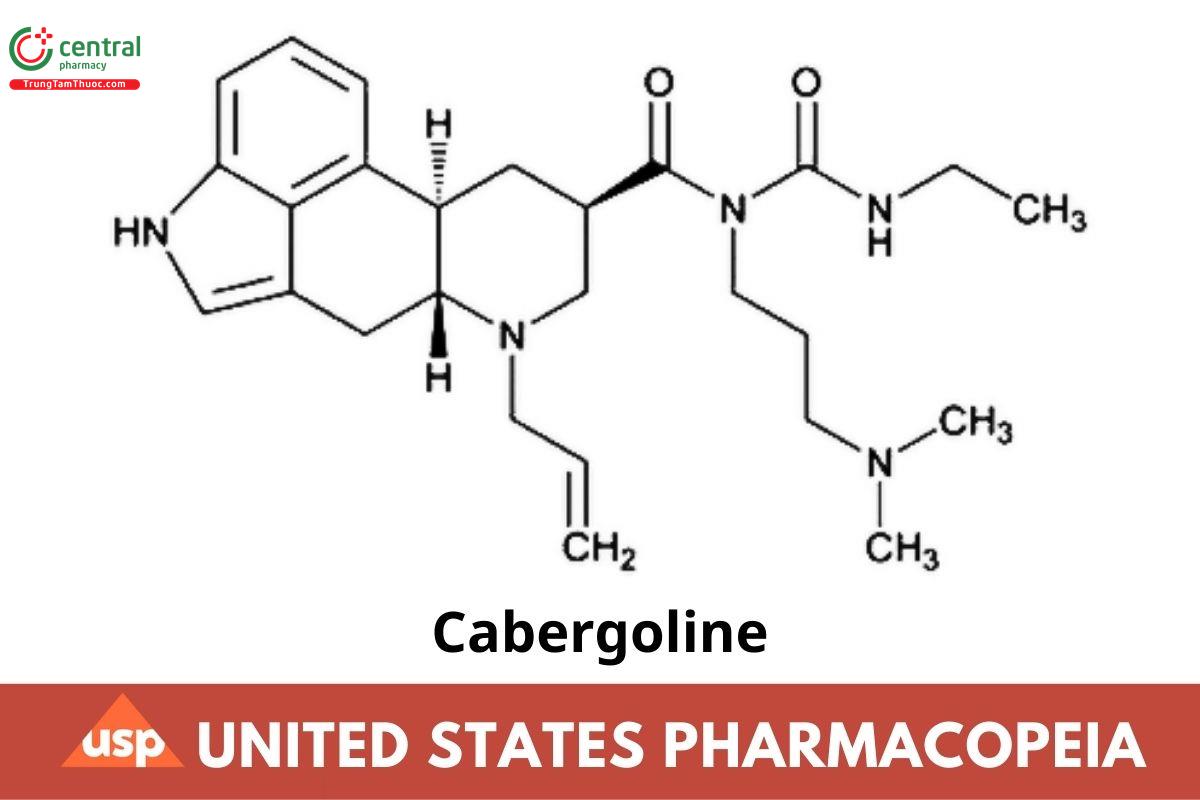

This article is compiled based on the United States Pharmacopeia (USP) – 2025 Edition
Issued and maintained by the United States Pharmacopeial Convention (USP)
C26H37N5O2 451.60
Ergoline-8β-carboxamide, N-[3-(dimethylamino)propyl]-N-[(ethylamino)carbonyl]-6-(2-propenyl)-;
1-[(6-Allylergolin-8β-yl)carbonyl]-1-[3-(dimethylamino)propyl]-3-ethylurea CAS RN: 81409-90-7; UNII: LL60K9J05T.
1 DEFINITION
Cabergoline contains NLT 98.0% and NMT 102.0% of cabergoline (C26H37N5O2), calculated on the anhydrous basis for the crystalline form and on the anhydrous and solvent-free basis for the amorphous form.
2 IDENTIFICATION
A. SPECTROSCOPIC IDENTIFICATION TESTS (197), Infrared Spectroscopy: 197K
Change to read:
B.
Proceed as directed for Procedure 1 or Procedure 2. The criteria for Procedure 1 or Procedure 2 must be met.
Procedure 1: Crystallinity (695)
Acceptance criteria
For the crystalline form: Meets the requirements
For the amorphous form: Does not meet the requirements
Procedure 2: X-Ray Powder Diffraction (941) (CN 1-May-2022)
Acceptance criteria
For the crystalline form: A diffraction pattern is present.
For the amorphous form: No diffraction pattern is present.
3 ASSAY
C. The retention time of the major peak of the Sample solution corresponds to that of the Standard solution, as obtained in the Assay.
PROCEDURE
Prepare solutions immediately before use, and protect from light.
Buffer: Dissolve 6.8 g of monobasic potassium phosphate in 900 ml. of water, adjust with phosphoric acid to a pH of 2.0, and dilute to 1 L. Add 0.2 mL of triethylamine to the resulting solution and mix.
Mobile phase: Acetonitrile and Buffer (4:21)
Standard solution: 0.25 mg/mL of USP Cabergoline RS in Mobile phase. Sonicate if needed.
Sample solution: 0.25 mg/ml of Cabergoline in Mobile phase. Sonicate if needed.
Chromatographic system
(See Chromatography (621), System Suitability.)
Mode: LC
Detector: UV 280 nm
Column: 4.0-mm × 25-cm; 10-µm packing L1
Flow rate: 1.3 mL/min
Injection volume: 100 µL
System suitability
Sample: Standard solution
Suitability requirements
Column efficiency: NLT 1000 theoretical plates
Relative standard deviation: NMT 2.0% for five replicate injections
Analysis
Samples: Standard solution and Sample solution
Calculate the percentage of cabergoline (C26H37N5O2) in the portion of Cabergoline taken:
Result = (ru /rs ) × (Cs /Cu ) × 100
ru = peak response from the Sample solution
rs = peak response from the Standard solution
Cs = concentration of USP Cabergoline RS in the Standard solution (mg/mL)
Cu = concentration of Cabergoline in the Sample solution (mg/mL)
Acceptance criteria
For the crystalline form: 98.0%–102.0% on the anhydrous basis
For the amorphous form: 98.0%–102.0% on the anhydrous and solvent-free basis
4 IMPURITIES
RESIDUE ON IGNITION (281): NMT 0.1%
ORGANIC IMPURITIES
Prepare solutions immediately before use, and protect from light.
Buffer and Mobile phase: Proceed as directed in the Assay.
System suitability solution: To 10 mL of 0.1 M sodium hydroxide add 50 mg of Cabergoline and stir for about 15 min. To 1 ml. of the suspension add 1 mL of 0.1 M hydrochloric acid, and dilute with Mobile phase to 10.0 mL. Sonicate until dissolution is complete. [NOTE-The main degradation product obtained is cabergoline related compound A.]
Sample solution: 0.25 mg/mL of Cabergoline in Mobile phase. Sonicate if needed.
Chromatographic system
(See Chromatography (621), System Suitability.)
Mode: LC
Detector: UV 280 nm
Column: 4.0-mm x 25-cm; 10-µm packing L1
Flow rate: 1.3 mL/min
Injection volume: 100 µL
System suitability
Sample: System suitability solution
[NOTE-See Table 1 for relative retention times.]
Suitability requirements
Resolution: NLT 3.0 between cabergoline and cabergoline related compound A
Analysis
Sample: Sample solution
Calculate the percentage of each impurity in the portion of Cabergoline taken:
Result = (ru /rT ) × 100
ru = peak response of each impurity from the Sample solution
rT = sum of all the peak responses from the Sample solution
Acceptance criteria: See Table 1.
Table 1
Name | Relative Retention Time | Acceptance Criteria, NMT (%) |
| Cabergoline related compound Da | 0.3 | 0.1 |
| Cabergoline related compound Bb | 0.6 | 0.1 |
| Cabergoline related compound Ac | 0.8 | 0.3 |
| Cabergoline | 1.0 | |
| Cabergoline related compound Cd | 2.9 | 0.3 |
| Any other individual unidentied impurity | - | 0.10 |
| Total impurities | - | 0.8 |
a (6aR,9R,10aR)-N-[3-(Dimethylamino)propyl]-7-(prop-2-enyl)-4,6,6a,7,8,9,10,10a-octahydroindolo[4,3-fg]quinoline-9-carboxamide.
b (6aR,9R,10aR)-N9-[3-(Dimethylamino)propyl]-N4-ethyl-7-(prop-2-enyl)6a,7,8,9,10,10a-hexahydroindolo[4,3-fg]quinoline-4,9(6H)-dicarboxamide.
c (6aR,9R,10aR)-7-(Prop-2-enyl)-4,6,6a,7,8,9,10,10a-octahydroindolo[4,3-fg]quinoline-9-carboxylic acid.
d (6aR,9R,10aR)-N9-[3-(Dimethylamino)propyl]-N4-ethyl-N9-(ethylcarbamoyl)-7-(prop-2-enyl)-6a,7,8,9,10,10a-hexahydroindolo[4,3- fg]quinoline-4,9(6H)-dicarboxamide.
5 SPECIFIC TESTS
OPTICAL ROTATION, Specific Rotation (781S)
Sample solution: 1 mg/mL in alcohol
Acceptance criteria
For the crystalline form: -77" to -83" on the anhydrous basis
For the amorphous form: -77" to -83" on the anhydrous and solvent-free basis
WATER DETERMINATION, Method / (921)
Acceptance criteria
For the crystalline form: NMT 0.5%
For the amorphous form: NMT 1.5%
6 ADDITIONAL REQUIREMENTS
PACKAGING AND STORAGE: Preserve in tight containers, protected from light. If it is labeled as amorphous, preserve under nitrogen in tight containers, store cold, and protect from light.
LABELING: Where it is the amorphous form, the label so indicates.
USP REFERENCE STANDARDS (11)
USP Cabergoline RS

