
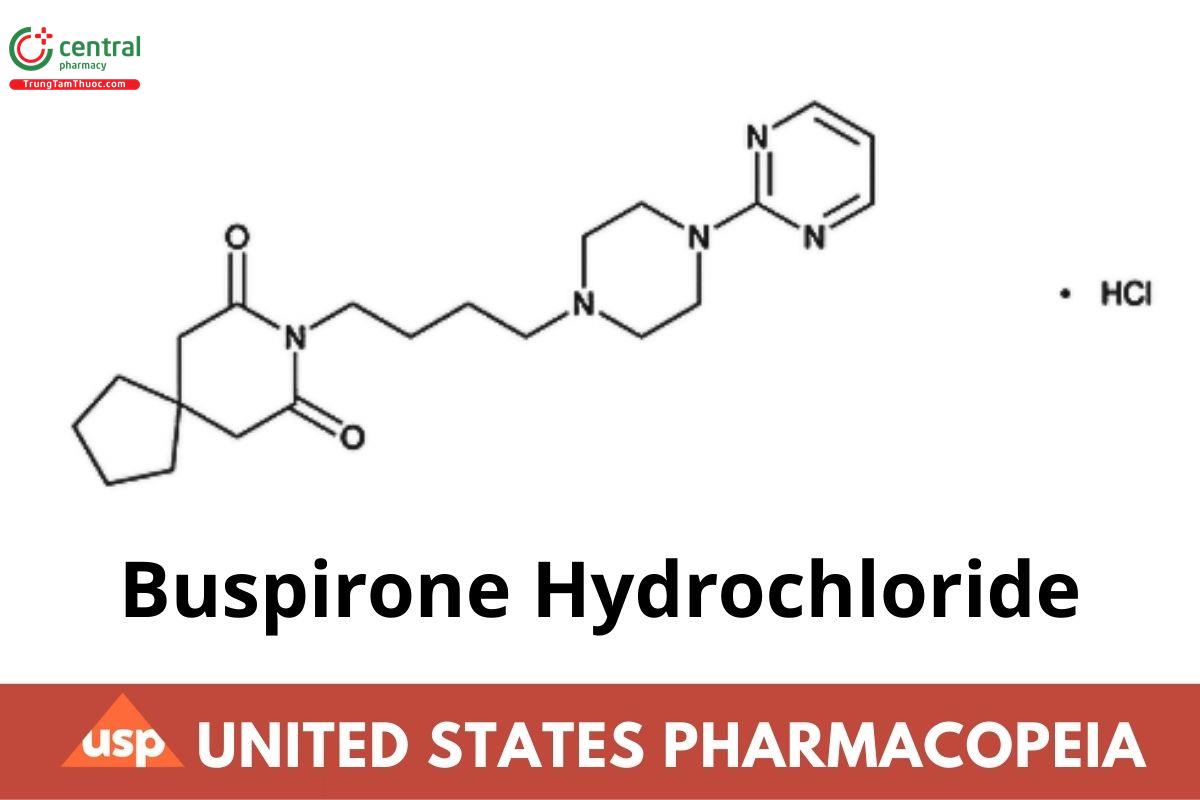
Buspirone Hydrochloride
If you find any inaccurate information, please let us know by providing your feedback here

Tóm tắt nội dung
This article is compiled based on the United States Pharmacopeia (USP) – 2025 Edition
Issued and maintained by the United States Pharmacopeial Convention (USP)
C21H31N2O5 . HCI 421.96
8-Azaspiro [4,5]decane-7,9-dione, 8-[4-[4-(2-pyrimidinyl)-1-piperazinyl] butyl]-, monohydrochloride;
N-[4-[4-(2-Pyrimidinyl)-1-piperazinyl]butyl]-1,1-cyclopentanediacetamide monohydrochloride CAS RN®: 33386-08-2; UNII: 207LT9J90C.
1 DEFINITION
Buspirone Hydrochloride contains NLT 97.5% and NMT 102.5% of buspirone hydrochloride (C21H31N2O5 . HCI), calculated on the as-is basis.
2 IDENTIFICATION
Change to read:
A. ASPECTROSCOPIC IDENTIFICATION TESTS (197), Infrared Spectroscopy: 197K ( CN 1-MAY-2020)
B. The retention time of the major peak of the Sample solution corresponds to that of the Standard solution, as obtained in the Assay.
C. IDENTIFICATION TESTS-GENERAL, Chloride (191).
Sample solution: 10 mg/mL in water
Acceptance criteria: Meets the requirements
3 ASSAY
3.1 PROCEDURE
Buffer A: 6.8 g/L of monobasic potassium phosphate and 0.93 g/L of sodium 1-hexanesulfonate monohydrate. Adjust with phosphoric acid to a pH of 3.4.
Buffer B: 3.4 g/L of monobasic potassium phosphate and 3.52 g/L of sodium 1-hexanesulfonate monohydrate. Adjust with phosphoric acid to a pH of 2.2.
Solution A: Acetonitrile and Buffer A (5:95)
Solution B: Acetonitrile and Buffer B (75:25)
Mobile phase: See Table 1.
Table 2
| Time (min) | Solution A (%) | Solution B (%) |
| 0 | 90 | 10 |
| 6 | 90 | 10 |
| 34 | 42 | 58 |
| 45 | 42 | 58 |
| 55 | 0 | 100 |
| 56 | 100 | 0 |
| 60 | 100 | 0 |
| 61 | 90 | 10 |
Diluent: Solution A
Impurities stock solution: 0.25 mg/mL each of USP Buspirone Related Compound A RS. USP Buspirone Related Compound G RS, USP Buspirone Related Compound K RS, USP Buspirone Related Compound L RS, and USP Buspirone Related Compound N RS in acetonitrile
System suitability solution: 1.0 mg/mL of USP Buspirone Hydrochloride RS and 0.001 mg/mL each of USP Buspirone Related Compound A RS, USP Buspirone Related Compound G RS, USP Buspirone Related Compound K RS, USP Buspirone Related Compound L RS, and USP
Buspirone Related Compound N. RS in Diluent, from Impurities stock solution
Standard solution: 0.1 mg/mL of USP Buspirone Hydrochloride RS in Diluent
Sample solution: 0.1 mg/mL of Buspirone Hydrochloride in Diluent
Chromatographic system
(See Chromatography (621). System Suitability.)
Mode: LC
Detector: UV 240 nm
Column: 4.6-mm x 15-cm; 5-µm packing L1
Column temperature: 40°
Flow rate: 1 mL/min
Injection volume: 20 µL
System suitability
Samples: System suitability solution and Standard solution
Suitability requirements
Resolution: NLT 2.0 between buspirone and buspirone related compound G peaks, System suitability solution
Tailing factor: NMT 1.5, Standard solution
Relative standard deviation: NMT 0.92%, Standard solution
Analysis
Samples: Standard solution and Sample solution
Calculate the percentage of buspirone hydrochloride (C21H31N2O5 . HCI) in the portion of Buspirone Hydrochloride taken:
Result = (rU/rS) × (CS/CU) × 100
rU = peak response from the Sample solution
rS = peak response from the Standard solution
CS = concentration of USP Buspirone Hydrochloride RS in the Standard solution (mg/mL)
CU = concentration of Buspirone Hydrochloride in the Sample solution (mg/mL)
Acceptance criteria: 97.5%-102.5% on the as-is basis
4 IMPURITIES
4.1 RESIDUE ON IGNITION (281): NMT 0.5%
4.2 ORGANIC IMPURITIES
Buffer A, Buffer B, Solution A, Solution B, Mobile phase, Diluent, Impurities stock solution, and System suitability solution: Proceed as directed in the Assay.
Standard solution: 0.001 mg/mL each of USP Buspirone Hydrochloride RS, USP Buspirone Related Compound A RS, USP Buspirone Related Compound G RS, USP Buspirone Related Compound K RS, USP Buspirone Related Compound L RS, and USP Buspirone Related Compound N RS in Diluent
Sample solution: 1.0 mg/mL of Buspirone Hydrochloride in Diluent
Chromatographic system
(See Chromatography (621), System Suitability.)
Mode: LC
Detector: UV 210 and 240 nm
Column: 4.6-mm x 15-cm; 5-µm packing L1
Column temperature: 40°
Flow rate: 1 mL/min
Injection volume: 20 µL
System suitability
Samples: System suitability solution and Standard solution
[NOTE-See Table 2 and Table 3 for relative retention times.]
Suitability requirements
Resolution at 240 nm: NLT 2.0 between buspirone and buspirone related compound G peaks, System suitability solution
Resolution at 210 nm: NLT 4.0 between buspirone related compound L and buspirone related compound N peaks, System suitability solution
Relative standard deviation: NMT 2.0% for each peak, Standard solution
Analysis
Samples: Standard solution and Sample solution
For impurities detected at UV 240 nm
Calculate the percentage of buspirone related compound A or buspirone related compound G in the portion of Buspirone Hydrochloride taken:
Result = (rU/rS) × (CS/CU) × 100
rU = peak response of buspirone related compound A or buspirone related compound G from the Sample solution
rS = peak response of buspirone related compound A or buspirone related compound G from the Standard solution
CS = concentration of USP Buspirone Related Compound A RS or USP Buspirone Related Compound G RS in the Standard solution (mg/mL)
CU = concentration of Buspirone Hydrochloride in the Sample solution (mg/mL)
Calculate the percentage of specified impurities and any other individual impurity in the portion of Buspirone Hydrochloride taken:
Result = (rU/rS) × (CS/CU) × (1/F) × 100
rU = peak response of specified impurities and any other individual impurity from the Sample solution
rS = peak response of buspirone from the Standard solution
CS = concentration of USP Buspirone Hydrochloride RS in the Standard solution (mg/mL)
CU = concentration of Buspirone Hydrochloride in the Sample solution (mg/mL)
F = relative response factor (see Table 2)
Acceptance criteria
For impurities detected at UV 240 nm: See Table 2. Disregard any peak below 0.05%.
Table 2
| Name | Relative Retention Time | Relative Response Factor | Acceptance Criteria, NMT (%) |
| Buspirone related compound Aa | 0.2 | - | 0.10 |
| Spiroammonium saltb | 0.3 | 1.0 | 0.10 |
| Bispyrimidinylpiperazinyl butanec | 0.6 | 1.0 | 0.10 |
| Bispyrimidinylpiperazinylbutyl etherd | 0.7 | 1.0 | 0.10 |
| Buspirone open ringe | 0.8 | 1.0 | 0.3 |
| Buspirone open ring dimerf | 0.9 | 1.0 | 0.10 |
| Buspirone | 1.0 | - | - |
| Buspirone related compound Gg | 1.05 | - | 0.10 |
| Buspirone diester dimerh | 1.1 | 1.0 | 0.10 |
| Chlorobuspironei | 1.2 | 1.0 | 0.10 |
| Buspirone open ring spirodimerj | 1.5 | 0.5 | 0.2 |
| Any other individual impurityi | - | 1.0 | 0.10 |
| Total impurities | - | - | 0.4 |
a 2-(Piperazin-1-yl)pyrimidine.
b 8-(Pyrimidin-2-yl)-8-aza-5-azoniaspiro[4.5]decane.
c 1,4-Bis[4-(pyrimidin-2-yl)piperazin-1-yl]butane.
d Bis{4-[1-(pyrimidine-2-yl)piperazine-4-yl]butane-1-yl) ether.
e 2-(1-[2-0xo-2-({4-[4-(pyrimidin-2-yl)piperazin-1-yl]butyl)amino) ethyl]cyclopentyl)acetic acid.
f 4-[4-(Pyrimidin-2-yl)piperazin-1-yl]butyl 2-(1-[2-oxo-2-({4-[4-(pyrimidin-2-yl)piperazin-1-yl]butyl)amino)ethyl]cyclopentyl)acetate.
g 1,4-Di(pyrimidin-2-yl)piperazine.
h Bis{4-[4-(pyrimidin-2-yl)piperazin-1-yl]butyl) 2,2'-(cyclopentane-1,1-diyl)diacetate.
i 8-(4-[4-(5-Chloropyrimidin-2-yl)piperazin-1-yl]butyl)-8-azaspiro [4.5] decane-7,9-dione.
j 4-(7,9-Dioxo-8-azaspiro [4.5]decan-8-yl)butyl 2-{1-[2-oxo-2-({4-[4-(pyrimidin-2-yl)piperazin-1-yl]butyl)amino)ethyl]cyclopentyl)acetate.
For impurities detected at UV 210 nm
Calculate the percentage of buspirone related compound K, buspirone related compound L, or buspirone related compound N in the portion of Buspirone Hydrochloride taken:
Result = (rU/rS) × (CS/CU) × 100
r = peak response of buspirone related compound K, buspirone related compound L, or buspirone related compound N from the Sample solution
r = peak response of buspirone related compound K, buspirone related compound L, or buspirone related compound N from the Standard solution
C= concentration of USP Buspirone Related Compound K RS. USP Buspirone Related Compound L RS, or USP Buspirone Related Compound N RS in the Standard solution (mg/mL)
C= concentration of Buspirone Hydrochloride in the Sample solution (mg/mL)
Calculate the percentage of buspirone bromobutyl analog and any other individual impurity in the portion of Buspirone Hydrochloride taken:
Result = (rU/rS) × (CS/CU) × 100
rU = peak response of buspirone bromobutyl analog and any other individual impurity from the Sample solution
rS = peak response of buspirone from the Standard solution s
CS = concentration of USP Buspirone Hydrochloride RS in the Standard solution (mg/mL)
CU = concentration of Buspirone Hydrochloride in the Sample solution (mg/mL)
Acceptance criteria
For impurities detected at UV 210 nm: See Table 3. Disregard any peak below 0.05%.
Table 3
| Name | Relative Retention Time | Acceptance Criteria, NMT (%) |
| Buspirone related compound Ka | 0.6 | 0.1 |
| Buspirone | 1.0 | - |
| Buspirone related compound Lb | 1.7 | 0.10 |
| Buspirone bromobutyl analogc | 1.8 | 0.10 |
| Buspirone related compound Nd | 1.9 | 0.10 |
| Any other individual impurity | - | 0.10 |
| Total impurities | - | 0.2 |
a 8-Azaspiro [4,5] decane-7,9-dione.
b 8-(4-Chlorobutyl)-8-azaspiro [4.5]decane-7,9-dione.
c 8-(4-Bromobutyl)-8-azaspiro [4.5]decane-7,9-dione.
d 8,8'-(Butane-1,4-diyl)bis(8-azaspiro [4.5] decane-7,9-dione).
5 SPECIFIC TESTS
WATER DETERMINATION, Method (921): NMT 0.5%
6 ADDITIONAL REQUIREMENTS
PACKAGING AND STORAGE: Preserve in tight, light-resistant containers, at controlled room temperature.
USP REFERENCE STANDARDS (11)
USP Buspirone Hydrochloride RS
USP Buspirone Related Compound A RS
2-(Piperazin-1-yl)pyrimidine.
C8H12N4 164.21
USP Buspirone Related Compound G RS
1,4-Di(pyrimidin-2-yl)piperazine.
C12H14N6 242.28
USP Buspirone Related Compound K RS
8-Azaspiro [4.5]decane-7,9-dione.
C9H13NO2 167.21
USP Buspirone Related Compound L RS
8-(4-Chlorobutyl)-8-azaspiro [4.5] decane-7,9-dione.
C13H20CINO2 257.76
USP Buspirone Related Compound N RS
8,8'-(Butane-1,4-diyl)bis (8-azaspiro [4.5] decane-7,9-dione).
C22H32N2O4 388.50

