
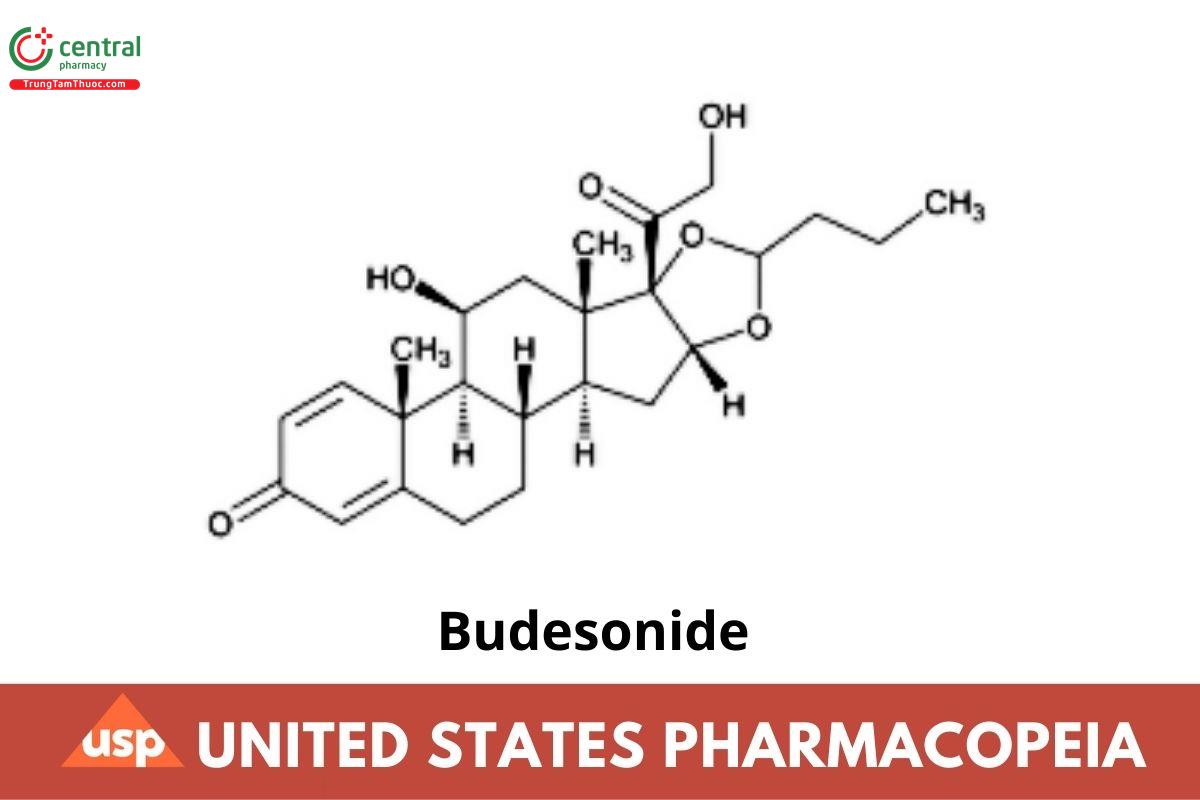
Budesonide
If you find any inaccurate information, please let us know by providing your feedback here

This article is compiled based on the United States Pharmacopeia (USP) – 2025 Edition
Issued and maintained by the United States Pharmacopeial Convention (USP)
1 DEFINITION
Budesonide is a mixture of two epimeric forms, epimer A (C-22S) and epimer B (C-22R). It contains NLT 40.0% and NMT 51.0% of epimer A, and the sum of both epimers is NLT 98.0% and NMT 102.0% of budesonide (C₂₅H₃₄O₆), calculated on the dried basis.
[Note—Protect all solutions containing Budesonide from light.]
2 IDENTIFICATION
A. Spectroscopic Identification Tests 〈197〉, Infrared Spectroscopy: 197K
B. Spectroscopic Identification Tests 〈197〉, Ultraviolet-Visible Spectroscopy: 197U
Sample solution: 25 µg/mL
Medium: Methanol
Acceptance criteria: Meets the requirements
3 ASSAY
Procedure
Buffer: 0.5 mL of glacial acetic acid in 1 L of water. Adjust with potassium hydroxide to a pH of 3.9.
Mobile phase: Acetonitrile and Buffer (45:55)
Standard solution: 0.06 mg/mL of USP Budesonide RS prepared as follows. Transfer USP Budesonide RS to a suitable volumetric flask, dissolve in acetonitrile equivalent to 30% of the flask volume, and dilute with water to volume.
Sample solution: 0.06 mg/mL of Budesonide prepared as follows. Transfer Budesonide to a suitable volumetric flask, dissolve in acetonitrile equivalent to 30% of the flask volume, and dilute with water to volume.
Chromatographic system
(See Chromatography 〈621〉, System Suitability.)
Mode: LC
Detector: UV 240 nm
Column: 4.6-mm × 25-cm; 3-µm packing L1
Column temperature: 50°
Flow rate: 1 mL/min
Injection volume: 20 µL
System suitability
Sample: Standard solution
[Note—The relative retention time for epimer B is 0.96 with respect to epimer A.]
Resolution: NLT 1.2 between the two budesonide epimer peaks
Relative standard deviation: NMT 1.0%, for the sum of the peak areas of the two budesonide epimers
Analysis
Samples: Standard solution and Sample solution
Calculate the percentage of budesonide epimer A (C₂₅H₃₄O₆) in the portion of Budesonide taken:
Result = [rUA/(rUA + rUB)] × 100
rUA = peak area of epimer A from the Sample solution
rUB = peak area of epimer B from the Sample solution
Calculate the percentage of budesonide (C₂₅H₃₄O₆) in the portion of Budesonide taken:
Result = [(rUA+ rUB)/(rSA + rSB)] × (CS/CU) × 100
rUA= peak area of epimer A from the Sample solution
rUB= peak area of epimer B from the Sample solution
rSA = peak area of epimer A from the Standard solution
rSB= peak area of epimer B from the Standard solution
CS= concentration of USP Budesonide RS in the Standard solution (mg/mL)
CU= concentration of Budesonide in the Sample solution (mg/mL)
Acceptance criteria:
Epimer A: 40.0%–51.0%
Both epimers: 98.0%–102.0% on the dried basis
4 IMPURITIES
Change to read:
Organic Impurities
Solution A: 0.5 mL of glacial acetic acid in 1 L of water. Adjust with potassium hydroxide to a pH of 3.9.
Solution B: Acetonitrile
Mobile phase: See Table 1.
| Time (min) | Solution A (%) | Solution B (%) |
| 0 | 75 | 25 |
| 5 | 75 | 25 |
| 35 | 68 | 32 |
| 42 | 59 | 41 |
| 59 | 25 | 75 |
| 60 | 75 | 25 |
| 70 | 75 | 25 |
Diluent: Acetonitrile and water (3:7)
System suitability stock solution A: 0.3 mg/mL of USP Budesonide Related Compound E RS in acetonitrile
System suitability stock solution B: 0.3 mg/mL of USP Budesonide Related Compound G RS in acetonitrile
System suitability stock solution C: 0.3 mg/mL of USP Budesonide Related Compound L RS in acetonitrile
System suitability solution: 0.6 mg/mL of USP Budesonide RS and 3 µg/mL each of USP Budesonide Related Compound E RS, USP Budesonide Related Compound G RS, and USP Budesonide Related Compound L RS in Diluent prepared as follows. Transfer USP Budesonide RS to a suitable volumetric flask and add suitable quantities of System suitability stock solution A, System suitability stock solution B, and System suitability stock solution C. Dilute with acetonitrile equivalent to 30% of the final volume and dilute with water to volume.
Standard stock solution: 0.6 mg/mL of USP Budesonide RS prepared as follows. Transfer USP Budesonide RS to a suitable volumetric flask, dissolve in acetonitrile equivalent to 30% of the flask volume, and dilute with water to volume.
Sensitivity solution: 0.3 μg/mL of USP Budesonide RS in Diluent from the Standard stock solution
Standard solution: 6 µg/mL of USP Budesonide RS in Diluent from the Standard stock solution
Sample solution: 0.6 mg/mL of Budesonide prepared as follows. Transfer Budesonide to a suitable volumetric flask, dissolve in acetonitrile equivalent to 30% of the flask volume, and dilute with water to volume.
Chromatographic system
(See Chromatography 〈621〉, System Suitability.)
Mode: LC
Detector: UV 240 nm
Column: 4.6-mm × 25-cm; 3-µm packing L1
Temperatures:
Autosampler: 4°
Column: 50°. [Note—The resolution between budesonide related compound E and budesonide related compound L may be improved by lowering the temperature, but to NLT 40°.]
Flow rate: 1.5 mL/min
Injection volume: 50 µL
System suitability
Samples: System suitability solution, Sensitivity solution, and Standard solution
[Note—The relative retention times of the two epimers of budesonide are 0.96 (epimer B) and 1.00 (epimer A), respectively.]
Resolution: NLT 1.2 between budesonide related compound E and budesonide related compound L and NLT 3.0 between budesonide epimer A and the first epimer of budesonide related compound G, System suitability solution
Tailing factor: NMT 1.5 for the budesonide epimer B peak, Standard solution
Relative standard deviation: NMT 5.0%, for the sum of the peak areas of the two budesonide epimers, Standard solution
Signal-to-noise ratio: NLT 10, Sensitivity solution
Analysis
Samples: Standard solution and Sample solution
Calculate the percentage of each impurity in the portion of Budesonide taken:
Result = (rU/rS) × (CS/CU) × 100
rU= peak response of each individual impurity from the Sample solution
rS= peak response of the sum of budesonide epimers from the Standard solution
CS= concentration of USP Budesonide RS in the Standard solution (mg/mL)
CU= concentration of Budesonide in the Sample solution (mg/mL)
Acceptance criteria: See Table 2. Disregard peaks that are less than 0.05% of the total peak areas of the budesonide epimers. Disregard peaks eluting after 60 min, which, if present, are due to the change in the gradient.
| Name | Relative Retention Time | Acceptance Criteria, NMT (%) |
| 16α-Hydroxyprednisolonea | 0.12 | 0.2 |
| Budesonide acetaldehyde acetal | 0.39, 0.40 | 0.10c |
| (epimers)b | ||
| Budesonide d-homo analogd,e | 0.47 | 0.10 |
| Desonidee,f | 0.51 | 0.10 |
| Budesonide glyoxal (epimers)g | 0.76, 0.78 | 0.10c▲ |
| Budesonide related compound Eh | 0.86 | 0.10 |
| Budesonide related compound Li | 0.88 | 0.2 |
| Budesonide epimer B | 0.96 | — |
| Budesonide epimer A | 1.00 | — |
| Budesonide related compound G | 1.07, 1.08 | 0.10c |
| (epimers)j | ||
| Budesonide 21-acetate (epimers)k | 1.39, 1.40 | 0.10c |
| Budesonide 21-butyratel | 1.48 | 0.10 |
| Any other individual impurity | — | 0.10 |
| Total specified impurities | — | 0.4 |
| Total unspecified impurities | — | 0.4 |
a 11β,16α,17,21-Tetrahydroxypregna-1,4-diene-3,20-dione.
b 16α,17-[Ethylidenebis(oxy)]-11β,21-dihydroxypregna-1,4-diene-3,20-dione.
c Limit includes both epimers.
d 16α,17-[Butylidenebis(oxy)]-11β-hydroxy-17-(hydroxymethyl)-d-homoandrosta-1,4-diene-3,17a-dione; also known as d-homobudesonide.
e This impurity is to be reported under total unspecified impurities. Do not report it under total specified impurities.
f 16α,17-[1-Methylethylidenebis(oxy)]-11β, 21-dihydroxypregna-1,4-diene-3,20-dione.
g 16α,17-[Butylidenebis(oxy)]-11β-hydroxy-3,20-dioxopregna-1,4-dien-21-al; also known as 21-dehydrobudesonide.
h Also known as 14,15-dehydrobudesonide or budesonide 14-ene.
i Also known as 11-ketobudesonide.
j Also known as 1,2-dihydrobudesonide.
k 16α,17-[Butylidenebis(oxy)]-11β-hydroxypregna-1,4-diene-3,20-dione-21-yl acetate.
l 16α,17-[Butylidenebis(oxy)]-11β,21-dihydroxypregna-1,4-diene-3,20-dione-21-butyrate.
5 SPECIFIC TESTS
Microbial Enumeration Tests 〈61〉 and Tests for Specified Microorganisms 〈62〉:
The total aerobic microbial count is NMT 10³ cfu/g, and the total combined molds and yeast count is NMT 10² cfu/g.
Loss on Drying 〈731〉
Analysis: Dry at 105° to constant weight.
Acceptance criteria: NMT 0.3%
6 ADDITIONAL REQUIREMENTS
Packaging and Storage:
Preserve in tight, light-resistant containers. Store at controlled room temperature.
USP Reference Standards 〈11〉
USP Budesonide RS
USP Budesonide Related Compound E RS
16α,17-[Butylidenebis(oxy)]-11β,21-dihydroxypregna-1,4,14-triene-3,20-dione. C₂₅H₃₂O₆ 428.52
USP Budesonide Related Compound G RS
16α,17-[Butylidenebis(oxy)]-11β,21-dihydroxypregna-4-ene-3,20-dione. C₂₅H₃₆O₆ 432.55
USP Budesonide Related Compound L RS
16α,17-[Butylidenebis(oxy)]-21-hydroxypregna-1,4-diene-3,11,20-trione. C₂₅H₃₂O₆ 428.52

