
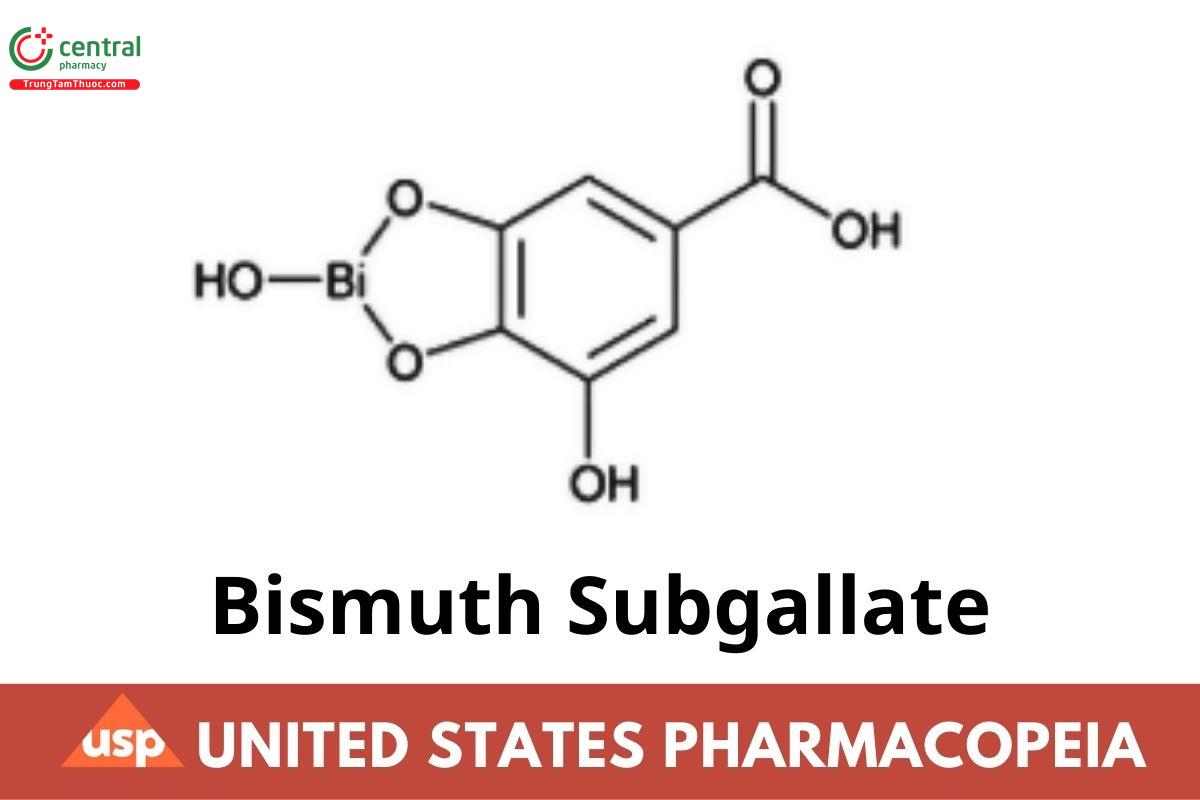
Bismuth Subgallate
If you find any inaccurate information, please let us know by providing your feedback here

Tóm tắt nội dung
This article is compiled based on the United States Pharmacopeia (USP) – 2025 Edition
Issued and maintained by the United States Pharmacopeial Convention (USP)
C7H5BiO6 394.09
Gallic acid bismuth basic salt CAS RN®: 99-26-3; UNII: YIW503M17V.
1 DEFINITION
Bismuth Subgallate is a basic salt that, when dried at 105° for 3 h, contains the equivalent of NLT 52.0% and NMT 57.0% of bismuth trioxide (Bi2O3).
2 IDENTIFICATION
2.1 A. IDENTIFICATION TESTS-GENERAL, Bismuth (191)
Sample: When heated to redness, it at first chars, leaving finally a yellow residue. Use the residue for analysis.
Acceptance criteria: Meets the requirements
2.2 B.
Sample: 100 mg
Analysis: Agitate the Sample thoroughly with an excess of hydrogen sulfide TS, filter, and boil the filtrate to expel the dissolved gas. Cool, and add 1 drop of ferric chloride TS.
Acceptance criteria: A purplish blue mixture is produced.
3 ASSAY
3.1 PROCEDURE
Sample solution: Dry 1 g of Bismuth Subgallate at 105° for 3 h, then weigh and ignite in a porcelain crucible. Allow it to cool, and add nitric acid to the residue, dropwise, warming until complete solution has been effected.
Analysis: Evaporate the Sample solution to dryness, and carefully ignite the residue to constant weight. From the weight of the residue, determine the percentage of Bi₂O, in the portion of Bismuth Subgallate taken.
Acceptance criteria: 52.0%-57.0% on the dried basis
4 IMPURITIES
Change to read:
4.1 ARSENIC (211), Procedures, Procedure 1 (CN 1-JUN-2023)
Test preparation: 400 mg
Analysis: Triturate the Test preparation with 400 mg of calcium hydroxide, and ignite. Dissolve the residue in 5 mL of 3 N hydrochloric acid.
Acceptance criteria: NMT 7.5 ppm; the solution, without further treatment, meets the requirements.
4.2 LIMIT OF NITRATE
Sample: 100 mg
Analysis: Mix the Sample with 5 mL of 2N sulfuric acid and 5 mL of ferrous sulfate TS, filter the mixture, and carefully superimpose the filtrate, without mixing, on 5 mL of sulfuric acid, in a test tube.
Acceptance criteria: No reddish brown color appears at the zone of contact of the two liquids.
4.3 LIMITS OF COPPER, LEAD, AND SILVER
Sample: 3 g
Analysis: Ignite the Sample in a porcelain crucible, cool, and cautiously add, dropwise, just sufficient nitric acid to dissolve the residue upon warming. Evaporate the solution to dryness, again ignite, and cool. Cautiously dissolve the residue in just sufficient nitric acid with the aid of gentle heat, concentrate the solution to about 4 mL, and pour it into 100 mL of water. Filter, evaporate the filtrate on a steam bath to 20 mL, again filter, and divide this filtrate into portions of 5 mL each.
Acceptance criteria
Copper: To 5 mL of the filtrate add a slight excess of 6 N ammonium hydroxide: the liquid does not exhibit a bluish color.
Lead: To 5 mL of the filtrate add 5 mL of 2 N sulfuric acid: the liquid does not become cloudy.
Silver: To 5 mL of the filtrate add hydrochloric acid, dropwise: no precipitate is formed that is insoluble in a slight excess of hydrochloric acid, but that is soluble in 6 N ammonium hydroxide.
4.4 LIMIT OF ALKALIES AND ALKALINE EARTHS
Sample: 1.0 g
Analysis: Boil the Sample with 20 mL of a mixture of equal volumes of 6 N acetic acid and water, cool, and filter. Precipitate the bismuth from the filtrate by the addition of hydrogen sulfide, boil the mixture, and filter. Add 5 drops of sulfuric acid to the filtrate, evaporate to dryness, and ignite to constant weight. Weigh the residue.
Acceptance criteria: NMT 5 mg (0.5%)
4.5 LIMIT OF FREE GALLIC ACID
Sample: 1.0 g
Analysis: Shake the Sample with 20 mL of alcohol for 1 min, filter, and evaporate the filtrate to dryness on a steam bath, then dry the residue at 105° for 1 h. Weigh the residue.
Acceptance criteria: NMT 5 mg (0.5%)
5 SPECIFIC TESTS
LOSS ON DRYING (731)
Analysis: Dry a sample at 105° for 3 h.
Acceptance criteria: NMT 7.0%
6 ADDITIONAL REQUIREMENTS
PACKAGING AND STORAGE: Preserve in tight, light-resistant containers.

