
Betahistine Hydrochloride
If you find any inaccurate information, please let us know by providing your feedback here
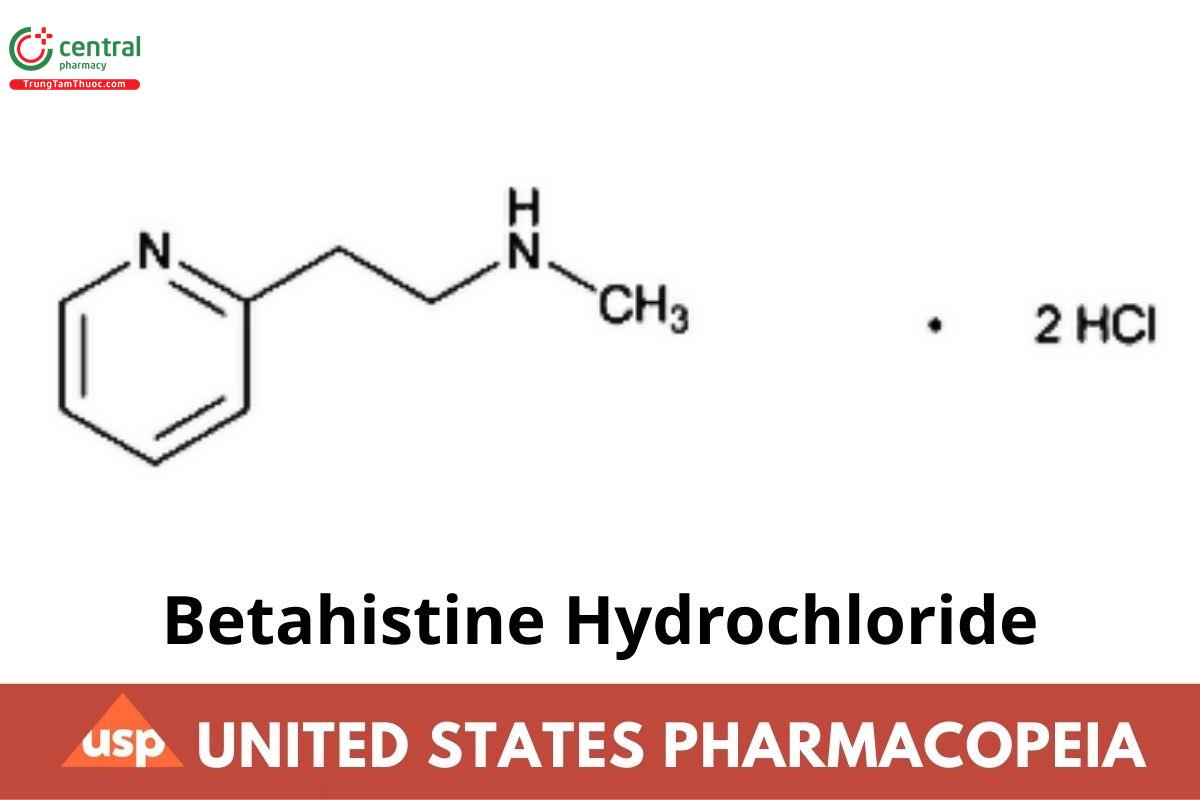

This article is compiled based on the United States Pharmacopeia (USP) – 2025 Edition
Issued and maintained by the United States Pharmacopeial Convention (USP)
C8H12N2 · 2HCl 209.12
2-Pyridineethanamine, N-methyl-, dihydrochloride;
2-[2-(Methylamino)ethyl]pyridine, dihydrochloride CAS RN: 5579-84-0.
1 DEFINITION
Betahistine Hydrochloride contains NLT 99.0% and NMT 101.0% of betahistine hydrochloride (C8H12N2 · 2HCl), calculated on the dried basis.
2 IDENTIFICATION
Change to read:
A. SPECTROSCOPIC IDENTIFICATION TESTS (197), Infrared Spectroscopy: 197A or 197K (CN 1-May-2020)
Meets the requirements.
B. The retention time of the major peak of the Sample solution corresponds to that of the Standard solution, as obtained in the Assay.
C. IDENTIFICATION TESTS-GENERAL (191), Chemical Identification Tests, Chloride: Meets the requirements
3 ASSAY
PROCEDURE
Solution A: 0.69 mg/mL of ammonium acetate in water. Adjust with glacial acetic acid to a pH of 4.7.
Mobile phase: Acetonitrile and Solution A containing 2.88 mg/mL of sodium lauryl sulfate (7:13)
Standard solution: 0.38 mg/mL of USP Betahistine Hydrochloride RS in Mobile phase
Sample solution: 0.38 mg/mL of Betahistine Hydrochloride in Mobile phase
Chromatographic system
(See Chromatography (621), System Suitability.)
Mode: LC
Detector: UV 254 nm
Column: 3.0-mm x 15-cm; 5-µm packing L1
Column temperature: 40°
Flow rate: 0.5 mL/min
Injection volume: 10 µL
System suitability
Sample: Standard solution
Suitability requirements
Tailing factor: NMT 2.0
Relative standard deviation: NMT 0.73%
Analysis
Samples: Standard solution and Sample solution
Calculate the percentage of betahistine hydrochloride (C8H12N2 · 2HCl) in the portion of Betahistine Hydrochloride taken:
Result = (ru /rs ) × (Cs /Cu ) × 100
ru = peak response of betahistine from the Sample solution
rs = peak response of betahistine from the Standard solution
Cs = concentration of USP Betahistine Hydrochloride RS in the Standard solution (mg/mL)
Cu = concentration of Betahistine Hydrochloride in the Sample solution (mg/mL)
Acceptance criteria: 99.0%–101.0% on the dried basis
4 IMPURITIES
RESIDUE ON IGNITION (281): NMT 0.1%
ORGANIC IMPURITIES
Solution A, Mobile phase, Sample solution, and Chromatographic system: Proceed as directed in the Assay.
Analysis
Sample: Sample solution
Calculate the percentage of each impurity in the portion of Betahistine Hydrochloride taken:
Result = (rU /rT ) × 1/F × 100
rU = peak response of each impurity from the Sample solution
rT = sum of all the peak responses from the Sample solution
F = relative response factor of each impurity (see Table 1); 1.0 for all other peaks
Acceptance criteria: See Table 1.
Table 1
Name | Relative Retention Time | Relative Response Factor | Acceptance Criteria, NMT (%) |
| 2-(2-Hydroxyethyl) pyridinea | 0.3 | 1.5 | 1.5 |
| 2-Vinylpyridinea | 0.4 | 2.0 | 1.5 |
| N-Methyl-N,N-bis(2-pyridin-2-ylethyl) amineb | 2.4 | 1.1 | 1.5 |
| Any unspecied impurity | - | - | 0.15 |
| Total impurities | - | - | 0.5 |
a This impurity is a hydrochloride salt.
b This impurity exists as a trihydrochloride.
5 SPECIFIC TESTS
PH (791).
Sample: 100 mg/mL of Betahistine Hydrochloride in water
Acceptance criteria: 2.0-3.0
LOSS ON DRYING (731)
Analysis: Dry between 100o and 105o to constant weight.
Acceptance criteria: NMT 1.0%
6 ADDITIONAL REQUIREMENTS
USP REFERENCE STANDARDS (11)
USP Betahistine Hydrochloride RS

