
Azelastine Hydrochloride
If you find any inaccurate information, please let us know by providing your feedback here

Tóm tắt nội dung
This article is compiled based on the United States Pharmacopeia (USP) – 2025 Edition
Issued and maintained by the United States Pharmacopeial Convention (USP)
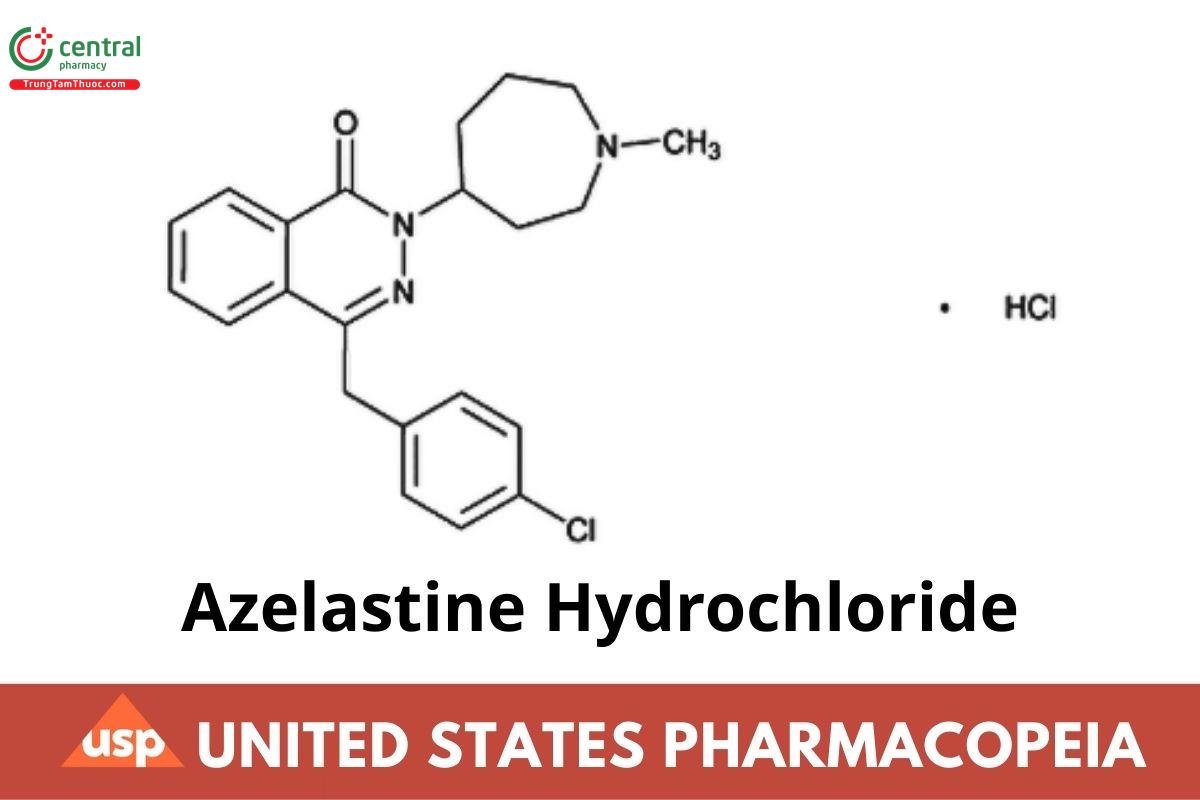
C22H24CIN3O . HCI 418.36
1(2H)-Phthalazinone, 4-[(4-chlorophenyl)methyl]-2-(hexahydro-1-methyl-1H-azepin-4-yl), monohydrochloride;
4-(p-Chlorobenzyl)-2-(hexahydro-1-methyl-1H-azepin-4-yl)-1(2H)-phthalazinone monohydrochloride CAS RN®: 79307-93-0.
UNII: OL591QR101
1 DEFINITION
Azelastine Hydrochloride contains NLT 99.0% and NMT 101.0% of azelastine hydrochloride (C22H24CIN3O . HCI), calculated on the dried basis.
2 IDENTIFICATION
A. SPECTROSCOPIC IDENTIFICATION TESTS (197), Infrared Spectroscopy: 197K
B. The retention time of the major peak of the Sample solution corresponds to that of the Identification solution, as obtained in the test for Organic Impurities.
C. IDENTIFICATION TESTS-GENERAL (191), Chemical Identification Tests, Chloride: Meets the requirements
3 ASSAY
Change to read:
3.1 PROCEDURE
Sample: 300 mg
Blank: 5 mL of anhydrous formic acid and 30 mL of acetic anhydride
Titrimetric system
(See Titrimetry (541).)
Mode: Direct titration
Titrant: 0.1 N perchloric acid in glacial acetic acid VS (USP 1-Dec-2021)
Endpoint detection: Potentiometric
Analysis: In order to avoid overheating in the reaction medium, mix thoroughly throughout and stop the titration immediately after the
endpoint has been reached.
Dissolve the Sample in 5 mL of anhydrous formic acid, and add 30 mL of acetic anhydride. Titrate with Titrant.
Calculate the percentage of azelastine hydrochloride (C22H24CIN3O . HCI) in the portion of Azelastine Hydrochloride taken:
Result = {[(VS -VB) x N x F]/W} x 100
VS = Titrant volume consumed by the Sample (mL)
VB = Titrant volume consumed by the Blank (mL)
N = actual normality of the Titrant (mEq/mL)
F = equivalency factor, 418.4 (USP 1-Dec-2021) mg/mEq
W = weight of the Sample (mg)
Acceptance criteria: 99.0%-101.0% on the dried basis
4 IMPURITIES
4.1 RESIDUE ON IGNITION (281)
NMT 0.2%
Change to read:
4.2 ORGANIC IMPURITIES
Solution A: 127 mL/L of phosphoric acid in water (USP 1-Dec-2021)
Buffer: 2.9 g/L of octanesulfonic acid sodium salt and 0.9 g/L of monobasic potassium phosphate in water. Adjust with Solution A to a pH of 3.0. (USP 1-Dec-2021)
Mobile phase: Acetonitrile and Buffer (23:77) (USP 1-Dec-2021)
Diluent: Acetonitrile and water (45:55)
Identification solution: 2.5 mg/mL of USP Azelastine Hydrochloride RS in Diluent. [NOTE-This solution is used for Identification B.]
System suitability stock solution: 0.5 mg/mL each of benzoyl hydrazide, (USP 1-Dec-2021) USP Azelastine Related Compound B RS.
chlorophenylacetylbenzoic acid, (USP 1-Dec-2021) USP Azelastine Related Compound D RS, and USP Azelastine Related Compound E RS in
acetonitrile. [NOTE-The concentration of each related compound is in terms of the free form.] (USP 1-DEC-2021)
System suitability solution: 0.05 mg/mL (USP 1-Dec-2021) each of benzoyl hydrazide, (USP 1-Dec-2021) USP Azelastine Related Compound B RS, chlorophenylacetylbenzoic acid, (USP 1-Dec-2021) USP Azelastine Related Compound D RS, and USP Azelastine Related Compound E RS from the System suitability stock solution and 2.5 mg/mL of USP Azelastine Hydrochloride RS in Diluent. [NOTE-The concentration of
each related compound is in terms of the free form.) (USP 1-DEC-2021)
Standard stock solution: 0.05 mg/mL (USP 1-Dec-2021) of USP Azelastine Hydrochloride RS in acetonitrile
Standard solution: 0.0025 mg/mL (USP 1-Dec-2021) of USP Azelastine Hydrochloride RS in Diluent
Sensitivity solution: 0.0013 mg/mL of USP Azelastine Hydrochloride RS in Diluent from the Standard solution (USP 1-Dec-2021)
Sample solution: 2.5 mg/mL of Azelastine Hydrochloride in Diluent
Chromatographic system
(See Chromatography (621), System Suitability.)
Mode: LC
Detector: UV 210 nm
Column: 4.6-mm × 25-cm; 5-µm packing (USP 1-Dec-2021) L10
Column: 4.6-mm x 25-cm; 5-µm packing (USP 1-Dec-2021) L10
Column temperature: 30°
Flow rate: 2 mL/min
Injection volume: 10 µL
Run time: ANLT (USP 1-Dec-2021) 2.4 times the retention time of azelastine
System suitability
Samples: System suitability solution and Standard solution
[NOTE-See Table 1 for the relative retention times.) (USP 1-DEC-2021)
Suitability requirements
Resolution: NLT 1.5 between benzoyl hydrazide and azelastine related compound B; NLT 1.5 between chlorophenylacetylbenzoic acid and azelastine related compound D; (USP 1-Dec-2021) NLT 1.5 between azelastine related compound D and azelastine; NLT 1.5 between azelastine and azelastine related compound E, System suitability solution
Tailing factor: 0.9-2.0, Standard solution (USP 1-Dec-2021)
Relative standard deviation: NMT 5.0%, Standard solution
Signal-to-noise ratio: NLT 10, Sensitivity solution (USP 1-Dec-2021)
Analysis
Samples: (USP 1-Dec-2021) Standard solution and Sample solution
Calculate the percentage of each impurity in the portion of Azelastine Hydrochloride taken:
Result = (rU/rS) × (CS/CU) × (1/F) × 100
rU = peak area of each impurity from the Sample solution
rS = peak area of azelastine from the Standard solution
CS = concentration of USP Azelastine Hydrochloride RS in the Standard solution (mg/mL)
CU = concentration of Azelastine Hydrochloride in the Sample solution (mg/mL)
F = relative response factor (see Table 1)
Acceptance criteria: See Table 1. The reporting threshold is 0.05% (USP 1-Dec-2021)
Table 1
| Name | Relative Retention Time | Relative Response Factor | Acceptance Criteria, NMT (%) |
| Benzoyl hydrazidea | 0.15 (USP 1-Dec-2021) | 0.38 | 0.1 |
| Azelastine related compound B (USP 1-Dec-2021) | 0.20 (USP 1-Dec-2021) | 0.22 | 0.1 |
| Chlorophenylacetylbenzoic acidb | 0.48 | 0.56 (USP 1-Dec-2021) | 0.1 |
| Azelastine related compound D (USP 1-Dec-2021) | 0.54 (USP 1-Dec-2021) | 1.2 | 0.1 |
| Azelastine | 1.0 | 1.0 | - |
| Azelastine related compound E (USP 1-Dec-2021) | 1.4 | 0.48 | 0.1 |
| Any individual unspecified impurity | - | 1.0 | 0.10 |
| Total impurities | - | - | 0.2 |
a Benzohydrazide.
b 2-[2-(4-Chlorophenyl)acetyl benzoic acid.
5 SPECIFIC TESTS
5.1 LOSS ON DRYING (731)
Analysis: Dry at 105° to constant weight.
Acceptance criteria: NMT 1.0%
Delete the following:
5.2 ACIDITY OR ALKALINITY
Sample solution: 10 mg/mL of Azelastine Hydrochloride in water
Analysis: Add 0.2 mL of bromothymol blue TS to 10 mL of the Sample solution.
Acceptance criteria: NMT 0.1 mL of 0.01 M hydrochloric acid or 0.01 M sodium hydroxide is required to produce a color change. (USP 1-Dec-2021)
6 ADDITIONAL REQUIREMENTS
6.1 PACKAGING AND STORAGE
Preserve in well-closed containers. Protect from light and moisture. Store at controlled room temperature.
Change to read:
6.2 USP REFERENCE STANDARDS (11)
USP Azelastine Hydrochloride RS
USP Azelastine Related Compound B RS
N'-(1-Methylazepan-4-yl)benzohydrazide hydrochloride.
C14H21N3O . HCI 283.80 (USP 1-Dec-2021)
USP Azelastine Related Compound D RS
4-(4-Chlorobenzyl)phthalazin-1(2H)-one.
C15H11CIN2O 270.71
USP Azelastine Related Compound E RS
3-(4-Chlorobenzylidene)isobenzofuran-1(3H)-one.
C15H9OCIO2 256.68

