
Atropine Sulfate
If you find any inaccurate information, please let us know by providing your feedback here
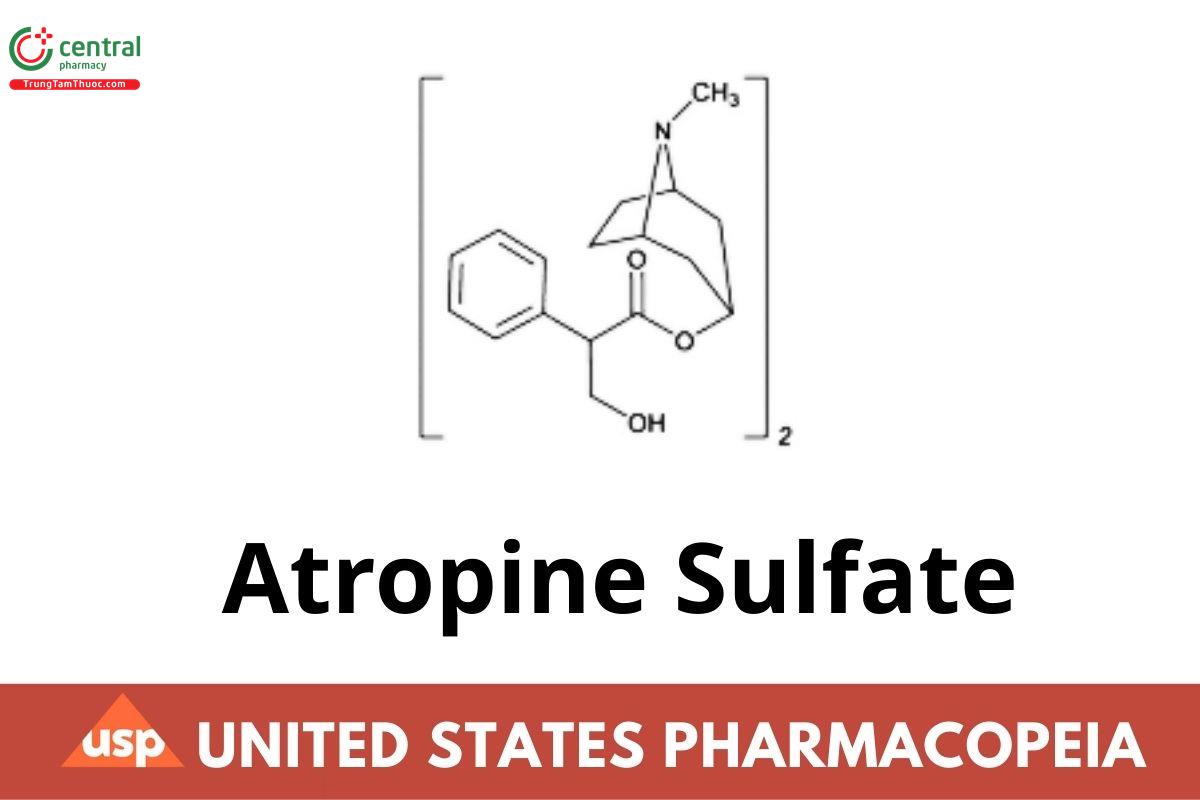

This article is compiled based on the United States Pharmacopeia (USP) – 2025 Edition
Issued and maintained by the United States Pharmacopeial Convention (USP)
Atropine Sulfate
Change to read:
(C₁₇H₂₃NO₃)₂·H₂SO₄·H₂O ▲694.84▲ (ERR 1-Jul-2020)
Anhydrous 676.82
Benzeneacetic acid, α-(hydroxymethyl)-, 8-methyl-8-azabicyclo[3.2.1]oct-3-yl ester, endo-(±)-, sulfate (2:1) (salt), monohydrate;
1αH,5αH-Tropan-3-α-ol (±)-tropate (ester), sulfate (2:1) (salt) monohydrate
CAS RN®: 5908-99-6; UNII: 03J5ZE7KA5.
Anhydrous CAS RN®: 55-48-1; UNII: KAE4PSB0Z3.
1 DEFINITION
Atropine Sulfate contains NLT 98.0% and NMT 102.0% of atropine sulfate (C₁₇H₂₃NO₃)₂·H₂SO₄ calculated on the anhydrous basis.
[Caution—Handle atropine sulfate with exceptional care, because it is highly potent.]
2 IDENTIFICATION
A. Spectroscopic Identification Tests 〈197〉, Infrared Spectroscopy: 197K or 197A
B. Identification Tests—General 〈191〉, Chemical Identification Tests, Sulfate
Sample solution: 50 mg/mL
Acceptance criteria: Meets the requirements
C. The retention time of the major peak of the Sample solution corresponds to that of the System suitability solution, as obtained in the Assay.
3 ASSAY
Procedure
Buffer: 1.8 g/L of monobasic potassium phosphate and 2.5 g/L of sodium 1-pentanesulfonate, adjusted with phosphoric acid to a pH of 2.5
Diluent: Acetonitrile and Buffer (20:80)
Solution A: Acetonitrile and Buffer (5:95)
Solution B: Acetonitrile and Buffer (80:20)
Mobile phase: See Table 1.
| Time (min) | Solution A (%) | Solution B (%) |
| 0 | 92 | 8 |
| 11 | 79 | 21 |
| 15 | 46 | 54 |
| 15.1 | 92 | 8 |
| 20 | 92 | 8 |
[Note—The gradient was established on an HPLC system with a dwell volume of approximately 0.8 mL.]
System suitability solution: 1 µg/mL of USP Hyoscyamine Related Compound A RS and 0.5 mg/mL of USP Atropine Sulfate RS in Diluent
Sensitivity solution: 0.25 µg/mL of USP Atropine Sulfate RS in Diluent
Standard solution: 0.5 mg/mL of USP Atropine Sulfate RS in Diluent
Sample solution: 0.5 mg/mL of Atropine Sulfate in Diluent
Chromatographic system
(See Chromatography 〈621〉, System Suitability.)
Mode: LC
Detector: UV 210 nm
Column: 4.6-mm × 15-cm; 3-µm packing L1
Column temperature: 50°
Flow rate: 2 mL/min
Injection volume: 5 µL
System suitability
Samples: System suitability solution, Sensitivity solution, and Standard solution
[Note—See Table 2 for the relative retention times.]
Suitability requirements
Resolution: NLT 1.4 between hyoscyamine related compound A and atropine, System suitability solution
Tailing factor: 0.8–1.8 for atropine, System suitability solution
Relative standard deviation: NMT 0.73%, Standard solution
Signal-to-noise ratio: NLT 10 for atropine, Sensitivity solution
Analysis
Samples: Standard solution and Sample solution
Calculate the percentage of atropine sulfate (C₁₇H₂₃NO₃)₂·H₂SO₄·H₂O
in the portion of Atropine Sulfate taken:
Result = (rᵤ/rₛ) × (Cₛ/Cᵤ) × 100
rᵤ = peak response of atropine from the Sample solution
rₛ = peak response of atropine from the Standard solution
Cₛ = concentration of USP Atropine Sulfate RS in the Standard solution (mg/mL)
Cᵤ = concentration of Atropine Sulfate in the Sample solution (mg/mL)
Acceptance criteria: 98.0%–102.0% on the anhydrous basis
4 IMPURITIES
Residue on Ignition 〈281〉: NMT 0.2%
Organic Impurities
Buffer, Diluent, Solution A, Solution B, Mobile phase, System suitability solution, Sensitivity solution, Standard solution, Sample solution, Chromatographic system, and System suitability: Proceed as directed in the Assay.
Analysis
Sample: Sample solution
Calculate the percentage of each impurity in the portion of Atropine Sulfate taken:
Result = (rᵢ/rₜ) × (1/F) × 100
rᵢ = peak response of each impurity from the Sample solution
rₜ = sum of all the peak responses from the Sample solution
F = relative response factor for each impurity (see Table 2)
Acceptance criteria: See Table 2. The reporting threshold is 0.05%.
| Name | Relative Retention Time | Relative Response Factor | Acceptance Criteria, NMT (%) |
| Tropic acidᵃ | 0.56 | 2.1 | 0.2 |
| 7-Hydroxyhyoscyamineᵇ | 0.66 | 1.0 | 0.2 |
| Scopolamineᶜ | 0.72 | 1.0 | 0.2 |
| 6-Hydroxyhyoscyamineᵈ | 0.75 | 1.0 | 0.2 |
| Hyoscyamine related comp. A | 0.97 | 1.2 | 0.3 |
| Atropine | 1.0 | 1.0 | — |
| Littorineᵉ | 1.13 | 1.2 | 0.2 |
| Apoatropineᶠ | 1.60 | 2.0 | 0.2 |
| Any individual, unspecified impurity | — | 1.0 | 0.1 |
| Total impurities | — | — | 0.5 |
a 3-Hydroxy-2-phenylpropanoic acid; also known as (2RS)-3-Hydroxy-2-phenylpropanoic acid.
b (1S,3R,5S)-6-Hydroxy-8-methyl-8-azabicyclo[3.2.1]oct-3-yl (S)-3-hydroxy-2-phenylpropanoate; also known as (1S,3R,5S,6RS)-6-Hydroxy-8-methyl-8-azabicyclo[3.2.1]oct-3-yl (2S)-3-hydroxy-2-phenylpropanoate.
c (S)-(1R,2R,4S,5S,7s)-9-Methyl-3-oxa-9-azatricyclo[3.3.1.02,4]nonan-7-yl 3-hydroxy-2-phenylpropanoate; also known as (S)-(1R,2R,4S,5S,7s)-9-Methyl-3-oxa-9-azatricyclo[3.3.1.02,4]non-7-yl (2S)-3-hydroxy-2-phenylpropanoate.
d (1R,3S,5R)-6-Hydroxy-8-methyl-8-azabicyclo[3.2.1]octan-3-yl (S)-3-hydroxy-2-phenylpropanoate; also known as (1R,3S,5R,6RS)-6-Hydroxy-8-methyl-8-azabicyclo[3.2.1]oct-3-yl (2S)-3-hydroxy-2-phenylpropanoate.
e (1R,3r,5S)-8-Methyl-8-azabicyclo[3.2.1]octan-3-yl 2-hydroxy-3-phenylpropanoate; also known as (1R,3r,5S)-8-Methyl-8-azabicyclo[3.2.1]oct-3-yl (2RS)-2-hydroxy-3-phenylpropanoate.
f (1R,3r,5S)-8-Methyl-8-azabicyclo[3.2.1]octan-3-yl 2-phenylacrylate; also known as (1R,3r,5S)-8-Methyl-8-azabicyclo[3.2.1]oct-3-yl 2-phenylpropenoate.
5 SPECIFIC TESTS
Optical Rotation 〈781S〉, Procedures, Specific Rotation
Sample solution: 0.1 g/mL of Atropine Sulfate in water
Temperature: 20°
Path length: 1.0 or 2.0 dm
Acceptance criteria: Between −0.50° and +0.05°
Water Determination 〈921〉, Method I : NMT 4.0%
6 ADDITIONAL REQUIREMENTS
Packaging and Storage: Preserve in tight, light-resistant containers.
USP Reference Standards 〈11〉
USP Atropine Sulfate RS
USP Hyoscyamine Related Compound A RS
Norhyoscyamine sulfate; (1R,3r,5S)-8-Azabicyclo[3.2.1]octan-3-yl (S)-3-hydroxy-2-phenylpropanoate sulfate (2:1).
(C₁₆H₂₁NO₃)₂·H₂SO₄ 648.77

