
Atropine
If you find any inaccurate information, please let us know by providing your feedback here

Tóm tắt nội dung
This article is compiled based on the United States Pharmacopeia (USP) – 2025 Edition
Issued and maintained by the United States Pharmacopeial Convention (USP)
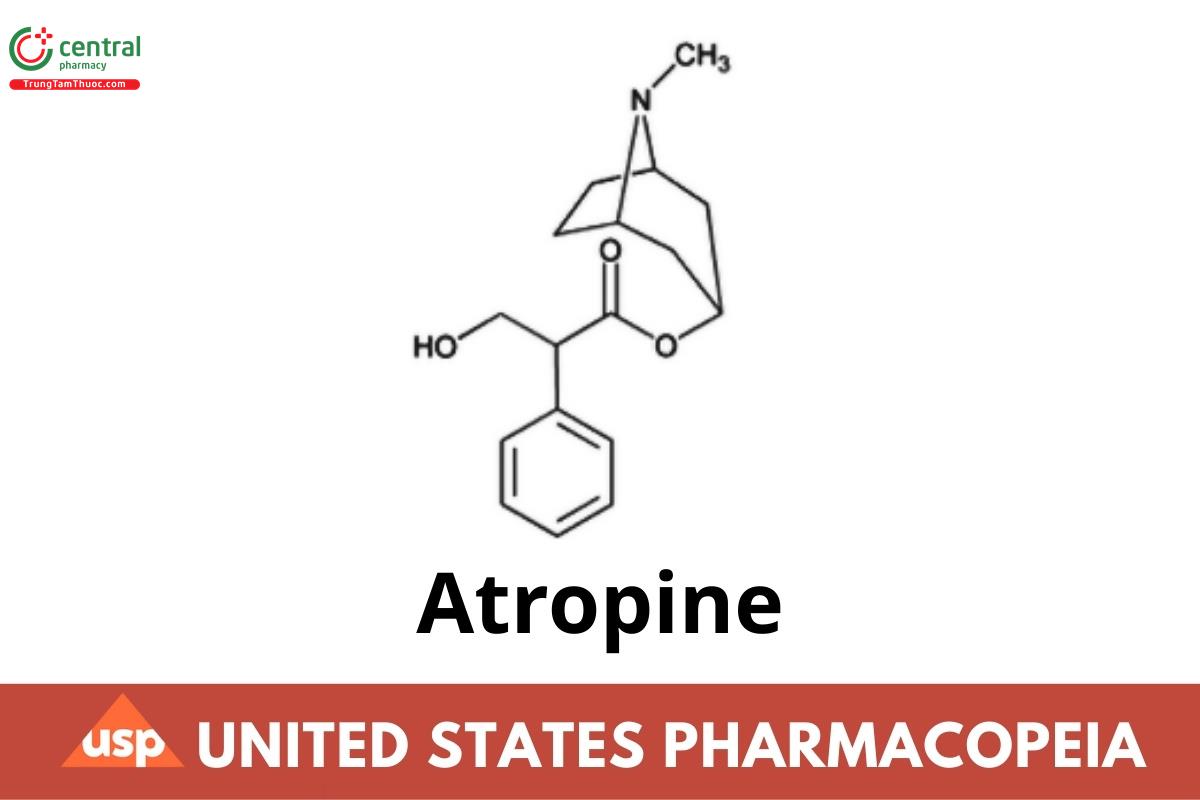
C17H23NO3 289.37
Benzeneacetic acid, a-(hydroxymethyl)-8-methyl-8-azabicyclo[3.2.1]oct-3-yl ester, endo-(+)-;
1αH,5αH-Tropan-3α-ol (±)-tropate (ester) CAS RN®: 51-55-8; UNII: 7C0697DR9I.
1 DEFINITION
Atropine contains NLT 99.0% and NMT 100.5% of atropine (C17H23NO3), calculated on the anhydrous basis. [CAUTION-Handle Atropine with exceptional care, because it is highly potent.]
2 IDENTIFICATION
2.1 A.
Standard: 36 mg of USP Atropine Sulfate RS
Sample: 30 mg
Analysis: Dissolve the Standard and Sample in individual 60-mL separators with the aid of 5-mL portions of water. To each separator add 1.5 mL of 1 N sodium hydroxide solution and 10 mL of chloroform. Shake for 1 min, allow the layers to separate, and pass the chloroform extracts through separate filters of 2 g of anhydrous granular sodium sulfate supported on pledgets of glass wool. Extract each aqueous layer with two additional 10-mL portions of chloroform, filtering and combining with the respective main extracts. Evaporate the chloroform solutions under reduced pressure to dryness, and dissolve each residue in 10 mL of carbon disulfide.
Acceptance criteria: The IR absorption spectrum, determined in a 1-mm cell, of the solution of the Sample exhibits maxima only at the same wavelengths as that of the solution of the Standard.
2.2 B.
Sample solution: A solution (1 in 50) in 3 N hydrochloric acid
Analysis: Add gold chloride TS to the Sample solution.
Acceptance criteria: A lusterless precipitate is formed (distinction from hyoscyamine, which, similarly treated, yields a lustrous precipitate).
3 ASSAY
3.1 PROCEDURE
Sample: 400 mg of Atropine
Analysis: Dissolve the Sample in 50 mL of glacial acetic acid. Titrate with 0.1 N perchloric acid VS to a green endpoint, using 1 drop of crystal violet TS. Perform a blank determination (see Titrimetry (541)). Each mL of 0.1 N perchloric acid is equivalent to 28.94 mg of atropine (C17H23NO3).
Acceptance criteria: 99.0%-100.5% on the anhydrous basis
4 IMPURITIES
4.1 RESIDUE ON IGNITION (281)
NMT 0.1%
4.2 LIMIT OF FOREIGN ALKALOIDS AND OTHER IMPURITIES
Standard solution: 24 mg/mL of USP Atropine Sulfate RS in methanol
Sample solution A: 20 mg/mL of Atropine in methanol
Sample solution B: 1 mg/mL of Atropine in methanol
Chromatographic system
(See Chromatography (621), Thin-Layer Chromatography.)
Mode: TLC
Adsorbent: 0.5-mm layer of chromatographic silica gel
Application volume: See Analysis.
Developing solvent system: Chloroform, acetone, and diethylamine (5:4:1)
Spray reagent: Potassium iodoplatinate TS
Analysis
Samples: Standard solution, 5 µL; Sample solution A, 25 µL; Sample solution B, 1 µL
Apply the Samples to the TLC plate. Allow the spots to dry, and develop the chromatogram in the Developing solvent system until the solvent front has moved three-fourths of the length of the plate. Allow the solvent to evaporate. Locate the spots on the plate by spraying with Spray reagent.
Acceptance criteria: NMT 0.2%; the R, value of the principal spot of each Sample solution corresponds to that of the Standard solution; no secondary spot of Sample solution A exhibits intensity equal to or greater than the principal spot of Sample solution B.
4.3 READILY CARBONIZABLE SUBSTANCES TEST (271)
Sample solution: 200 mg in 5 mL of 2 N sulfuric acid
Acceptance criteria: The solution has no more color than Matching Fluid A, and the solution is colored no more than light yellow upon the addition of 0.2 mL of nitric acid.
5 SPECIFIC TESTS
OPTICAL ROTATION, Angular Rotation(781)
Sample solution: 1 g, previously dried at 105° for 1 h, in sufficient 50% alcohol (w/w) to obtain a volume of 20 mL at 25° (using a 200-mm tube)
Acceptance criteria: -0.70° to +0.05° (limit of hyoscyamine)
MELTING RANGE OR TEMPERATURE (741): 114°-118°
WATER DETERMINATION, Method (921): NMT 0.2%
6 ADDITIONAL REQUIREMENTS
PACKAGING AND STORAGE: Preserve in tight, light-resistant containers.
USP REFERENCE STANDARDS (11)
USP Atropine Sulfate RS

