
Atracurium Besylate
If you find any inaccurate information, please let us know by providing your feedback here
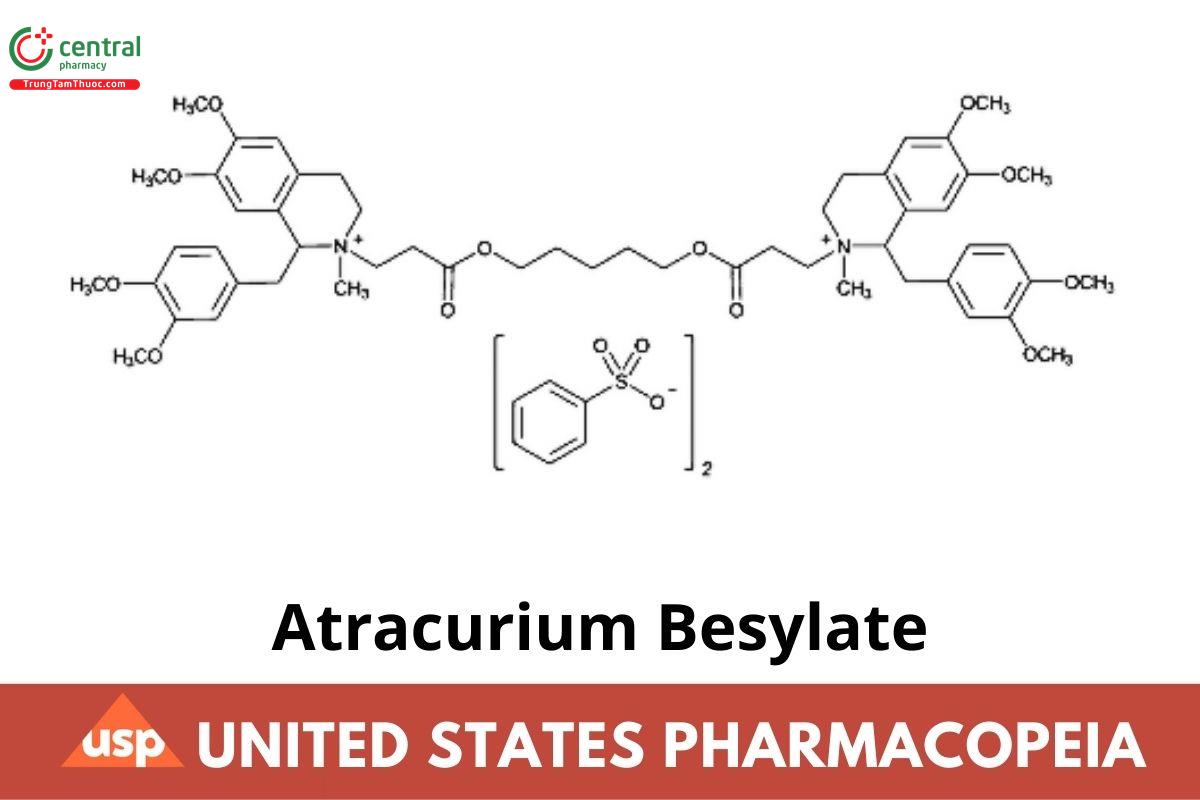

This article is compiled based on the United States Pharmacopeia (USP) – 2025 Edition
Issued and maintained by the United States Pharmacopeial Convention (USP)
Atracurium Besylate
C₆₅H₈₂N₂O₁₈S₂ 1243.48
Isoquinolinium, 2,2′-[1,5-pentanediylbis[oxy(3-oxo-3,1-propanediyl)]]bis[1-[(3,4-dimethoxyphenyl)methyl]-1,2,3,4-tetrahydro-6,7-dimethoxy-2-methyl-, dibenzenesulfonate;
2-(2-Carboxyethyl)-1,2,3,4-tetrahydro-6,7-dimethoxy-2-methyl-1-veratrylisoquinolinium benzenesulfonate, pentamethylene ester
CAS RN®: 64228-81-5; UNII: 40AX66P76P.
1 DEFINITION
Atracurium besylate contains NLT 96.0% and NMT 102.0% of C₆₅H₈₂N₂O₁₈S₂, calculated on the anhydrous basis.
It contains NLT 5.0% and NMT 6.5% of the trans-trans isomer, NLT 34.5% and NMT 38.5% of the cis-trans isomer, and NLT 55.0% and NMT 60.0% of the cis-cis isomer.
2 IDENTIFICATION
A. Spectroscopic Identification Tests 〈197〉, Infrared Spectroscopy: 197K
B. The retention times of the three main isomeric peaks of the Sample solution correspond to those of the Standard solution, as obtained in the Assay.
3 ASSAY
Procedure
Buffer: 10.2 g of monobasic potassium phosphate in a 1000-mL volumetric flask. Dissolve in 950 mL of water. While stirring, adjust with phosphoric acid to a pH of 3.1, and dilute with water to volume.
Solution A: Acetonitrile, methanol, and Buffer (20:5:75)
Solution B: Acetonitrile, methanol, and Buffer (20:30:50)
Mobile phase: See Table 1.
| Time (min) | Solution A (%) | Solution B (%) |
|---|---|---|
| 0 | 80 | 20 |
| 5 | 80 | 20 |
| 15 | 40 | 60 |
| 25 | 40 | 60 |
| 30 | 0 | 100 |
| 45 | 0 | 100 |
| 50 | 80 | 20 |
Standard solution: 1 mg/mL of USP Atracurium Besylate RS in Solution A
Sample solution: 1 mg/mL of Atracurium Besylate in Solution A
Chromatographic system
Mode: LC
Detector: UV 280 nm
Column: 4.6-mm × 25-cm; 5-µm base-deactivated packing L1
Flow rate: 1 mL/min
Injection size: 20 µL
System suitability
Sample: Standard solution
Resolution: NLT 1.5 between the atracurium trans-trans isomer and the cis-trans isomer peaks; NLT 1.5 between the atracurium cis-trans isomer and the cis-cis isomer peaks
Relative standard deviation: NMT 2.0%, for the cis-cis isomer peak
Analysis
Calculate the percentage of atracurium besylate (C₆₅H₈₂N₂O₁₈S₂) in the portion of Atracurium Besylate taken:
Result = (rU / rS) × (CS / CU) × 100
rU = sum of the peak responses for the trans-trans isomer, the trans-cis isomer, and the cis-cis isomer from the Sample solution
rS= sum of the peak responses for the trans-trans isomer, the trans-cis isomer, and the cis-cis isomer from the Standard solution
CS = concentration of USP Atracurium Besylate RS in the Standard solution (mg/mL)
CU= concentration of Atracurium Besylate in the Sample solution (mg/mL)
Acceptance criteria: 96.0%–102.0%, calculated on the anhydrous basis. It contains NLT 5.0% and NMT 6.5% of the trans-trans isomer, NLT 34.5% and NMT 38.5% of the cis-trans isomer, and NLT 55.0% and NMT 60.0% of the cis-cis isomer
4 IMPURITIES
Residue on Ignition 〈281〉: NMT 0.2%
Organic Impurities
Buffer, Solution A, Solution B, Mobile phase, Chromatographic system, and Sample solution: Proceed as directed in the Assay.
Standard solution: 0.01 mg/mL of USP Atracurium Besylate RS in Solution A
System suitability solution: 1 mg/mL of USP Atracurium Besylate RS in Solution A
System suitability
Resolution: NLT 1.5 between the atracurium trans-trans isomer and the cis-trans isomer peaks; NLT 1.5 between the atracurium cis-trans isomer and the cis-cis isomer peaks
Analysis
Calculate the percentage of each impurity in the portion of Atracurium Besylate taken:
Result = (rU / rS) × (CS / CU)× (1/F) × 100
rU = peak response for each impurity from the Sample solution
rS= sum of peak responses due to the atracurium cis-cis, trans-trans, and cis-trans isomers from the Standard solution
CS = concentration of USP Atracurium Besylate RS in the Standard solution (mg/mL)
CU= concentration of Atracurium Besylate in the Sample solution (mg/mL)
F = relative response factor (see Table 2)
Acceptance criteria: See Table 2. Disregard any peak less than 0.05%.
| Name | Relative Retention Time | Relative Response Factor | Acceptance Criteria, NMT (%) |
| Impurity Eᵃ | 0.2 | 1.0 | 1.5 |
| Impurity Fᵇ | 0.25 | 1.0 | 1.0 |
| Impurity G (laudanosine)ᶜ | 0.3 | 2.0 | 1.0 |
| Impurity D | 0.45ᵈ and 0.5ᵉ | 1.0 | 1.5ᵖ |
| Atracurium trans-trans isomer | 0.8 | — | — |
| Atracurium cis-trans isomer | 0.9 | — | — |
| Atracurium cis-cis isomer | 1.0 | — | — |
| Impurity A | 1.04ᶠ and 1.08ⁱ | 1.0 | 1.5ᵖ |
| Impurity I | 1.07ᵍ and 1.12ᵏ | 1.0 | 1.0ᵖ |
| Impurity H | 1.07ʰ and 1.12ˡ | 1.0 | 1.0ᵖ |
| Impurity Kʲ | 1.09 and 1.12 | 1.0 | 1.0ᵖ |
| Impurity Bᵐ | 1.15 | 1.0 | 0.1 |
| Impurity C | 1.2ⁿ and 1.3ᵒ | 1.0 | 1.0ᵖ |
| Any individual impurity | — | 1.0 | 0.1 |
| Total impurities | — | — | 3.5 |
a 3-[1-(3,4-Dimethoxybenzyl)-6,7-dimethoxy-2-methyl-1,2,3,4-tetrahydroisoquinolinio]propanoate.
b 1-(3,4-Dimethoxybenzyl)-6,7-dimethoxy-2,2-dimethyl-1,2,3,4-tetrahydroisoquinolinium.
c 1-(3,4-Dimethoxybenzyl)-6,7-dimethoxy-2-methyl-1,2,3,4-tetrahydroisoquinoline.
d trans Isomer of 1-(3,4-dimethoxybenzyl)-2-[3-[(5-hydroxypentyl)oxy]-3-oxopropyl]-6,7-dimethoxy-2-methyl-1,2,3,4-tetrahydroisoquinolinium.
e cis Isomer of 1-(3,4-dimethoxybenzyl)-2-[3-[(5-hydroxypentyl)oxy]-3-oxopropyl]-6,7-dimethoxy-2-methyl-1,2,3,4-tetrahydroisoquinolinium.
f cis-trans Isomer of 1-(3,4-dimethoxybenzyl)-2-[13-[1-(3,4-dimethoxybenzyl)-6,7-dimethoxy-3,4-dihydroisoquinolin-2(1H)-yl]-3,11-dioxo-4,10- dioxatridecyl]-6,7-dimethoxy-2-methyl-1,2,3,4-tetrahydroisoquinolinium.
g cis-trans Isomer of 2,2′-[(3-methylpentane-1,5)-diylbis[oxy(3-oxopropane-1,3-diyl)]]bis[1-(3,4-dimethoxybenzyl)-6,7-dimethoxy-2-methyl1,2,3,4 tetrahydroisoquinolinium].
h cis-trans Isomer of 2,2′-[hexane-1,6-diylbis[oxy(3-oxopropane-1,3-diyl)]]bis[1-(3,4-dimethoxybenzyl)-6,7-dimethoxy-2-methyl-1,2,3,4-tetrahydroisoquinolinium].
i cis-cis Isomer of 1-(3,4-dimethoxybenzyl)-2-[13-[1-(3,4-dimethoxybenzyl)-6,7-dimethoxy-3,4-dihydroisoquinolin-2(1H)-yl]-3,11-dioxo-4,10- dioxatridecyl]-6,7-dimethoxy-2-methyl-1,2,3,4-tetrahydroisoquinolinium.
j 2,2′-[(Hexane-1,5)-diylbis(3-oxopropane-1,3-diyl)]]bis[1-(3,4-dimethoxybenzyl)-6,7-dimethoxy-2-methyl-1,2,3,4-tetrahydro isoquinolinium].
k cis-cis Isomer of 2,2′-[(3-methylpentane-1,5)-diylbis[oxy(3-oxopropane-1,3-diyl)]]bis[1-(3,4-dimethoxybenzyl)-6,7-dimethoxy-2-methyl1,2,3,4 tetrahydroisoquinolinium].
l cis-cis Isomer of 2,2′-[hexane-1,6-diylbis[oxy(3-oxopropane-1,3-diyl)]]bis[1-(3,4-dimethoxybenzyl)-6,7-dimethoxy-2-methyl-1,2,3,4-tetrahydro isoquinolinium].
m Pentane-1,5-diyl bis[3-[1-(3,4-dimethoxybenzyl)-6,7-dimethoxy-3,4-dihydroisoquinolin-2(1H)-yl)propanoate].
n trans Isomer of 1-(3,4-dimethoxybenzyl)-2-(3,11-dioxo-4,10-dioxatridec-12-enyl)-6,7-dimethoxy-2-methyl-1,2,3,4-tetrahydroisoquinolinium
benzenesulfonate.
o cis Isomer of 1-(3,4-dimethoxybenzyl)-2-(3,11-dioxo-4,10-dioxatridec-12-enyl)-6,7-dimethoxy-2-methyl-1,2,3,4-tetrahydroisoquinolinium benzenesulfonate.
p Impurity consists of two isomers that are separated under these conditions; integrate both peaks for the impurity calculations.
Limit of Impurity J (Methyl Benzenesulfonate)
Buffer, Solution A, and Solution B: Prepare as directed in the Assay.
Standard stock solution: 0.2 mg/mL of Impurity J (methyl benzenesulfonate) in acetonitrile
Standard solution: 1 µg/mL of Impurity J (methyl benzenesulfonate) in Solution A from Standard stock solution
Sample solution: 10 mg/mL of Atracurium Besylate in Solution A
Mobile phase: See Table 3.
| Time (min) | Solution A (%) | Solution B (%) |
| 0 | 80 | 20 |
| 5 | 80 | 20 |
| 15 | 75 | 25 |
| 25 | 75 | 25 |
| 30 | 55 | 45 |
| 38 | 0 | 100 |
| 45 | 0 | 100 |
Mode: LC
Detector: UV 217 nm
Column: 4.6-mm × 25-cm; 5-µm base-deactivated packing L1
Flow rate: 1 mL/min
Injection size: 100 µL
Analysis
Acceptance criteria: NMT 0.01%, the peak response of the Sample solution being NMT that of the Standard solution
5 SPECIFIC TESTS
Water Determination, Method I〈921〉: NMT 5.0%
6 ADDITIONAL REQUIREMENTS
Packaging and Storage: Preserve in tight, light-resistant containers, in a cold place. [Note—Atracurium Besylate is unstable at room temperature.]
USP Reference Standards 〈11〉: USP Atracurium Besylate RS

