
Atovaquone
If you find any inaccurate information, please let us know by providing your feedback here

This article is compiled based on the United States Pharmacopeia (USP) – 2025 Edition
Issued and maintained by the United States Pharmacopeial Convention (USP)
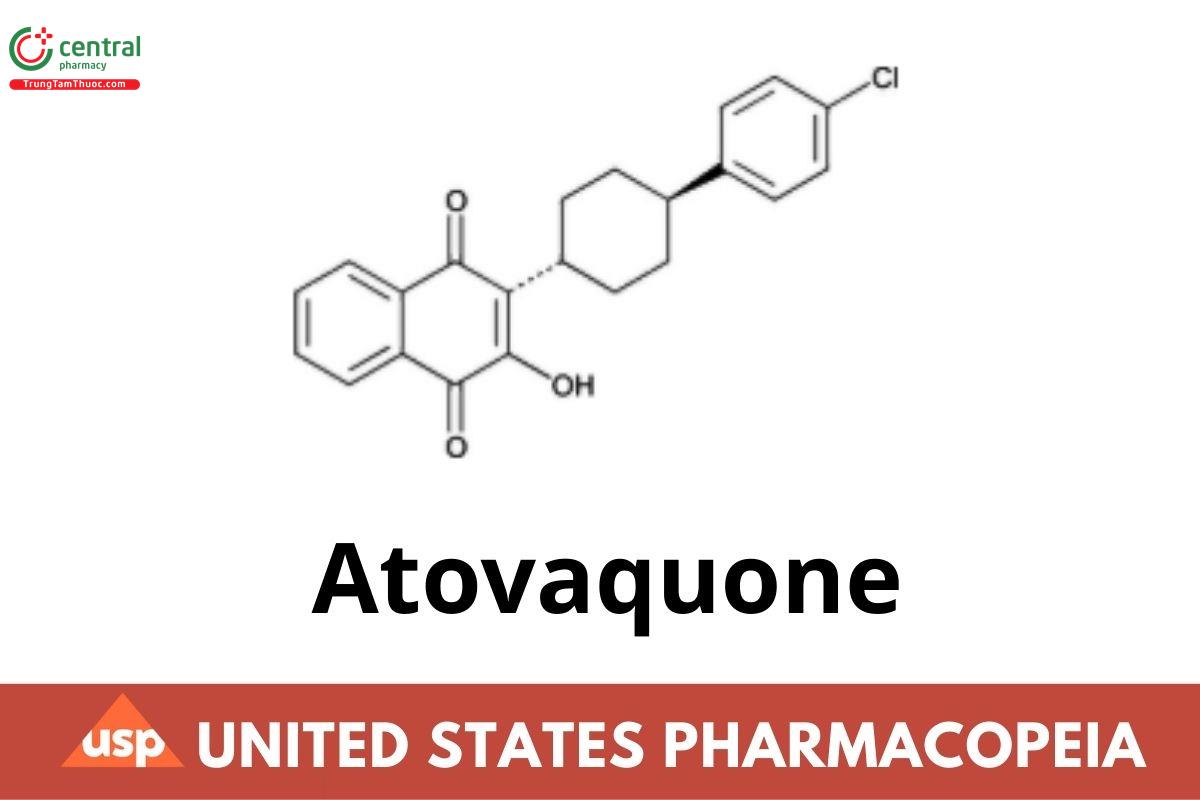
Atovaquone
C₂₂H₁₉ClO₃ 366.84
1,4-Naphthalenedione, 2-[4-(4-chlorophenyl)cyclohexyl]-3-hydroxy-, trans-;
2-[trans-4-(p-Chlorophenyl)cyclohexyl]-3-hydroxy-1,4-naphthoquinone
CAS RN®: 95233-18-4; UNII: Y883P1Z2LT.
1 DEFINITION
Atovaquone contains NLT 97.5% and NMT 101.5% of atovaquone (C₂₂H₁₉ClO₃), calculated on the anhydrous and organic solvent-free basis.
2 IDENTIFICATION
A. Spectroscopic Identification Tests 〈197〉, Infrared Spectroscopy: 197M
B. The retention time of the major peak of the Sample solution corresponds to that of the Standard solution, as obtained in the Assay.
3 ASSAY
Procedure
Mobile phase: Acetonitrile, methanol, water, and phosphoric acid (525:175:300:5)
Diluent: Acetonitrile and water (80:20)
System suitability solution: 0.25 mg/mL of USP Atovaquone RS and 0.02 mg/mL of USP Atovaquone Related Compound A RS in Diluent. Store in a low-actinic glass container.
Standard solution: 0.25 mg/mL of USP Atovaquone RS in Diluent
Sample solution: 0.25 mg/mL of Atovaquone in Diluent. Use a low-actinic volumetric flask.
Chromatographic system
(See Chromatography 〈621〉, System Suitability.)
Mode: LC
Detector: UV 220 nm
Column: 4.6-mm × 25-cm; packing L1
Flow rate: 3 mL/min
Injection volume: 20 µL
System suitability
Samples: System suitability solution and Standard solution
[Note—The relative retention times for atovaquone related compound A and atovaquone are about 0.85 and 1.0, respectively.]
Suitability requirements
Resolution: NLT 4 between atovaquone related compound A and atovaquone, System suitability solution
Column efficiency: NLT 9000 theoretical plates, Standard solution
Tailing factor: NMT 1.5, Standard solution
Relative standard deviation: NMT 2%, Standard solution
Analysis
Samples: Standard solution and Sample solution
Calculate the percentage of atovaquone (C₂₂H₁₉ClO₃) in the portion of Atovaquone taken:
Result = (rU / rS) × (CS / CU) × 100
rU = peak response from the Sample solution
rS= peak response from the Standard solution
CS = concentration of USP Atovaquone RS in the Standard solution (mg/mL)
CU= concentration of Atovaquone in the Sample solution (mg/mL)
Acceptance criteria: 97.5%–101.5% on the anhydrous and organic solvent-free basis
4 IMPURITIES
Residue on Ignition 〈281〉: NMT 0.1%
Organic Impurities
Mobile phase, Diluent, System suitability solution, Standard solution, Sample solution, Chromatographic system and System suitability: Proceed as directed in the Assay.
Analysis
Sample: Sample solution
Calculate the percentage of atovaquone related compounds in the portion of Atovaquone taken:
Result = (rU / rT) × 100
rU = peak response of each impurity from the Sample solution
rT= sum of all the peak responses from the Sample solution
Acceptance criteria: See Table 1
| Name | Relative Retention Time | Acceptance Criteria, NMT (%) |
| Indene isomerᵃ | 0.63 | 0.5 |
| Atovaquone related compound A | 0.85 | 1.0 |
| Didehydroatovaquoneᵇ | 0.89 | 0.3 |
| Atovaquone | 1.0 | — |
| O-Methyl atovaquoneᶜ | 1.8 | 0.5 |
| Any other individual, unidentified impurity | — | 0.2 |
| Sum of all other individual impurities | — | 1.0 |
| Total impurities | — | 1.5 |
ᵃ trans-2-[4-(4-Chlorophenyl)cyclohexyl]-1-oxo-1H-indene-3-carboxylic acid.
ᵇ (RS)-2-[4-(4-Chlorophenyl)cyclohex-3-enyl]-3-hydroxy-1,4-naphthoquinone.
ᶜ trans-2-[4-(4-Chlorophenyl)cyclohexyl]-3-methoxy-1,4-naphthoquinone.
5 SPECIFIC TESTS
Water Determination, Method I〈921〉: NMT 1.0%
6 ADDITIONAL REQUIREMENTS
Packaging and Storage: Preserve in tight, light-resistant containers.
USP Reference Standards 〈11〉
USP Atovaquone RS
USP Atovaquone Related Compound A RS
cis-2-[4-(4-Chlorophenyl)cyclohexyl]-3-hydroxy-1,4-naphthoquinone.
C₂₂H₁₉ClO₃ 366.84

