
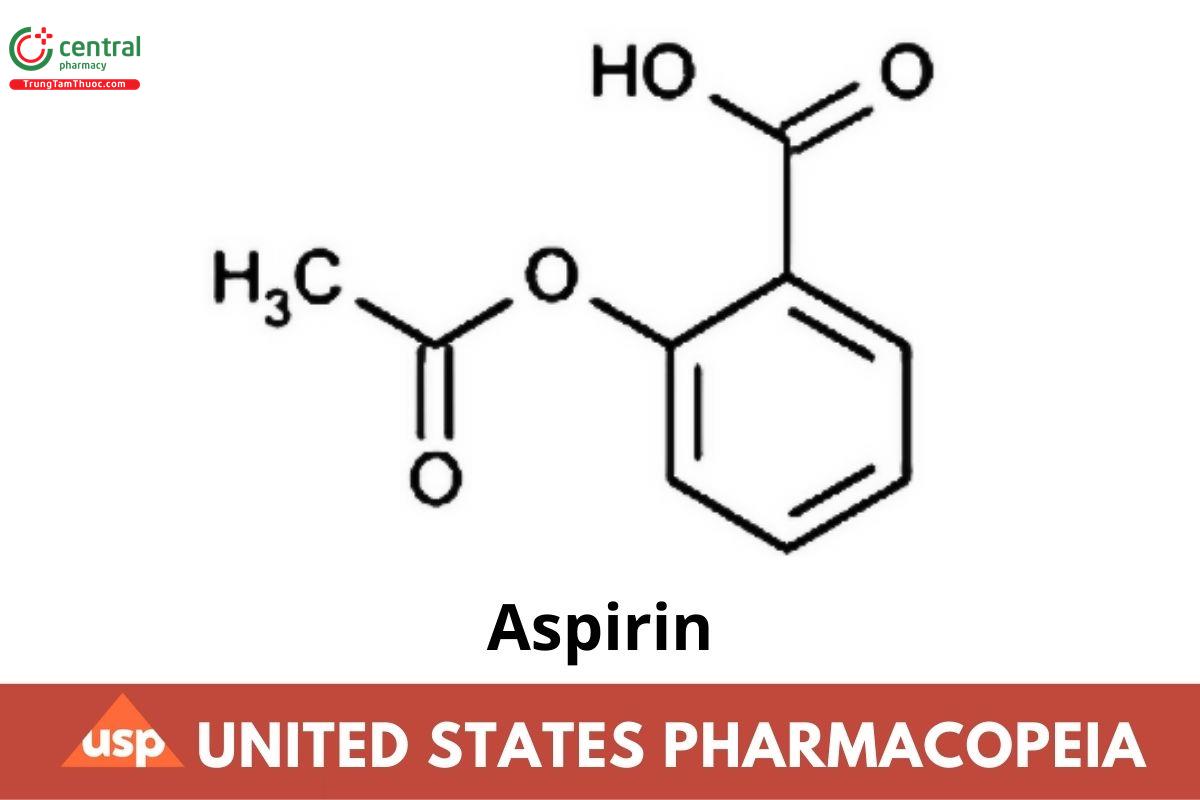
Aspirin
If you find any inaccurate information, please let us know by providing your feedback here

Tóm tắt nội dung
This article is compiled based on the United States Pharmacopeia (USP) – 2025 Edition
Issued and maintained by the United States Pharmacopeial Convention (USP)
C9H8O4 180.16
Benzoic acid, 2-(acetyloxy)-.
Salicylic acid acetate CAS RN: 50-78-2; UNII: R16CO5Y76E.
Aspirin contains not less than 99.5 percent and not more than 100.5 percent of C9H8O4 calculated on the dried basis.
Packaging and storage-Preserve in tight containers.
USP REFERENCE STANDARDS (11)
USP Aspirin RS
1 Identification
A: Heat it with water for several minutes, cool, and add 1 or 2 drops of ferric chloride TS: a violet-red color is produced.
B: Spectroscopic Identification Tests (197), Infrared Spectroscopy: 197K.
LOSS ON DRYING (731)-Dry it over silica gel for 5 hours: it loses not more than 0.5% of its weight.
READILY CARBONIZABLE SUBSTANCES (271)-Dissolve 500 mg in 5 mL of sulfuric acid the solution has no more color than Matching Fluid Q.
RESIDUE ON IGNITION (281); not more than 0.05%.
2 Substances insoluble in sodium carbonate TS
A solution of 500 mg in 10 mL of warm sodium carbonate TS is clear.
CHLORIDE (221)-Boil 1.5 g with 75 mL of water for 5 minutes, cool, add sufficient water to restore the original volume, and filter. A 25-ml portion of the filtrate shows no more chloride than corresponds to 0.10 mL of 0.020 N hydrochloric acid (0.014%).
SULFATE-Dissolve 6.0 g in 37 mL of acetone, and add 3 mL of water. Titrate potentiometrically with 0.02 M lead perchlorate, prepared by dissolving 9.20 g of lead perchlorate in water to make 1000 mL of solution, using a pH meter capable of a minimum reproducibility of ±0.1 mV (see pH (791)) and equipped with an electrode system consisting of a lead-specific electrode and a silver-silver chloride reference glass-sleeved electrode containing a solution of tetraethylammonium perchlorate in glacial acetic acid (1 in 44) (see Titrimetry (541)): not more than 1.25 mL of 0.02 M lead perchlorate is consumed (0.04%). [NOTE-After use, rinse the lead-specific electrode with water, drain the reference electrode, flush with water, rinse with methanol, and allow to dry.]
3 Limit of free salicylic acid
Dissolve 2.5 g in sufficient alcohol to make 25.0 mL. To each of two matched color-comparison tubes add 48 mL of water and 1 mL of a freshly prepared, diluted ferric ammonium sulfate solution (prepared by adding 1 mL of 1 N hydrochloric acid to 2 mL of ferric ammonium sulfate TS and diluting with water to 100 mL). Into one tube pipet 1 mL of a standard solution of salicylic acid in water, containing 0.10 mg of salicylic acid per mL.. Into the second tube pipet 1 mL of the 1 in 10 solution of Aspirin. Mix the contents of each tube: after 30 seconds, the color in the second tube is not more intense than that in the tube containing the salicylic acid (0.1%).
Change to read:
Assay-Place about 1.5 g of Aspirin, accurately weighed, in a flask, add 50.0 mL of 0.5 N sodium hydroxide VS, and boil the mixture gently for 10 minutes. Add phenolphthalein TS, and titrate the excess sodium hydroxide with 0.5 N sulfuric acid VS. Perform a blank determination (see
Titrimetry (541) (CN 1-Aug-2024)). Each mL of 0.5 N sodium hydroxide is equivalent to 45.04 mg of C9H8O4

