
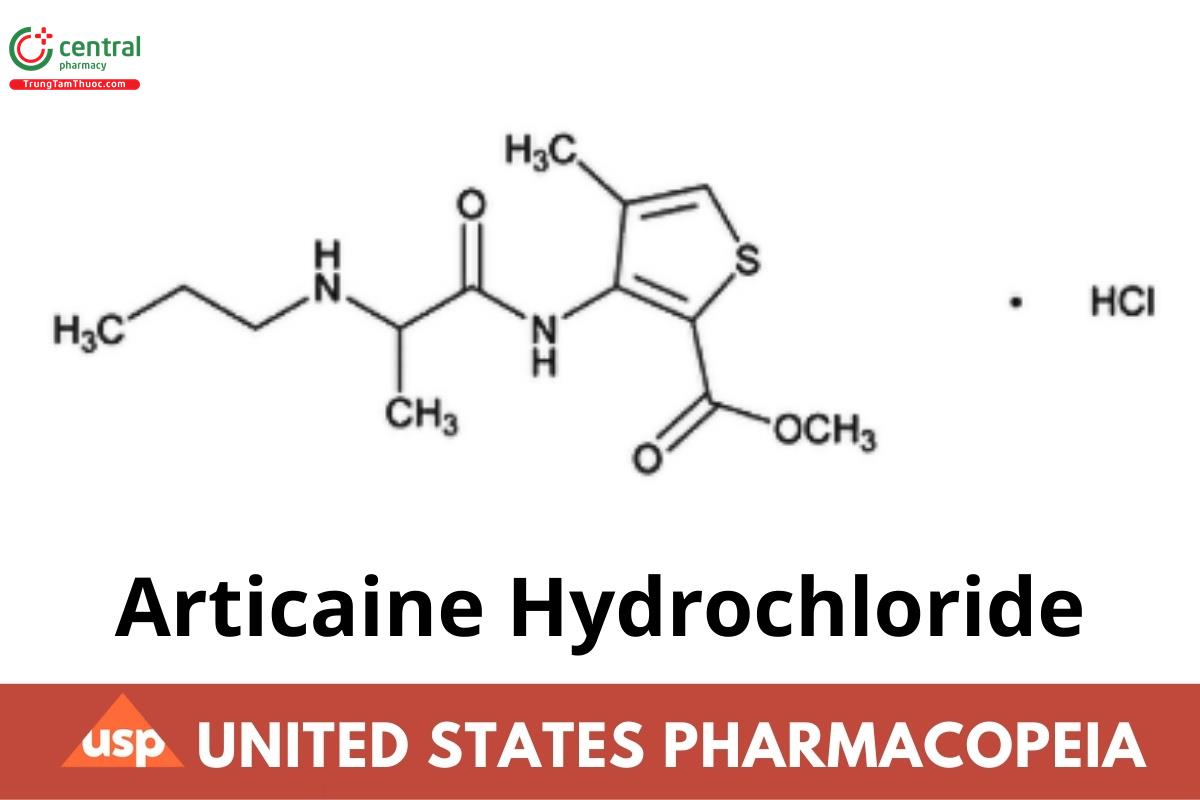
Articaine Hydrochloride
If you find any inaccurate information, please let us know by providing your feedback here

Tóm tắt nội dung
This article is compiled based on the United States Pharmacopeia (USP) – 2025 Edition
Issued and maintained by the United States Pharmacopeial Convention (USP)
Change to read:
C13H20N2O3S.HCI 320.83
2-Thiophenecarboxylic acid, 4-methyl-3-{[1-oxo-2-(propylamino)propyl]amino)-, methyl ester, monohydrochloride; (CN 1-Aug-2024)
Methyl 4-methyl-3-[2-(propylamino)propionamido]-2-thiophenecarboxylate, monohydrochloride CAS RN®: 23964-57-0; UNII: QS9014Q792.
1 DEFINITION
Articaine Hydrochloride contains NLT 98.5% and NMT 101.0% of C13H20N2O3S HCI, calculated on the dried basis.
2 IDENTIFICATION
2.1 A. SPECTROSCOPIC IDENTIFICATION TESTS (197), Infrared Spectroscopy: 197F
Standard solution: 12 mg/mL of USP Articaine RS in methylene chloride. Transfer 20 µL of this solution onto a 300-mg disk.
Sample solution: Dissolve 100 mg of Articaine Hydrochloride in 5 mL of water. Add 3 mL of a saturated solution of sodium bicarbonate, and shake twice with 2 mL of methylene chloride. Combine the methylene chloride layers, dilute with methylene chloride to 5.0 mL, and dry over anhydrous sodium sulphate. Transfer 20 µL of this solution onto a 300-mg disk.
2.2 B. IDENTIFICATION TESTS-GENERAL, Chloride (191)
3 ASSAY
3.1 PROCEDURE
Sample solution: 250 mg of Articaine Hydrochloride to a 250-mL conical flask. Add 5.0 mL of 0.01 M hydrochloric acid and 50 mL of alcohol. Stir to dissolve.
Analysis: Titrate with 0.1 M sodium hydroxide VS, determining the endpoint potentiometrically, using a glass electrode. Calculate the volume of sodium hydroxide consumed by reading the volume added between the two points of inflection. Each mL of 0.1 M sodium hydroxide is equivalent to 32.08 mg of C13H20N2O3S.HCI.
Acceptance criteria: 98.5%-101.0% on the dried basis.
4 IMPURITIES
4.1 INORGANIC IMPURITIES
RESIDUE ON IGNITION (281)
Sample: 1 g
Acceptance criteria: NMT 0.1%
4.2 ORGANIC IMPURITIES
PROCEDURE
Buffer solution: 2.02 g of sodium 1-heptanesulfonate and 4.08 g of potassium dihydrogen phosphate in 1 L of water. Adjust with phosphoric acid to a pH of 2.0.
Mobile phase: Acetonitrile and Buffer solution (1:3)
Standard solution: 2 µg/mL of USP Articaine Related Compound A, and 1 µg/mL each of USP Articaine Related Compound E RS and USP Articaine Hydrochloride RS in Mobile phase. [NOTE-This solution is also used to determine the reporting threshold limit.]
Sample solution: 1.0 mg/mL of Articaine Hydrochloride in Mobile phase
Chromatographic system
(See Chromatography (621), System Suitability.)
Mode: LC
Detector: UV 276 nm
Column: 4.6-mm x 25-cm; packing L1
Temperature: 45°
Flow rate: 1 mL/min
Injection size: 10 µL
System suitability
Sample: Standard solution
Suitability requirements
Resolution: NLT 1.2 between articaine related compound A and articaine related compound E
Analysis
Samples: Standard solution and Sample solution. [NOTE-Run time is 5 times the retention time of articaine.]
Calculate the percentage of any articaine related compound A in the portion of Articaine Hydrochloride taken:
Result = (rU/rS) × (CS/CU) × 100
rU = response of articaine related compound A from the Sample solution
rS = response of articaine related compound A from the Standard solution
CS = concentration of USP Articaine Related Compound A RS in the Standard solution (mg/mL)
CU = concentration of Articaine Hydrochloride in the Sample solution (mg/mL)
Calculate the percentage of each individual impurity in the portion of Articaine Hydrochloride taken:
Result = (rU/rS) × (CS/CU) × 100
rU = response of each individual impurity from the Sample solution
rS = response of articaine hydrochloride from the Standard solution
CS = concentration of USP Articaine Hydrochloride RS in the Standard solution (mg/mL)
CU = concentration of Articaine Hydrochloride in the Sample solution (mg/mL)
[NOTE-Disregard any peak below 0.05%.]
Acceptance criteria
Individual impurities: See Impurity Table 1.
Total impurities: NMT 0.5%. [NOTE-Excluding articaine related compound A.]
Impurity Table 1
| Name | Relative Retention Time | Acceptance Criteria, NMT (%) |
| Articaine acida | 0.6 | 0.1 |
| Ethylarticaineb | 0.7 | 0.1 |
| Articaine related compound Ac | 0.8 | 0.2 |
| Articaine related compound Ed | 0.86 | 0.1 |
| Articaine acid-propionamidee | 0.9 | 0.1 |
| Articaine | 1.0 | - |
| Butylarticainef | 1.7 | 0.1 |
| Dipropylarticaineg | 2.1 | 0.1 |
| 3-Aminoarticaineh | 2.6 | 0.1 |
| Articaine isopropyl esteri | 3.6 | 0.1 |
| Bromo compoundj | 4.0 | 0.1 |
| Any other individual impurity | - | 0.10 |
a 4-Methyl-3-[[(2RS)-2-(propylamino)propanoyl)amino]thiophene-2-carboxylic acid.
b Methyl 3-[[(2RS)-2-(ethylamino)propanoyl)amino]-4-methylthiophene-2-carboxylate.
c Methyl 4-methyl-3-[2-(propylamino) acetamido]thiophene-2-carboxylate.
d Methyl 3-[2-(isopropylamino)propanamido]-4-methylthiophene-2-carboxylate.
e 4-Methyl-N-propyl-3-[[(2RS)-2-(propylamino) propanoyl)amino]thiophene-2-carboxamide.
f Methyl 3-[[(2RS)-2-(butylamino)propanoyl]amino]-4-methylthiophene-2-carboxylate.
g Methyl 3-[[(2RS)-2-(dipropylamino) propanoyl)amino]-4-methylthiophene-2-carboxylate.
h Methyl 3-amino-4-methylthiophene-2-carboxylate.
i 1-Methylethyl 4-methyl-3-[[(2RS)-2-(propylamino)propanoyl]amino] thiophene-2-carboxylate.
j Methyl 3-[[(2RS)-2-bromopropanoyl)amino]-4-methylthiophene-2-carboxylate.
5 SPECIFIC TESTS
LOSS ON DRYING (731): Dry at 105° for 5 h: it loses NMT 0.5% of its weight.
PH (791).
Sample solution: 10 mg/mL
Acceptance criteria: 4.2-5.2
6 ADDITIONAL REQUIREMENTS
6.1 PACKAGING AND STORAGE
Preserve in light-resistant containers.
Change to read:
0.10
6.2 USP REFERENCE STANDARDS (11)
USP Articaine RS
USP Articaine Hydrochloride RS
USP Articaine Related Compound A RS
Methyl 4-methyl-3-[2-(propylamino) acetamido]thiophene-2-carboxylate hydrochloride.
C12H18N2O3S HCI 306.81 (CN 1-Aug-2024)
USP Articaine Related Compound E RS
Methyl 3-[2-(isopropylamino) propanamido]-4-methylthiophene-2-carboxylate.
C13H20N2O3S 284.37

