
Antimony Potassium Tartrate
If you find any inaccurate information, please let us know by providing your feedback here
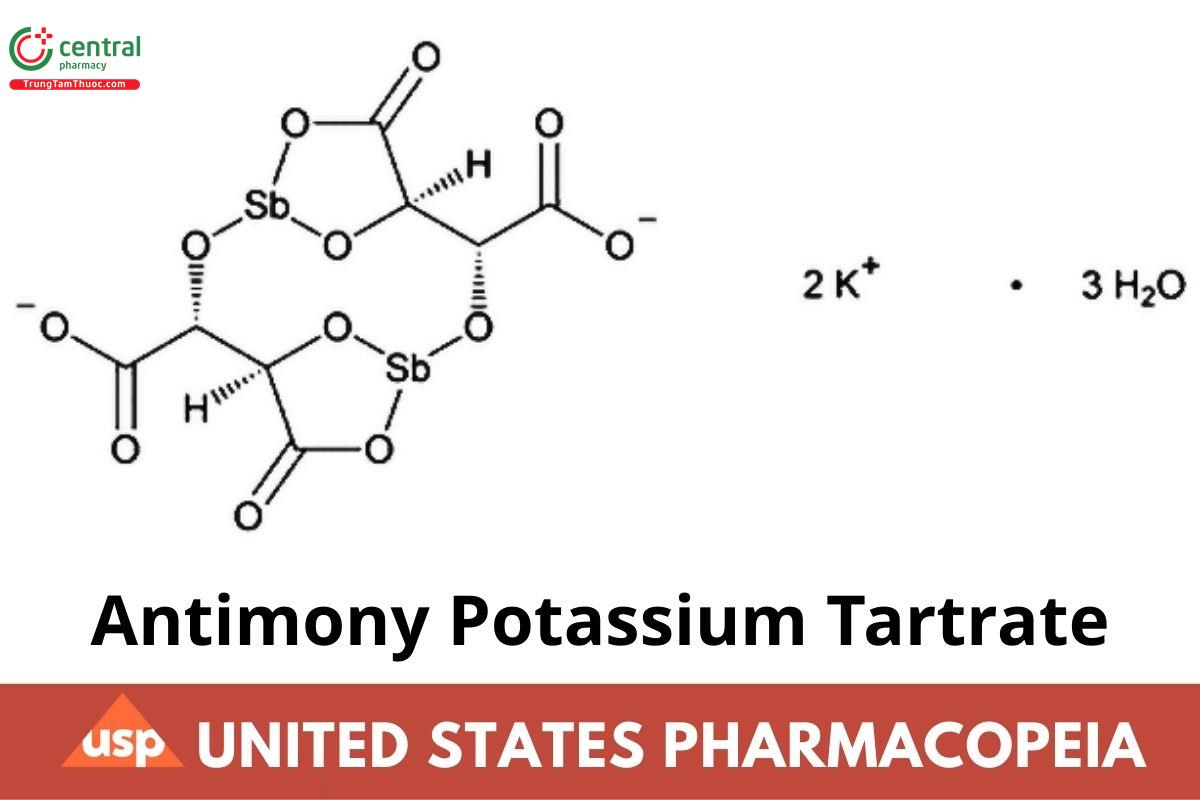

This article is compiled based on the United States Pharmacopeia (USP) – 2025 Edition
Issued and maintained by the United States Pharmacopeial Convention (USP)
C8H4K2O12Sb2 · 3H2O 667.87
C8H4K2O12Sb2 613.82
Antimonate(2-), bis[u-[2,3-dihydroxybutanedioato(4-)-01,02:03,04]]-di-, dipotassium, trihydrate, stereoisomer;
Dipotassium bis[u-[L-(+)-tartrato(4-)]]diantimonate(2-) trihydrate CAS RN: 28300-74-5; UNII: DL6OZ476V3.
Anhydrous CAS RN: 11071-15-1, UNII: Z8830U53UE
1 DEFINITION
Antimony Potassium Tartrate contains NLT 99.0% and NMT 103.0% of antimony potassium tartrate (C8H4K2O12Sb2 · 3H2O).
2 IDENTIFICATION
A.
Sample: An appropriate quantity
Analysis: Heat the Sample to redness.
Acceptance criteria: It chars, emits an odor resembling that of burning sugar, and leaves a blackened residue. This residue has an alkaline reaction, and when a small fragment of it is held in a nonluminous flame, the flame is tinted violet.
B.
Sample solution: Antimony Potassium Tartrate (1 in 20) in water acidified with hydrochloric acid
Analysis: Add hydrogen sulfide TS to the Sample solution.
Acceptance criteria: It yields an orange-red precipitate, which is soluble in ammonium sulfide TS and in 1 N sodium hydroxide.
C. IDENTIFICATION TESTS GENERAL, Tartrate (191): Meets the requirements
3 ASSAY
PROCEDURE
Sample: 500 mg
Analysis: Dissolve the Sample in 50 mL of water, add 5 g of potassium sodium tartrate, 2 g of sodium borate, and 3 mL of starch TS, and immediately titrate with 0.1 N iodine VS to the production of a persistent blue color. Each mL of 0.1 N iodine is equivalent to 16.70 mg of antimony potassium tartrate (C8H4K2O12Sb2 · 3H2O).
Acceptance criteria: 99.0%-103.0%
4 IMPURITIES
ARSENIC
Sample solution: Dissolve 100 mg in 5 ml. of hydrochloric acid. Add 10 mL of a recently prepared solution of 20 g of stannous chloride in 30 ml. of hydrochloric acid.
Blank: Add 5 mL of hydrochloric acid to 10 mL of a recently prepared solution of 20 g of stannous chloride in 30 mL of hydrochloric acid.
Analysis: Transfer the Sample solution to a color-comparison tube, and allow to stand for 30 min.
Acceptance criteria: NMT 0.015%; viewed downward over a white surface, the color of the solution appears no deeper than that of the Blank to which has been added 15 µg of arsenic.
Change to read:
LEAD (251), Procedures, Procedure 1 (CN 1-Jun-2023): NMT 20 ppm
5 SPECIFIC TESTS
COMPLETENESS OF SOLUTION (641)
Sample: 750 mg
Solvent: Water
Acceptance criteria: Meets the requirements
LOSS ON DRYING (731)
Analysis: Dry at 105° to constant weight.
Acceptance criteria: NMT 2.7%
ACIDITY OR ALKALINITY
Sample solution: Dissolve 1.0 g in 50 ml. of carbon dioxide-free water.
Analysis: Titrate the Sample solution with 0.010 N hydrochloric acid or 0.010 N sodium hydroxide to a pH of 4.5.
Acceptance criteria: NMT 2.0 mL
6 ADDITIONAL REQUIREMENTS
PACKAGING AND STORAGE: Preserve in well-closed containers.

