
Anhydrous Lactose
If you find any inaccurate information, please let us know by providing your feedback here
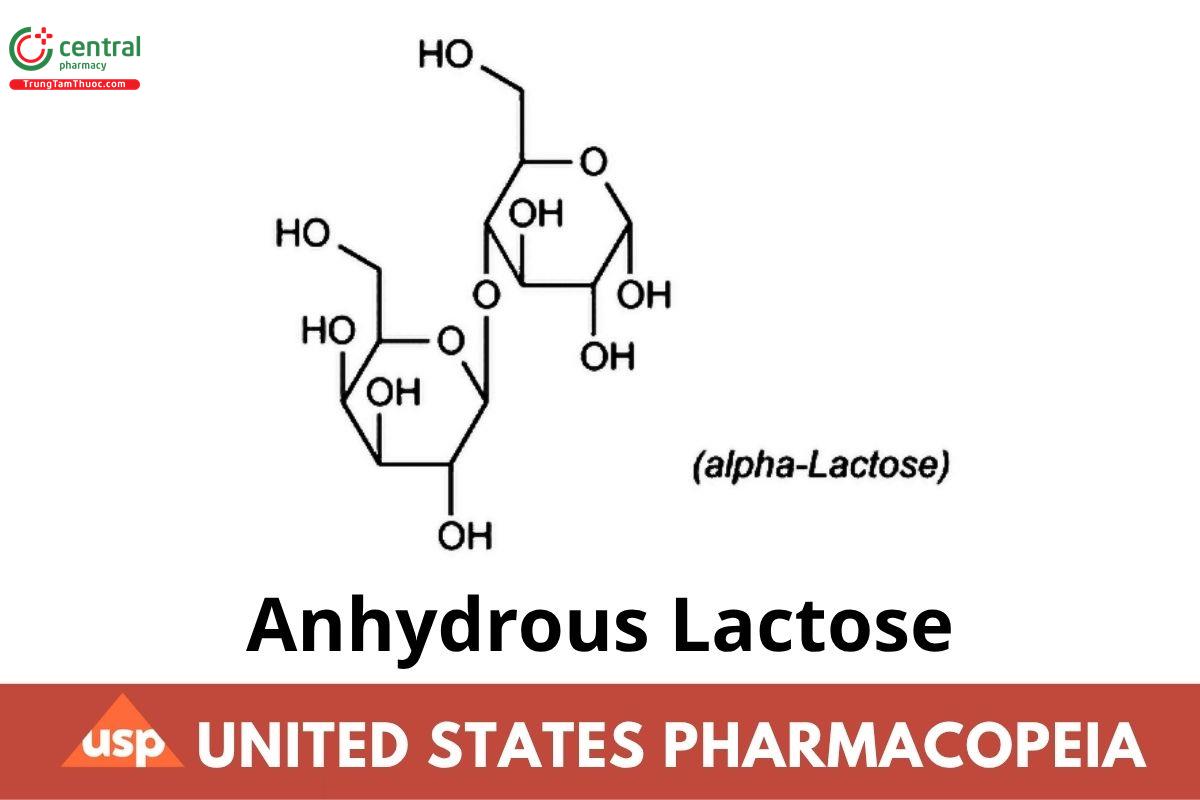

This article is compiled based on the United States Pharmacopeia (USP) – 2025 Edition
Issued and maintained by the United States Pharmacopeial Convention (USP)
1 DEFINITION
Anhydrous Lactose is O-B-D-galactopyranosyl-(1→4)-B-D-glucopyranose (ẞ-lactose), or a mixture of O-B-D-galactopyranosyl-(1→4)-β-D-glucopyranose and O-B-D-galactopyranosyl-(1→4)-a-D-glucopyranose (a-lactose).
2 IDENTIFICATION
A. SPECTROSCOPIC IDENTIFICATION TESTS (197), Infrared Spectroscopy: 197K
B. THIN-LAYER CHROMATOGRAPHIC IDENTIFICATION TEST (201)
Adsorbent: 0.25-mm layer of chromatographic silica gel
Diluent: Methanol and water (3:2)
Standard solution A: 0.5 mg/mL of USP Anhydrous Lactose RS in Diluent
Standard solution B: Contains 0.5 mg/mL of USP Dextrose RS, 0.5 mg/mL of USP Anhydrous Lactose RS, 0.5 mg/mL of USP Fructose RS, and 0.5 mg/mL of USP Sucrose RS in Diluent
Sample solution: 0.5 mg/mL of Anhydrous Lactose in Diluent
Application volume: 2 µL
Developing solvent system: Ethylene dichloride, glacial acetic acid, methanol, and water (10:5:3:2)
Spray reagent: 5 mg/mL of thymol in a mixture of alcohol and sulfuric acid (19:1)
Analysis
Samples: Standard solution A, Standard solution B, and Sample solution
Allow the spots to dry, and develop the plate in a paper-lined chromatographic chamber equilibrated with the Developing solvent system for about 1 h prior to use. Allow the chromatogram to develop until the solvent front has moved about three-quarters of the length of the plate. Remove the plate from the chamber, dry in a current of warm air, and redevelop the plate in fresh Developing solvent system. Remove the plate from the chamber, mark the solvent front, and dry the plate in a current of warm air. Spray the plate evenly with Spray reagent. Heat the plate at 130° for 10 min.
System suitability: The test is not valid unless Standard solution B shows four clearly discernible spots, disregarding any spots at the origin.
Acceptance criteria: The principal spot from the Sample solution corresponds in appearance and RF, value to that from Standard solution A.,
3 OTHER COMPONENTS
CONTENT OF ALPHA AND BETA ANOMERS
Silylation reagent: Dimethyl sulfoxide, pyridine, and trimethylsilylimidazole (19.5: 58.5:22)
Standard solution: Prepare a mixture of alpha-lactose monohydrate and beta-lactose having an anomeric ratio of about 1:1 based on the labeled anomeric contents of the alpha-lactose monohydrate and the beta-lactose. Introduce 10 mg of this mixture into a vial with a screw cap. Add 4 mL of Silylation reagent. Sonicate for 20 min at room temperature. Transfer 400 µL to an injection vial. Add 1 mL of pyridine. Close the vial, and mix well.
Sample solution: Introduce 10 mg of Anhydrous Lactose into a vial with a screw cap. Add 4 mL of Silylation reagent. Sonicate for 20 min at room temperature. Transfer 400 µL to an injection vial. Add 1 mL of pyridine. Close the vial, and mix well.
Chromatographic system
(See Chromatography (621), System Suitability.)
Mode: GC
Detector: Flame ionization
Columns
Precolumn:1 0.53-mm × 2-m intermediate polarity deactivated fused silica
Analytical:2 0.25-mm × 15-m G27 on fused silica; lm thickness 0.25 µm
Temperatures
Detector: 325°
Injection port: 275° or use cold on-column injection
Column: See Table 1.
Table 1
Initial Temperature (°) | Temperature Ramp (°/min) | Final Temperature (°) | Hold Time at Final Temperature (min) |
| 80 | — | 80 | 1 |
| 80 | 35 | 150 | — |
| 150 | 12 | 300 | 2 |
Carrier gas: Helium
Flow rate: 2.8 mL/min
Injection volume: 0.5 µL
Injection type: Splitless or by cold on-column injection
System suitability
Sample: Standard solution
Suitability requirements
Resolution: NLT 3.0 between the peaks due to alpha-lactose and beta-lactose
Analysis
Sample: Sample solution
[NOTE-The relative retention time with reference to beta-lactose is about 0.9 for alpha-lactose (retention time = about 12 min).]
Calculate the percentage content of alpha-lactose:
Result = Sa / (Sa + Sb) x 100
Sa = area of the peak due to alpha-lactose a
Sb = area of the peak due to beta-lactose
Calculate the percentage content of beta-lactose:
Result = Sb / (Sa + Sb) x 100
Sa = area of the peak
Sb = area of the peak due to beta-lactose
4 IMPURITIES
RESIDUE ON IGNITION (281): NMT 0.1%
SPECIFIC TESTS
CLARITY AND COLOR OF SOLUTION
Hydrazine sulfate solution: Dissolve 1.0 g of hydrazine sulfate in water, and dilute to 100.0 mL. Allow to stand for 4-6 h.
Hexamethylenetetramine solution: In a 100-mL ground-glass stoppered flask dissolve 2.5 g of hexamethylenetetramine in 25.0 mL of water.
Primary opalescent suspension: To the Hexamethylenetetramine solution in the flask add 25.0 mL of the Hydrazine sulfate solution. Mix and allow to stand for 24 h. This suspension is stable for 2 months, provided it is stored in a glass container free from surface defects. The suspension must not adhere to the glass and must be well mixed before use.
Standard opalescence: Dilute 15.0 mL of the Primary opalescent suspension to 1000.0 mL with water. This suspension is freshly prepared and may be stored for up to 24 h.
Reference suspension: To 5.0 mL of the Standard opalescence add 95.0 mL of water. Mix and shake before use.
Reference solution: To 6.0 mL of ferric chloride CS, 2.5 mL of cobaltous chloride CS, and 1.0 mL of cupric sulfate CS add hydrochloric acid (10 g/L HCI) to make 1000 mL.
Sample solution: 1 g in 10 mL of boiling water. Allow to cool.
Instrumental conditions
Mode: Vis
Analytical wavelength: 400 nm
Acceptance criteria: NMT 0.04 for the absorbance divided by the path length in centimeters; and the clarity of the Sample solution is the same as that of water or its opalescence is not more pronounced than that of the Reference suspension, and it is not more colored than the Reference solution.
LOSS ON DRYING (731)
Analysis: Dry a sample at 80° for 2 h.
Acceptance criteria: NMT 0.5%
WATER DETERMINATION (921), Method I
Sample solution: Anhydrous Lactose in a mixture of methanol and formamide (2:1)
Acceptance criteria: NMT 1.0%
Change to read:
(NF 1-MICROBIAL ENUMERATION TESTS (61) and TESTS FOR SPECIFIED MICROORGANISMS (62): The total aerobic microbial count is NMT 102 cfu/g and (NF 1-Dec-2024) the total combined molds and yeasts count is NMT 50 cfu/g. (NF 1-Dec-2024) It meets the requirements of the test for absence of Escherichia coli.
PROTEIN AND LIGHT-ABSORBING IMPURITIES
(See Ultraviolet-Visible Spectroscopy (857).)
Sample solution: 1% solution (w/v)
Instrumental conditions
Mode: UV
Wavelength range: 210-300 nm
Acceptance criteria: NMT 0.25 for the absorbance divided by the path length in centimeters at 210-220 nm; NMT 0.07 for the absorbance divided by the path length in centimeters at 270-300 nm
Change to read:
ACIDITY OR ALKALINITY
Sample solution: Dissolve 6 g by heating in 25 mL of carbon dioxide-free water, cool, and add 0.3 mL of phenolphthalein TS.
Acceptance criteria: The solution is colorless, and NMT 0.4 mL of 0.1 N sodium hydroxide VSA (NF 1-Dec-2024) is required to produce a pink or red color.
OPTICAL ROTATION (781S), Procedures, Specific Rotation
Sample solution: Dissolve 10 g by heating in 80 mL of water to 50°. Allow to cool, and add 0.2 mL of 6 N ammonium hydroxide. Allow to stand for 30 min, and dilute with water to 100 mL..
Acceptance criteria: +54.4° to +55.9°, calculated on the anhydrous basis, at 20°
5 ADDITIONAL REQUIREMENTS
Change to read:
PACKAGING AND STORAGE: Preserve in tight containers. (NF 1-Dec-2024)
Change to read:
(NF 1-DEC-2024) LABELING: Where the labeling indicates the relative quantities of alpha- and beta-lactose, determine compliance using Content of Alpha and Beta Anomers. Where the labeling states the particle size distribution, it also indicates the d10', d50', and d90 values and the (NF 1-Dec-2024)
Change to read:
USP REFERENCE STANDARDS (11)
USP Dextrose RS
USP Fructose RS
USP Anhydrous Lactose RS
USP Sucrose RS
(NF 1-Dec-2024)
1 Restek Guard column is suitable.
2 Varian CP-Sil 8 CB is suitable.

