
Anethole
If you find any inaccurate information, please let us know by providing your feedback here
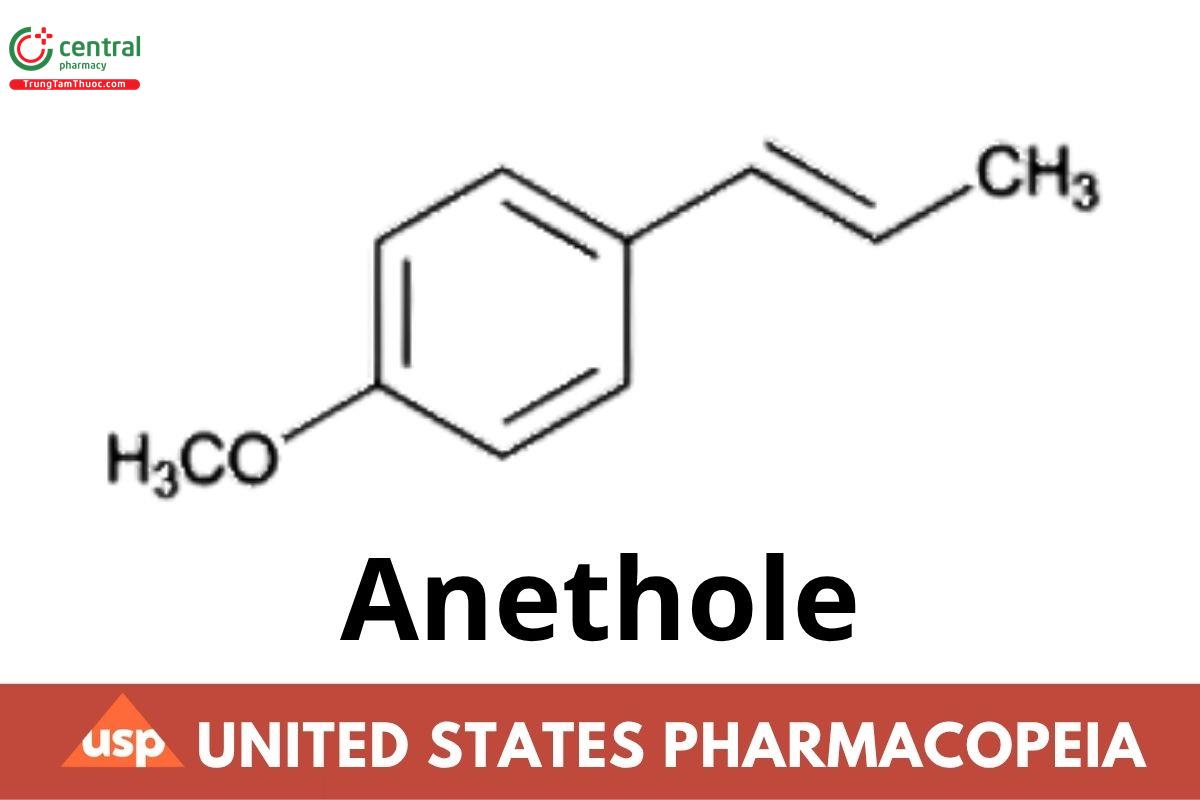

This article is compiled based on the United States Pharmacopeia (USP) – 2025 Edition
Issued and maintained by the United States Pharmacopeial Convention (USP)
C10H12O 148.20
Benzene, 1-methoxy-4-(1-propenyl)-, (E)-;
(E)-p-Propenylanisole CAS RN: 4180-23-8.
Synthetic CAS RN: 104-46-1.
1 DEFINITION
Anethole is obtained from Anise Oil and other sources, or it is prepared synthetically. It contains NLT 98.0% and NMT 102.0% of (E)-1-methoxy (ERR 1-Nov-2022)-4-(1-propenyl) benzene (or trans-anethole) (C10H12O).
2 IDENTIFICATION
A. SPECTROSCOPIC IDENTIFICATION TESTS (197), Infrared Spectroscopy: 197F
B. CHROMATOGRAPHIC IDENTITY
Analysis: Proceed as directed in the Assay for trans-Anethole.
Acceptance criteria: The retention time of the major peak, excluding the internal standard peak, of the Sample solution corresponds to the anethole peak of the Standard solution.
3 ASSAY
ASSAY FOR trans-ANETHOLE
Internal standard solution: 2 mg/mL of USP Menthol RS (internal standard) in hexanes
Standard solution: 2 mg/mL of USP Anethole RS in Internal standard solution (use a freshly prepared solution)
Sample solution: 2 mg/mL of Anethole in Internal standard solution (use a freshly prepared solution)
Chromatographic system
(See Chromatography (621), System Suitability.)
Mode: GC
Detector: Flame ionization
Column: 0.53-mm x 30-m capillary; bonded with a 1.0-µm layer of phase G16
Temperatures
Injection port: 250°
Detector: 250°
Column: 125° (isothermally)
Carrier gas: Helium
Flow rate: 10 mL/min
Injection volume: 1.0 µL
Injection type: Split injection; split ratio of 10:1
Run time: 30 min
System suitability
Sample: Standard solution
[NOTE-The relative retention times for menthol and trans-anethole are about 0.5 and 1.0, respectively.]
Suitability requirements
Resolution: NLT 15 between menthol and trans-anethole
Tailing factor: 0.8-2.0 for menthol and trans-anethole peaks
Relative standard deviation: NMT 2.0% for the peak response ratio of trans-anethole to the internal standard
Analysis
Samples: Standard solution and Sample solution
Calculate the percentage of trans-anethole (C10H12O) in the portion of Anethole taken:
Result = (Ru/Rs) × (Cs/Cu) × 100
Ru= peak response ratio of trans-anethole to the internal standard (peak response of trans-anethole/peak response of the internal standard) from the Sample solution
Rs= peak response ratio of trans-anethole to the internal standard (peak response of trans-anethole/peak response of the internal standard) from the Standard solution
Cs=concentration of USP Anethole RS in the Standard solution (mg/mL) C_{S} = 1
Cu= concentration of Anethole in the Sample solution (mg/mL)
Acceptance criteria: 98.0%-102.0%
4 IMPURITIES
LIMIT OF CIS-ANETHOLE, P-ANISALDEHYDE, AND OTHER VOLATILE IMPURITIES
Internal standard solution: 0.01 mg/mL of USP Menthol RS (internal standard) in hexanes
System suitability solution: 4 mg/mL of USP Anethole RS in Internal standard solution after exposure to UV light for 1 h
Standard solution: 0.01 mg/mL of USP Anethole RS and 0.01 mg/mL of USP p-Anisaldehyde RS in Internal standard solution (use a freshly prepared solution)
Sample solution: 2 mg/mL of Anethole in Internal standard solution (use a freshly prepared solution)
Chromatographic system: Proceed as directed in the Assay, except use a Run time of 60 min.
System suitability
Samples: System suitability solution and Standard solution
[NOTE-See Table 1 for the relative retention times.]
Table 1
| Name | Relative Retention Time |
| Menthol (internal standard) | 0.5 |
| cis-Anethole | 0.75 |
| trans-Anethole | 1.0 |
| p-Anisaldehyde | 2.2 |
Suitability requirements
Resolution: NLT 5 between cis-anethole and trans-anethole, System suitability solution
Relative standard deviation: NMT 5.0% for the peak response ratio of trans-anethole to the internal standard and NMT 5.0% for the peak response ratio of p-anisaldehyde to the internal standard, Standard solution
Analysis
Samples: Standard solution and Sample solution
Calculate the percentage of p-anisaldehyde in the portion of Anethole taken:
Result = (Ru1/Rs1) x (Cs1/Cu) × 100
Ru1= peak response ratio of p-anisaldehyde to the internal standard (peak response of p-anisaldehyde/peak response of the internal standard) from the Sample solution
Rs1= peak response ratio of p-anisaldehyde to the internal standard (peak response of p-anisaldehyde/peak response of the internal standard) from the Standard solution
CS1 = concentration of USP p-Anisaldehyde RS in the Standard solution (mg/mL)
Cu = concentration of Anethole in the Sample solution (mg/mL)
Calculate the percentage of cis-anethole or any other unspecified volatile impurity in the portion of Anethole taken:
Result = (Ru2/Rs2) × (Cs2/Cu) × 100
Ru2 = peak response ratio of cis-anethole or any other unspecied impurity to the internal standard (peak response of cis-anethole or any other unspecied impurity/peak response of the internal standard) from the Sample solution
Rs2 = peak response ratio of trans-anethole to the internal standard (peak response of trans-anethole/peak response of the internal standard) from the Standard solution
Cs2 = concentration of USP Anethole RS in the Standard solution (mg/mL)
Cu = concentration of Anethole in the Sample solution (mg/mL)
Acceptance criteria: Disregard peaks that are less than 0.05% for any unspecified impurities and any peaks due to solvent.
Total impurities including cis-anethole, p-anisaldehyde, and all other unspecified impurities: NMT 2.0%
LIMIT OF PHENOLS
Sample: 1 mL
Analysis: Shake the Sample with 20 mL of water, and allow the liquids to separate. Pass the water layer through a filter paper previously moistened with water, and to 10 mL of the filtrate add 3 drops of ferric chloride TS.
Acceptance criteria: No purple or purplish color is produced.
5 SPECIFIC TESTS
SPECIFIC GRAVITY (841): 0.983-0.988
DISTILLING RANGE, Method I (721): 231°-237", a correction factor of 0.063°/mm being applied as necessary
OPTICAL ROTATION, Angular Rotation (781A): -0.15° to +0.15°
REFRACTIVE INDEX (831): 1.557-1.561
6 ADDITIONAL REQUIREMENTS
PACKAGING AND STORAGE: Preserve in tight, light-resistant containers.
LABELING: Label to indicate whether it is of natural sources or is prepared synthetically.
USP REFERENCE STANDARDS (11)
USP Anethole RS
USP p-Anisaldehyde RS
USP Menthol RS

