
ANALYTICAL METHODOLOGIES BASED ON SCATTERING PHENOMENA—PARTICLE COUNTING VIA LIGHT SCATTERING
If you find any inaccurate information, please let us know by providing your feedback here

Tóm tắt nội dung
This article is compiled based on the United States Pharmacopeia (USP) – 2025 Edition
Issued and maintained by the United States Pharmacopeial Convention (USP)
1 1. INTRODUCTION
Light-scattering particle counter instrumentation can monitor or evaluate levels of particles with an equivalent diameter below 2 μm in both liquids and gases. The monitoring and/or evaluation of these particles may be needed for certain applications in the pharmaceutical industry.
A light scattering liquid-borne particle counter (LSLPC) is used for monitoring particle contamination in liquids for sizes lower than the typical sizes measured by light extinction particle counters that are specified in Particulate Matter in Injections 〈788〉 and ▲Methods for the Determination of Subvisible Particulate Matter 〈1788〉▲ (CN 1-May-2021).
Monitoring the size, number concentration, and number size distribution of particles suspended in a gas may also be needed in the pharmaceutical industry. Depending on the application, measuring particles suspended in a gas is performed using a light scattering aerosol spectrometer (LSAS) or a light scattering airborne particle counter (LSAPC).
LSLPCs are used for the evaluation of the cleanliness of pure water and chemicals, as well as the measurement of number and size distribution of particles in various liquids. The measured particle size using the LSLPC depends on the refractive index of particles and medium; therefore, the measured particle size is defined as being equivalent to the size of calibration particles in pure water.
LSASs can be used to measure particle number concentrations and particle size distribution of particles with an equivalent diameter of approximately 0.06–45 μm in several pharmaceutical applications including but not limited to: the characterization of metered dose inhalers (MDI), dry powder inhalers (DPI), and nebulizers in pharmacy; process control of active pharmaceutical ingredient production; and the fractional separation efficiency determination of filters.
Alternatively, an LSAPC can be used in the pharmaceutical industry to measure the size distribution and number concentration of particles suspended in air. The method is used to measure particles with a typical size range of 0.05–10 μm. LSAPCs are used for the classification of air cleanliness in cleanrooms and other controlled environment rooms as well as the measurement of number and size distribution of particles in various aerosols.
2 2. THEORY
The light scattering particle counter operation is based on the principles of light scattering phenomena. Particles may be sized using a light scattering technique based on the amount and direction of light that is scattered by a particle passing through the detection area of the particle counter. The measurement principle of a particle counter or sizer considers the particles as passing individually through a light beam, i.e., there is always only one particle in the scattering volume. The resulting signal is processed before the next measurement, and the cumulative resulting scattered light is then recorded. Simultaneously, the intensity of the scattered light is correlated with the particle size by using preselected scattering models depending on the type and size of the targeted sample.
Different models cover different scattering regimes, e.g., the Rayleigh regime, Mie regime, or Fraunhofer regime (see Analytical Methodologies Based on Scattering Phenomena—General 〈1430〉 and Analytical Methodologies Based on Scattering Phenomena—Light Diffraction Measurements of Particle Size 〈1430.2〉 for general principles of scattering and scattering regime models).
Depending on the choice of model, the height of the scattered light pulses would depend, in addition to the particle size, on the particle material (usually represented by the refractive index) and the particle shape. Hence, the final measurement output is the equivalent diameter of a sphere that scatters light as defined by the calibration with spherical latex particles.
3 3. INSTRUMENTATION
Instrumentation for both LSLPC and LSAPC consists of a laser light source, an optical system, a scattered light detector(s) [photodetector(s)] to measure the scattered light from the particles, and appropriate hardware and software to conduct the necessary computations. A sample handler is used to introduce either liquid or gas at a known flow rate into the light scattering instrument. The laser light source is usually a laser diode or helium–neon laser. The optical system components include laser collimators, mirrors, and beam splitters as appropriate for a given optical arrangement. The scattered light detectors are in general photomultipliers or photodiodes.
Commercial instruments use both low-angle and right-angle scattering optical configurations. A generic example of a right-angle light scattering particle counter is shown in Figure 1.
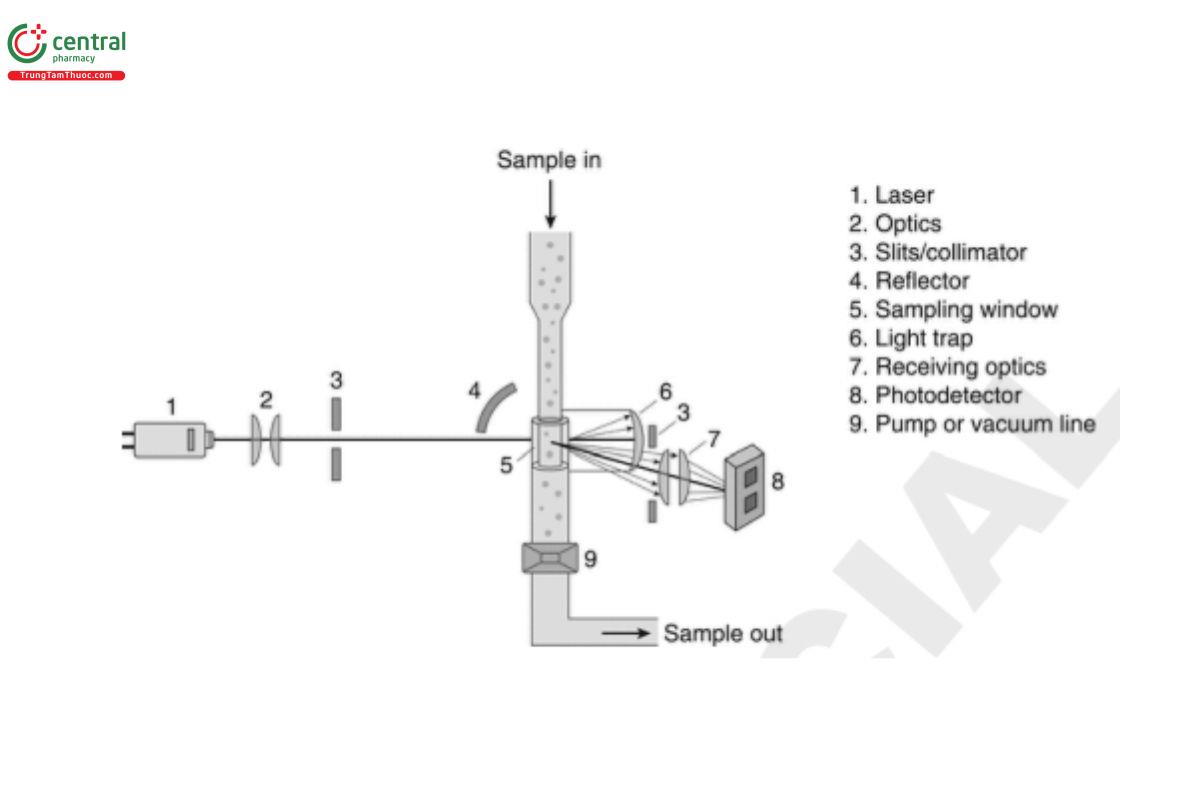
Further descriptions of common instrumentation configurations are shown in ISO 21501. The instrumentation for light scattering particle counters is similar to but not identical to the instrumentation used for light obscuration particle counters. The primary difference between light scattering and light obscuration particle counters is the use of light scattering detectors to detect smaller-sized particles that are below the size range of particles detected by light obscuration.
3.1 Liquid Counters
Liquid particle counters are used to count and size the number of particles in a volume of liquid that flows at a set flow rate for a predefined time. The choice of an appropriate scattering model is very important for the liquid counters. The models assume that the refractive index of particles and the medium is the same as the calibration particles; hence, the measured particle size is the light scattering equivalent size of the calibration particles in the same medium. The actual size of the particle may be different from this reported size.
3.2 Airborne Counters
Aerosol particle counters are used to count and size the number of particles in a volume of air. The instrumentation and the principle of measurement are similar to the liquid counters. The preferred optic alignment for airborne counters is the right-angle scattering configuration, i.e., the airflow, laser, and collection optics are all at right angles to one another. The airborne counters differ from the liquid counters in the measuring cell and associated accessories assembly and the mode of accomplishing the fluid movement through the cell. The liquid counters have a syringe or pump at the cell's outlet that draws the sample through the cell, whereas the airborne counters have a vacuum line attached to the cell assembly outlet that draws air through the cell.
3.3 Light Scattering Aerosol Spectrometers
Light scattering aerosol spectrometers are a specialized type of aerosol particle counter that may be used in several pharmaceutical applications evaluating various types of aerosolized formulations and determining filter retention characteristics. The instrumentation and the principle of measurement of the light scattering aerosol spectrometers are similar to the airborne counters, but light scattering aerosol spectrometers generally have the capability of collecting data in more size channels than the conventional airborne counter to allow for a more complete assessment of the particle size distribution.
4 4. FACTORS THAT AFFECT THE TESTING
As light scattering aerosol and liquid particle counters are typically calibrated using polystyrene latex spherical particles of known size and concentration with a preset flow rate, differences in the physical properties of the actual particles present in an unknown sample, including changes in the refractive index and/or shape of the particles, or deviations from the calibrated flow conditions when measurements are performed may affect the observed particle size and count.
The presence of an immiscible fluid, such as silicone oil in aqueous solutions or gas bubbles in an unknown sample, may also affect the observed particle count and size measured from a liquid counter as these may artificially increase the observed particle count. The presence of dispersed water droplets in sampled air may also affect the observed particle count when using an airborne counter. In these cases, the observed particle counts and sizes from an unknown sample may require additional examination, including isolation using an appropriate filtration technique and further characterization by an orthogonal technique such as scanning electron microscopy to confirm the values reported by the light scattering particle counter.
Elevated particle concentrations in the unknown samples may also affect the observed particle size and count when the concentration of particles in the sample is above the coincidence limit of the detector. When the coincidence limit of the detector is exceeded, the concentration of particles is high enough that multiple smaller particles may be counted as fewer larger-sized particles, thus preventing accurate sizing and counting of the particulates. This can be managed by performing serial dilutions of the unknown sample with a particle-free diluent to lower the particle concentration and verifying that the particle counts match the applied dilution factors.
5 5. QUALIFICATION OF LIGHT SCATTERING PARTICLE COUNTING INSTRUMENTS
The following are the key system qualification parameters needed to ensure accuracy and precision of the measurements performed by the LSLPC, LSAS, or LSAPC:
Size calibration
Verification of size setting
Counting efficiency
Size resolution
Sampling flow rate
Sampling volume
Calibration interval
The above characteristics are similar to the counterpart characteristics used in the light obscuration particle counters (see 〈788〉 and 〈1788〉). Hence, the information in these chapters may be useful to serve as references for completing performance qualification and for testing of samples when using the various light scattering particle counters and sizers.
5.1 Size Calibration
It is recommended to calibrate an optical instrument experimentally by means of test particles of known size and refractive index. The output of such a calibrated instrument will then be related to light scattering equivalent particle diameter.
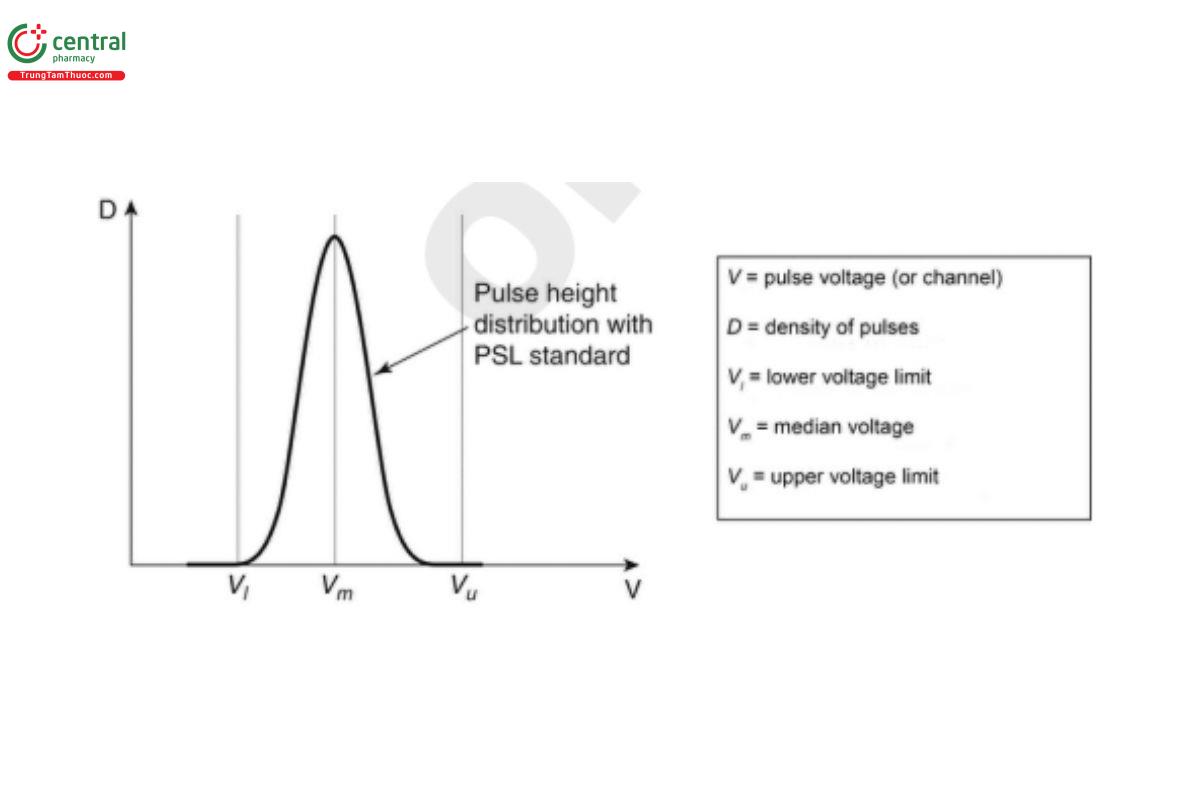
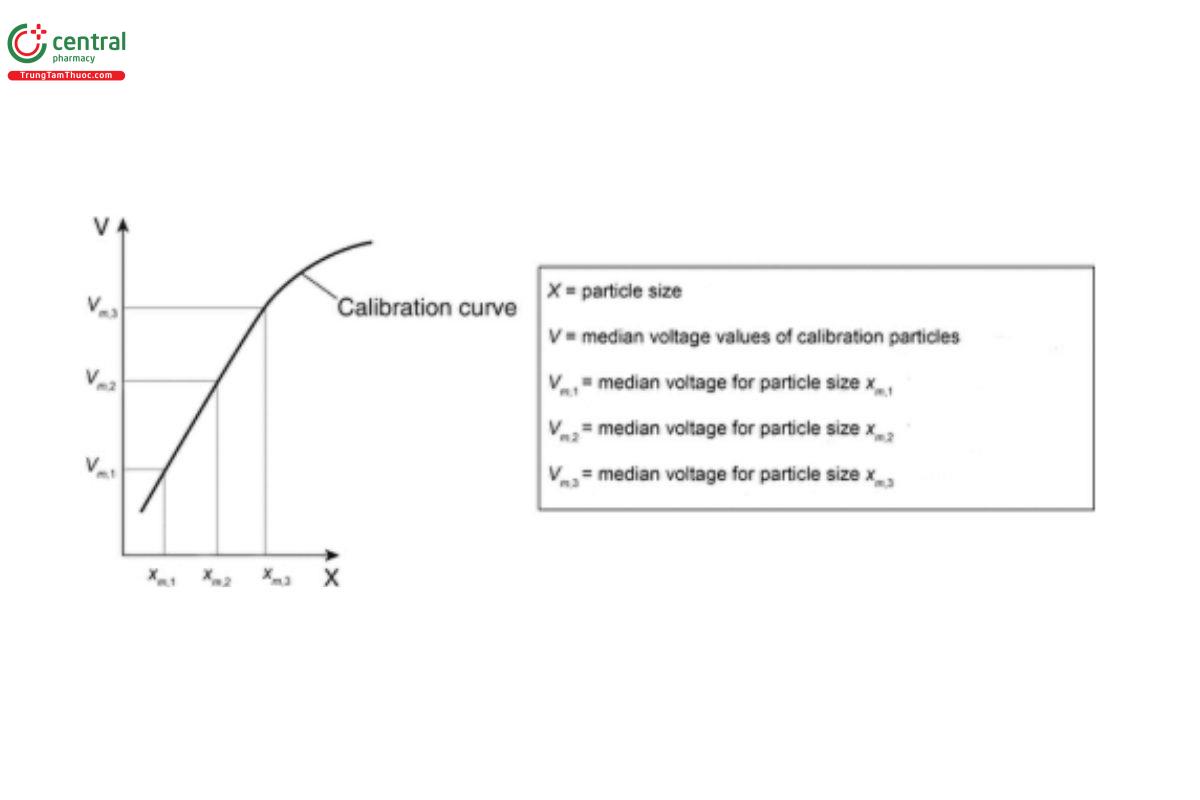
When calibrating a light scattering particle counter with calibration particles of known size, the particles are dispersed in a fluid or gas and introduced to the counter. The particles will produce a distribution of voltages where the median voltage [or internal pulse height analyzer (PHA) channel] corresponding to the particle size (see Figure 2) is selected for each size. Other-sized particles are then analyzed in the same manner to generate a calibration curve.
A monotonic, steadily increasing calibration curve is important for high size resolution and classification accuracy. Due to the influence of optical properties of the particle material, particle shape, and the optical setup (light source and detection angle), experimentally measured calibration curves may differ from theoretical predictions.
The voltages of channels corresponding to particle size should be determined in accordance with the calibration curve provided by the manufacturer (see Figure 3). In general, a cubic spline fit may be necessary to generate the calibration curve.
5.2 Verification of Size Setting
After calibration is completed, the calibration curve settings can be verified by obtaining response voltages (or internal PHA channel) using at least 3 sizes of calibration particles that span most of the reported size range, xᵣ, of the counter LSLPC.
Calculate the corresponding particle size, xₛ, from the voltage setting (or internal PHA channel) of the LSLPC using the calibration curve.
Obtain the percentage size-setting error, ε(%), by means of Equation 1. The recommended size-setting error is NMT 15%.
ε(%) = (xₛ − xᵣ) / xᵣ × 100 (1)
xₛ = calculated particle size (µm)
xᵣ = reported size range (µm)
5.3 Counting Accuracy
To test the counting accuracy of the LSLPC, use 2 sizes of calibration particles—one that is close to the minimum detectable reported size range and another that is 1.5–2 times larger than the minimum detectable size.
Measure the particle number concentration of both particles with the LSLPC under test and either a microscopic method or a calibrated LSLPC as a reference instrument.
The counting efficiency is the ratio of the particle number concentration measured by the LSLPC under test and the particle number concentration measured by the reference instrument.
5.4 Sensor Resolution
The width of a measured size distribution includes contributions from both the actual range of particle sizes in the sample and the inherent variability of the system (mainly the sensor resolution). The resolution of the particle sizer can be determined by using a single-size particle standard with a known size and standard deviation and comparing the theoretical standard deviation to the experimentally measured standard deviation determined with the instrument. The procedures for determining sensor resolution are similar to those detailed in the sensor resolution section of 〈1788〉.
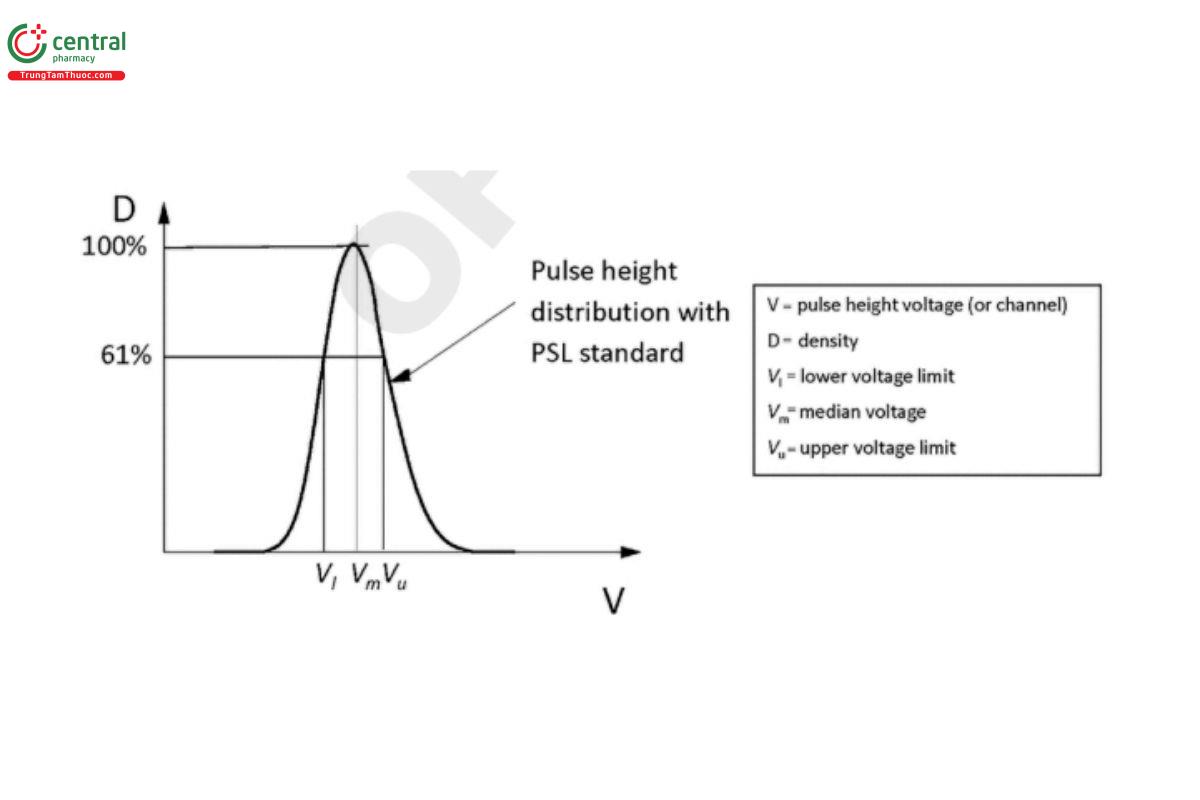
The median voltage (or internal PHA channel), Vₘ, is determined. The voltages (or channels) corresponding to 61% density of the median voltage (Vₘ) are defined as the lower voltage limit (Vₗ) and the upper voltage limit (Vᵤ). The particle sizes corresponding to Vₗ and Vᵤ are determined from the calibration curve. The absolute differences in size of the nominal particle size from these sizes represent the upper and lower standard deviation. The greater of these represents the experimentally determined standard deviation, σ. The percentage size resolution, R(%), of the LSLPC is obtained using Equation 2. The recommended size resolution is NMT 15%.
R(%) = (σ − 2σₚ) / (2√p × xₚ) × 100 (2)
σ = experimentally determined standard deviation of LSLPC (µm)
σₚ = supplier-reported standard deviation of calibration particles (µm)
xₚ = size of the calibration particle (µm)
5.5 Sampling Volume (For Liquid Counters Only)
An accurate sampling volume is critical for an accurate concentration determination. The procedure is the same as in 〈1788〉. The acceptable error of the sampling volume shall be NMT 5% of the preset value.
5.6 Sampling Flow Rate
Flow rate is important for the measurement, especially for the airborne counters, and should match the flow rate of the calibration that was performed. The acceptable error in the sampling flow rate shall be specified by the manufacturer, and the user should verify that the sampling flow rate is within the range specified by the manufacturer at the time of use.
5.7 Calibration Interval
The recommended calibration interval of an LSLPC, LSAPC, or LSAS is one year or less or as described by the manufacturer.
Change to read:
6 6. ADDITIONAL SOURCES OF INFORMATION
USP Particulate Matter in Injections 〈788〉. In USP–NF. Rockville, MD: USP; May 1, 2013.
USP ▲Methods for the Determination of Subvisible Particulate Matter 〈1788〉▲ (CN 1-May-2021). In USP–NF. Rockville, MD: USP; December 1, 2013.
ISO 21501, Determination of particle size distribution—Single particle light interaction methods—Part 1: Light scattering aerosol spectrometer.
ISO 21501, Determination of particle size distribution—Single particle light interaction methods—Part 2: Light scattering liquid-borne particle counter.
ISO 21501, Determination of particle size distribution—Single particle light interaction methods—Part 4: Light scattering airborne particle counter for clean spaces.
ISO 9276-1, Representation of results of particle size analysis—Part 1: Graphical representation.
ASTM International. ASTM F50-92 (2001)e1: Standard Practice for Continuous Sizing and Counting of Airborne Particles in Dust-Controlled Areas and Clean Rooms Using Instruments Capable of Detecting Single Sub-Micrometre and Larger Particles. West Conshohocken, PA.
ASTM International. ASTM F328-98 (2003): Standard Practice for Calibration of an Airborne Particle Counter Using Monodisperse Spherical Particles. West Conshohocken, PA.
ASTM International. ASTM F649-01: Standard Practice for Secondary Calibration of Airborne Particle Counter Using Comparison Procedures. West Conshohocken, PA.
JIS B 9925:1997, Light scattering automatic particle counter for liquid.
Guide to the expression of uncertainty in measurement (GUM), BIPM, IEC, IFCC, ISO, IUPAC, IUPAP, OIML, 1993, corrected and reprinted in 1995.

