
Alfadex
If you find any inaccurate information, please let us know by providing your feedback here

This article is compiled based on the United States Pharmacopeia (USP) – 2025 Edition
Issued and maintained by the United States Pharmacopeial Convention (USP)
1 DEFINITION
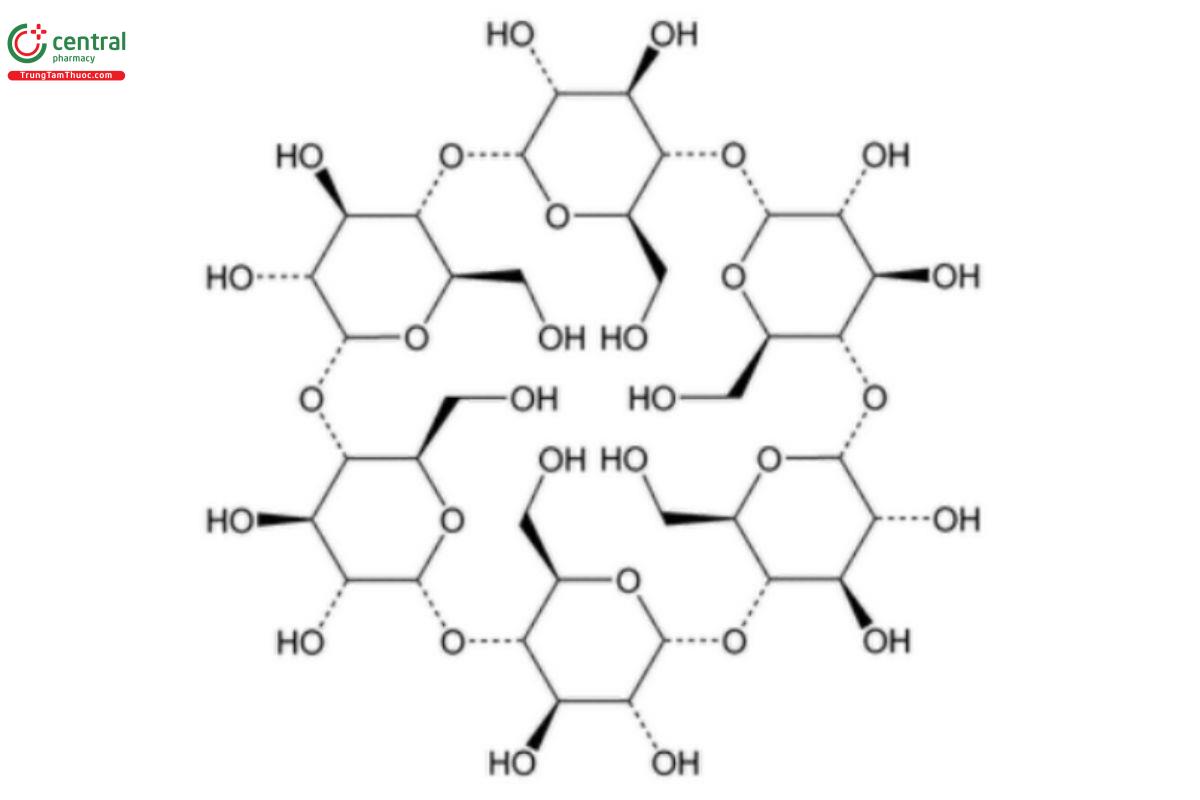
Alfadex is composed of six alpha-(1-4) linked β-glucopyranosyl units. It contains NLT 98.0% and NMT 101.0% of alfadex (C₆H₁₀O₅)₆, calculated on the anhydrous basis.
2 IDENTIFICATION
A. The retention time of the major peak of the Sample solution corresponds to that of the Standard solution, as obtained in the Assay.
B. It meets the requirements of the test for Optical Rotation (781S), Specific Rotation.
C.
Sample: 0.2 g
Analysis: Mix the Sample with 2 mL of iodine TS, warm in a water bath to dissolve, and allow to stand at room temperature.
Acceptance criteria: A yellow-brown precipitate is formed.
3 ASSAY
PROCEDURE
Mobile phase: Methanol and water (7:93)
System suitability solution: 0.5 mg/mL of USP Alpha Cyclodextrin RS, 0.5 mg/mL of USP Beta Cyclodextrin RS, and 0.5 mg/mL of USP Gamma Cyclodextrin RS
Standard solution: 1.0 mg/mL of USP Alpha Cyclodextrin RS
Sample stock solution: Transfer 250 mg of Alfadex to a 25-mL volumetric flask, and dissolve in water with the aid of heat. Cool, and dilute with water to volume.
Sample solution: 1.0 mg/mL of Alfadex, diluted from the Sample stock solution
Chromatographic system
(See Chromatography (621), System Suitability.)
Mode: LC
Detector: Refractive index
Column: 4.6-mm × 15-cm; 5-µm packing L1
Temperature
Column: 30°
Detector: 40°
Flow rate: 1.5 mL/min
Injection volume: 50 µL
System suitability
Sample: System suitability solution
[Note—The relative retention times for gamma cyclodextrin, alpha cyclodextrin, and beta cyclodextrin are 0.8, 1.0, and 2.0, respectively.]
Suitability requirements
Resolution: NLT 1.5 between the gamma cyclodextrin and alpha cyclodextrin peaks
Tailing factor: 0.8–2.0 for the three cyclodextrins
Relative standard deviation: NMT 2.0%
Analysis
Samples: Standard solution and Sample solution
Calculate the percentage of alfadex (C₆H₁₀O₅)₆ in the portion of the sample taken:
Result = (rᵤ/rₛ) × (Cₛ/Cᵤ) × 100
rᵤ = peak response of alpha cyclodextrin from the Sample solution
rₛ = peak response of alpha cyclodextrin from the Standard solution
Cₛ = concentration of alpha cyclodextrin in the Standard solution (mg/mL)
Cᵤ = concentration of alpha cyclodextrin in the Sample solution (mg/mL)
Acceptance criteria: 98.0%–101.0% on the anhydrous basis
4 IMPURITIES
4.1 RESIDUE ON IGNITION (281)
Sample: 1.0 g
Acceptance criteria: NMT 0.1%
4.2 LIMIT OF LIGHT-ABSORBING SUBSTANCES
Sample solution: 10 mg/mL of Alfadex, calculated on the anhydrous basis, in water that has been previously boiled and cooled to room temperature. Pass through a filter of 0.2-µm pore size.
Analysis: Determine the absorbance of the Sample solution in a 1-cm cell with a suitable spectrophotometer, after correcting for the blank.
Acceptance criteria: Between 230 and 350 nm, the absorbance is NMT 0.10; and between 350 and 750 nm, the absorbance is NMT 0.05.
4.3 LIMIT OF BETADEX, GAMMA CYCLODEXTRIN, AND OTHER RELATED SUBSTANCES
System suitability solution, Chromatographic system, and System suitability: Proceed as directed in the Assay.
Standard solution: System suitability solution and water (1:9)
Sample solution: Use the Sample stock solution prepared as directed in the Assay.
Analysis
Samples: Standard solution and Sample solution
Acceptance criteria
Beta cyclodextrin: The area of any peak corresponding to beta cyclodextrin is NMT 0.5 times the area of the corresponding peak from the Standard solution (0.25%).
Gamma cyclodextrin: The area of any peak corresponding to gamma cyclodextrin is NMT 0.5 times the area of the corresponding peak from the Standard solution (0.25%).
Other related substances: The sum of all of the peak areas, excluding the alpha cyclodextrin, beta cyclodextrin, and gamma cyclodextrin is NMT the area of the peak due to alpha cyclodextrin from the Standard solution (0.5%).
4.4 LIMIT OF REDUCING SUGARS
Cupric solution: 150 mg/mL of cupric sulfate
Tartrate solution: 25 mg/mL of anhydrous sodium carbonate, 25 mg/mL of potassium sodium tartrate, 20 mg/mL of sodium bicarbonate, and 200 mg/mL of anhydrous sodium sulfate
Cupric–tartaric solution: Immediately before use, mix Cupric solution with Tartrate solution (1:25).
Ammonium molybdate reagent: Mix 10 mL of disodium arsenate solution (6 in 100), 50 mL of a solution of ammonium molybdate (1 in 10), and 90 mL of diluted sulfuric acid, and dilute with water to 200 mL.
Sample solution: 1.0 g of Alfadex, calculated on the anhydrous basis, in 100 mL of water that has been previously boiled and cooled to room temperature. To 1 mL of this solution add 1 mL of Cupric–tartaric solution. Heat on a water bath for 10 min, then cool to room temperature. Add 10 mL of Ammonium molybdate reagent, and allow to stand for 15 min.
Standard stock solution: 20 mg/L of USP Dextrose RS
Standard solution: Prepare as directed for the Sample solution, at the same time, except use 1 mL of Standard stock solution in place of 1 mL of 10 mg/mL of Alfadex solution.
Instrumental conditions
(See Ultraviolet-Visible Spectroscopy (857).)
Mode: Vis
Analytical wavelength: 740 nm
Blank: Water
Analysis
Samples: Sample solution and Standard solution
Measure the Samples at the analytical wavelengths against the Blank.
Acceptance criteria: The absorbance of the Sample solution is NMT that of the Standard solution (0.2%).
5 SPECIFIC TESTS
5.1 CLARITY OF SOLUTION
Sample: 10 mg/mL in previously boiled and cooled water
Acceptance criteria: The resulting solution is clear.
5.2 MICROBIAL ENUMERATION TESTS (61), and TESTS FOR SPECIFIED MICROORGANISMS (62):
The total aerobic bacterial count does not exceed 10³ cfu/g, the total combined molds and yeasts count does not exceed 10² cfu/g, and it meets the requirements of the tests for absence of Salmonella species and Escherichia coli.
5.3 OPTICAL ROTATION, Specific Rotation (781S)
Sample solution: 10 mg/mL
Acceptance criteria: +147° to +152°, determined at 20°
5.4 pH (791)
Diluent: 224 g/L of potassium chloride
Sample solution: 30 mL of its aqueous solution (1 in 100) and 1 mL of Diluent
Acceptance criteria: 5.0–8.0
5.5 WATER DETERMINATION, Method I (921): NMT 11.0%
6 ADDITIONAL REQUIREMENTS
PACKAGING AND STORAGE: Preserve in tight containers. No storage requirements specified.
USP REFERENCE STANDARDS (11)
USP Alpha Cyclodextrin RS
USP Beta Cyclodextrin RS
USP Dextrose RS
USP Gamma Cyclodextrin RS

