
Alendronate Sodium
If you find any inaccurate information, please let us know by providing your feedback here

Tóm tắt nội dung
This article is compiled based on the United States Pharmacopeia (USP) – 2025 Edition
Issued and maintained by the United States Pharmacopeial Convention (USP)
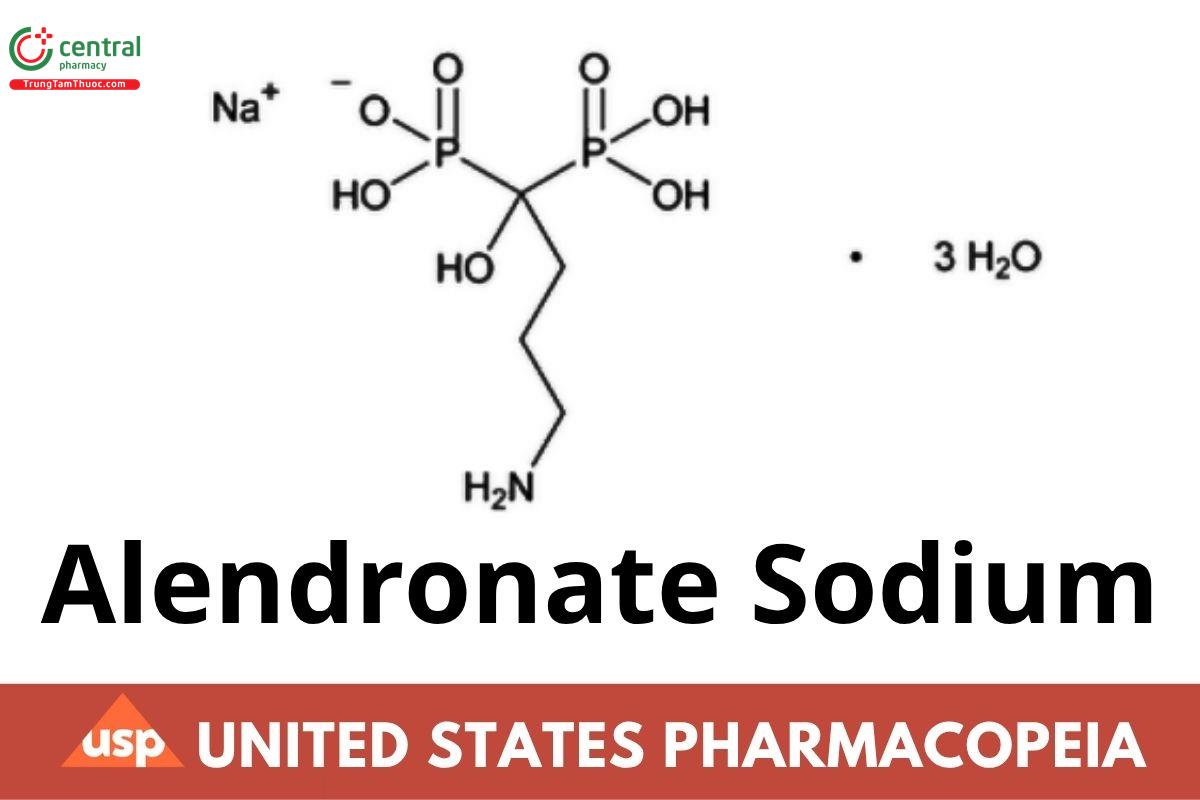
C4H12NNaO7P2 · 3H2O 325.12
Phosphonic acid, (4-amino-1-hydroxybutylidene) bis-, monosodium salt, trihydrate;
Sodium trihydrogen (4-amino-1-hydroxybutylidene)diphosphonate, trihydrate CAS RN®: 121268-17-5; UNII: 2UY4M2U3RA.
1 DEFINITION
Alendronate Sodium contains NLT 98.0% and NMT 102.0% of alendronate sodium (C4H12NNaO7P2 ), calculated on the dried basis.
2 IDENTIFICATION
Change to read:
A. Spectroscopic Identification Tests 〈197〉, Infrared Spectroscopy: 197M (CN 1-May-2020)
B. Identification Tests—General 〈191〉, Sodium: Meets the requirements of test A
3 ASSAY
3.1 Procedure
Buffer solution: 14.7 g/L of sodium citrate dihydrate and 7.05 g/L of anhydrous dibasic sodium phosphate. Adjust with phosphoric acid to a pH of 8.
Mobile phase: Acetonitrile, methanol, and Buffer solution (25:5:70)
Diluent: 29.4 g/L of sodium citrate dihydrate
Borate solution: 19.1 g/L of sodium borate
Solution A: 0.5 mg/mL of 9-fluorenylmethyl chloroformate in acetonitrile. [Note—Prepare this solution fresh just before use.] Standard stock solution: 0.1 mg/mL of USP Alendronate Sodium RS in Diluent
Standard solution: Transfer 5.0 mL of the Standard stock solution to a 50-mL polypropylene, screw-cap centrifuge tube containing 5 mL of Borate solution. Add 5 mL of Solution A, and shake for 30 s. Allow to stand at room temperature for 25 min. Add 25 mL of methylene chloride, and shake vigorously for 1 min. Centrifuge for 5–10 min. Use a portion of the clear upper aqueous layer.
Reagent blank: Transfer 5.0 mL of Diluent to a 50-mL polypropylene, screw-cap centrifuge tube containing 5 mL of Borate solution. Add 5 mL of Solution A, and shake for 30 s. Allow to stand at room temperature for 25 min. Add 25 mL of methylene chloride, and shake vigorously for 1 min. Centrifuge for 5–10 min. Use a portion of the clear upper aqueous layer.
Sample stock solution: 0.1 mg/mL of Alendronate Sodium in Diluent
Sample solution: Transfer 5.0 mL of the Sample stock solution to a 50-mL polypropylene, screw-cap centrifuge tube containing 5 mL of Borate solution. Add 5 mL of Solution A, and shake for 30 s. Allow to stand at room temperature for 25 min. Add 25 mL of methylene chloride, and shake vigorously for 1 min. Centrifuge for 5–10 min. Use a portion of the clear upper aqueous layer.
3.2 Chromatographic system
(See Chromatography 〈621〉, System Suitability.)
Mode: LC
Detector: UV 266 nm
Column: 4.1-mm × 25-cm; packing L21
Column temperature: 35°
Flow rate: 1.2 mL/min
Injection volume: 10 µL
System suitability
Sample: Standard solution
Suitability requirements
Tailing factor: NMT 1.5
Relative standard deviation: NMT 2.0% for replicate injections
3.3 Analysis
Samples: Standard solution, Reagent blank, and Sample solution
Calculate the percentage of alendronate sodium (C4H12NNaO7P2 ) in the portion of Alendronate Sodium taken:
Result = (rU /rS ) × (CS /CU ) × 100
rU = peak area from the Sample solution
rS = peak area from the Standard solution
CS = concentration of USP Alendronate Sodium RS in the Standard stock solution (mg/mL)
CU = concentration of Alendronate Sodium in the Sample stock solution (mg/mL)
Acceptance criteria: 98.0%–102.0% on the dried basis
4 IMPURITIES
4.1 Organic Impurities
Buffer solution: 2.94 g/L of sodium citrate dihydrate and 1.42 g/L of anhydrous dibasic sodium phosphate. Adjust with phosphoric acid to a pH of 8 and pass through a filter of 0.5-µm or finer pore size.
Solution A: Acetonitrile and Buffer solution (3:17)
Solution B: Acetonitrile and Buffer solution (7:3)
Mobile phase: See Table 1.
Time (min) | Solution A (%) | Solution B (%) |
0 | 100 | 0 |
15 | 50 | 50 |
25 | 0 | 100 |
27 | 100 | 0 |
32 | 100 | 0 |
Diluent and Borate solution: Proceed as directed in the Assay.
Solution C: 4 mg/mL of 9-uorenylmethyl chloroformate in acetonitrile. [Note—Prepare this solution fresh just before use.] Standard stock solution: 0.6 mg/mL of USP Alendronate Sodium RS in Diluent
Standard solution A: Transfer 5.0 mL of the Standard stock solution to a 50-mL polypropylene, screw-cap centrifuge tube containing 5 mL of Borate solution. Add 5 mL of acetonitrile and 5 mL of Solution C, and shake for 45 s. Allow to stand at room temperature for 30 min. Add 20 mL of methylene chloride, and shake vigorously for 1 min. Centrifuge for 5–10 min, and use a portion of the clear upper aqueous layer.
Standard solution B: 0.6 µg/mL of USP Alendronate Sodium RS in Diluent from Standard stock solution. Transfer 5 mL of this diluted solution (0.6 µg/mL) to a 50-mL polypropylene, screw-cap centrifuge tube containing 5 mL of Borate solution. Add 5 mL of acetonitrile and 5 mL of Solution C, and shake for 45 s. Allow to stand at room temperature for 30 min. Add 20 mL of methylene chloride, and shake vigorously for 1 min. Centrifuge for 5–10 min, and use a portion of the clear upper aqueous layer.
Reagent blank: Transfer 5.0 mL of Diluent to a 50-mL polypropylene, screw-cap centrifuge tube containing 5 mL of Borate solution. Add 5 mL of acetonitrile and 5 mL of Solution C, and shake for 45 s. Allow to stand at room temperature for 30 min. Add 20 mL of methylene chloride, and shake vigorously for 1 min. Centrifuge for 5–10 min, and use a portion of the clear upper aqueous layer.
Sample stock solution: 0.6 mg/mL of Alendronate Sodium in Diluent
Sample solution: Transfer 5.0 mL of Sample stock solution to a 50-mL polypropylene, screw-cap centrifuge tube containing 5 mL of Borate solution. Add 5 mL of acetonitrile and 5 mL of Solution C, and shake for 45 s. Allow to stand at room temperature for 30 min. Add 20 mL of methylene chloride, and shake vigorously for 1 min. Centrifuge for 5–10 min, and use a portion of the clear upper aqueous layer. Chromatographic system
(See Chromatography 〈621〉, System Suitability.)
Mode: LC
Detector: UV 266 nm
Column: 4.1-mm × 25-cm; packing L21
Column temperature: 45°
Flow rate: 1.8 mL/min
Injection volume: 20 µL
Samples: Standard solution A and Standard solution B
Suitability requirements
Tailing factor: NMT 2.0 for the main peak, Standard solution A
Signal-to-noise ratio: NLT 3 for the main peak, Standard solution B
4.2 Analysis
Samples: Reagent blank and Sample solution
[Note—Disregard any peak corresponding to those obtained from the Reagent blank.] Calculate the percentage of each impurity in the portion of Alendronate Sodium taken:
Result = (rU /rT ) × 100
rU = peak area of each impurity
rT = sum of all impurity peaks and the main peak
Acceptance criteria
Individual impurities: NMT 0.1%
Total impurities: NMT 0.5%
5 SPECIFIC TESTS
Loss on Drying 〈731〉
Sample: Dry at a pressure of NMT 5 mm of mercury at 140° to constant weight. Acceptance criteria: 16.1%–17.1%
6 ADDITIONAL REQUIREMENTS
Packaging and Storage: Preserve in well-closed containers, and store at room temperature.
USP Reference Standards 〈11〉
USP Alendronate Sodium RS

