
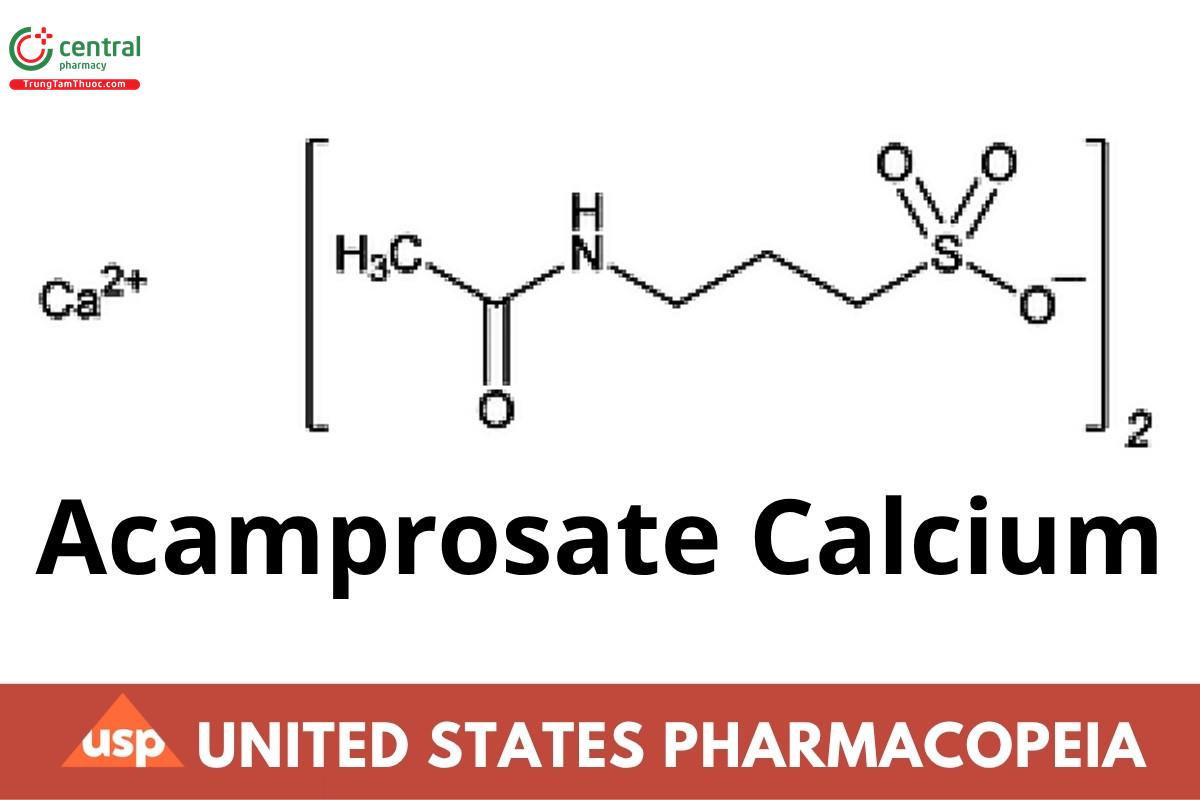
Acamprosate Calcium
If you find any inaccurate information, please let us know by providing your feedback here

Tóm tắt nội dung
This article is compiled based on the United States Pharmacopeia (USP) – 2025 Edition
Issued and maintained by the United States Pharmacopeial Convention (USP)
DOWNLOAD PDF HERE
C10H20CaN2O8S2 400.48
1-Propanesulfonic acid, 3-(acetylamino)-, calcium salt (2:1);
Calcium 3-(acetylamino) propane-1-sulfonate CAS RN: 77337-73-6
1 DEFINITION
Acamprosate Calcium contains NLT 98.0% and NMT 102.0% of acamprosate calcium C10H20CaN2O8S2, calculated on the dried basis.
2 IDENTIFICATION
Change to read:
A. SPECTROSCOPIC IDENTIFICATION TESTS (197), Infrared Spectroscopy: 197K(CN 1-MAY-2020)
B. The retention time of the major peak of the Sample solution corresponds to that of the Standard solution, as obtained in the Assay.
C. IDENTIFICATION TESTS-GENERAL (191), Chemical Identification Tests, Calcium: Meets the requirements
3 ASSAY
3.1 PROCEDURE
Mobile phase: Add 5.0 mL of triethylamine per 1 L of water and adjust with phosphoric acid to a pH of 4.0.
System suitability solution: 10 mg/mL of USP Acamprosate Calcium RS and 0.005 mg/mL each of USP Acamprosate Related Compound B RS and glacial acetic acid in water. Sonication may be used to aid in dissolution.
Standard solution: 0.3 mg/mL of USP Acamprosate Calcium RS in water. Sonication may be used to aid in dissolution.
Sample solution: 0.3 mg/mL of Acamprosate Calcium in water. Sonication may be used to aid in dissolution.
Chromatographic system
(See Chromatography 〈621〉, System Suitability.)
Mode: LC
Detector: UV 210 nm
Column: 4.6-mm × 25-cm; 5-μm packing L1
Flow rate: 0.7 mL/min
Injection volume: 20 μL
Run time: NLT 2 times the retention time of the acamprosate peak
System suitability
Samples: System suitability solution and Standard solution
[Note—See Table 1 for the relative retention times.]
Suitability requirements
Resolution: NLT 1.5 between acetic acid and acamprosate related compound B; NLT 1.3 between acamprosate related compound B and
acamprosate, System suitability solution
Tailing factor: NMT 2.0, Standard solution
Relative standard deviation: NMT 0.73%, Standard solution
Analysis
Samples: Standard solution and Sample solution
Calculate the percentage of acamprosate calcium (C10H20CaN2O8S2) in the portion of Acamprosate Calcium taken:
Result = (ru /rs) × (Cs /Cu) × 100
ru = peak response from the Sample solution
rs = peak response from the Standard solution
Cs = concentration of USP Acamprosate Calcium RS in the Standard solution (mg/mL)
Cu = concentration of Acamprosate Calcium in the Sample solution (mg/mL)
Acceptance criteria: 98.0%–102.0% on the dried basis
4 IMPURITIES
Change to read:
4.1 Limit of Acamprosate Related Compound A
Solution A: 5 g/L of fluorescamine in acetonitrile. Use within 24 h of preparation.
Buffer: 13.8 g/L of monobasic sodium phosphate prepared as follows. Transfer a suitable amount of monobasic sodium phosphate to a volumetric flask. Dissolve in 90% of the final flask volume of water. Adjust with 10 N sodium hydroxide TS or phosphoric acid to a pH of 6.5. Dilute with water to volume.
Mobile phase: Acetonitrile, methanol, and Buffer (10:10:80)
Diluent: 24.6 g/L of boric acid prepared as follows. Transfer a suitable amount of boric acid to an appropriate volumetric flask. Dissolve in 90% of the final flask volume of water. Adjust with 10 N sodium hydroxide TS to a pH of 10.4. Dilute with water to volume.
Standard stock solution A: 250 μg/mL of USP Acamprosate Related Compound A RS in water
Standard stock solution B: 1 μg/mL of USP Acamprosate Related Compound A RS from Standard stock solution A in Diluent
Standard solution: Transfer 3.0 mL of Standard stock solution B to an appropriate container. Add 0.15 mL of Solution A and shake vigorously for 30 s. Heat in a water bath at 50° for 30 min. Cool under a stream of cold water, centrifuge, and pass the supernatant through a suitable membrane filter.
Sample stock solution A: 20 mg/mL of Acamprosate Calcium in water
Sample stock solution B: 2000 μg/mL of Acamprosate Calcium from Sample stock solution A in Diluent
Sample solution: Transfer 3.0 mL of Sample stock solution B to an appropriate container. Add 0.15 mL of Solution A and shake for 30 s. Heat in a water bath at 50° for 30 min. Cool under a stream of cold water, centrifuge, and pass the supernatant through a suitable membrane filter.
Chromatographic system
(See Chromatography 〈621〉, System Suitability.)
Mode: LC
Detector: UV 261 nm
Column: 4.6-mm × 15-cm; 3- or 5-μm packing L1
Flow rate: 1 mL/min
Injection volume: 20 μL
Run time: NLT 2 times the retention time of acamprosate related compound A
System suitability
Sample: Standard solution
[Note—The relative retention times for fluorescamine and acamprosate related compound A are about 0.5 and 1.0, respectively. Acamprosate calcium is not detected by this chromatographic system.]
Suitability requirements
Resolution: NLT 2.0 between
uorescamine and acamprosate related compound A
Relative standard deviation: NMT 5.0% for acamprosate related compound A
Analysis
Samples: Standard solution and Sample solution
Calculate the percentage of acamprosate related compound A in the portion of Acamprosate Calcium taken:
Result = (ru /rs) × (Cs /Cu) × 100
ru = peak response from the Sample solution
rs = peak response from the Standard solution
Cs = concentration of USP Acamprosate Related Compound A RS (ERR 1-Dec-2018) in the Standard solution (μg/mL)
Cu = concentration of Acamprosate Calcium in the Sample solution (μg/mL)
Acceptance criteria: NMT 0.05%
4.2 Organic Impurities
Mobile phase: Add 5.0 mL of triethylamine per 1 L of water and adjust with phosphoric acid to a pH of 4.0.
System suitability solution: 10 mg/mL of USP Acamprosate Calcium RS and 0.005 mg/mL each of USP Acamprosate Related Compound B RS and glacial acetic acid in water. Sonication may be used to aid in dissolution.
Standard solution: 0.005 mg/mL of USP Acamprosate Calcium RS in water. Sonication may be used to aid in dissolution.
Sample solution: 10 mg/mL of Acamprosate Calcium in water. Sonication may be used to aid in dissolution.
Chromatographic system
(See Chromatography 〈621〉, System Suitability.)
Mode: LC
Detector: UV 210 nm
Column: 4.6-mm × 25-cm; 5-μm packing L1
Flow rate: 0.7 mL/min
Injection volume: 20 μL
Run time: NLT 6 times the retention time of the acamprosate peak
System suitability
Samples: System suitability solution and Standard solution
[Note—The relative retention time for acetic acid is 0.7; see Table 1 for the other relative retention times.]
Suitability requirements
Resolution: NLT 1.5 between acetic acid and acamprosate related compound B; NLT 1.3 between acamprosate related compound B and
acamprosate, System suitability solution
Tailing factor: NMT 1.5 for acamprosate, Standard solution
Relative standard deviation: NMT 15.0% for acetic acid, System suitability solution; NMT 5% for acamprosate, Standard solution
Analysis
Samples: Standard solution and Sample solution
Calculate the percentage of each impurity in the portion of Acamprosate Calcium taken:
Result = (ru /rs) × (Cs /Cu) × 100
ru = peak response of each impurity from the Sample solution
rs = peak response of acamprosate from the Standard solution
Cs = concentration of USP Acamprosate Calcium RS in the Standard solution (mg/mL)
Cu = concentration of Acamprosate Calcium in the Sample solution (mg/mL)
Acceptance criteria: See Table 1.
| Name | Relative Retention Time | Acceptance Criteria, NMT (%) |
| Calcium [a] | 0.4 | — |
| Acamprosate related compound B | 0.8 | 0.05 |
| Acamprosate | 1.0 | — |
| N-Methylacamprosate [b] | 1.9 | 0.05 |
Any individual unspecified impurity | — | 0.05 |
| Total impurities [c] | — | 0.5 |
a Included for identication only. This peak is due to the calcium counterion and hence is not an impurity.
b 3-(N-Methylacetamido)propane-1-sulfonate.
c The sum of acamprosate related compound A from the Limit of Acamprosate Related Compound A test and all impurities from the test for Organic Impurities.
5 SPECIFIC TESTS
5.1 pH 〈791〉
Sample solution: 0.05 g/mL of Acamprosate Calcium in carbon dioxide-free water
Acceptance criteria: 5.5–7.0
5.2 Loss on Drying 〈731〉
Analysis: Dry at 105° for 3 h.
Acceptance criteria: NMT 0.4%
6 ADDITIONAL REQUIREMENTS
6.1 Packaging and Storage: Store in tight containers.
6.2 USP Reference Standards 〈11〉
USP Acamprosate Calcium RS
USP Acamprosate Related Compound A RS
3-Aminopropane-1-sulfonic acid.
C3H9NO3S 139.17
USP Acamprosate Related Compound B RS
Calcium 3-formamidopropane-1-sulfonate.
C8H16CaN2O8S2 372.42

