
〈711〉 DISSOLUTION
If you find any inaccurate information, please let us know by providing your feedback here

Tóm tắt nội dung
- *FOR DOSAGE FORMS CONTAINING OR COATED WITH GELATIN
- APPARATUS
- PROCEDURE
- INTERPRETATION
This article is compiled based on the United States Pharmacopeia (USP) – 2025 Edition
Issued and maintained by the United States Pharmacopeial Convention (USP)
This general chapter is being harmonized with the corresponding texts of the European Pharmacopoeia and/or the Japanese Pharmacopoeia. These pharmacopeias have undertaken to not make any unilateral change to this harmonized chapter.
Portions of the present general chapter text that are national USP text, and therefore not part of the harmonized text, are marked with symbols (⧫♦) to specify this fact.
This test is provided to determine compliance with the dissolution requirements ⧫where stated in the individual monograph♦ for dosage forms administered orally. In this general chapter, a dosage unit is defined as 1 tablet or 1 capsule or the amount specified. ⧫Of the types of apparatus designs described herein, use the one specified in the individual monograph. Where the label states that an article is enteric coated and a dissolution or disintegration test does not specifically state that it is to be applied to delayed-release articles and is included in the individual monograph, the procedure and interpretation given for Delayed-Release Dosage Forms are applied, unless otherwise specified in the individual monograph.♦
1 *FOR DOSAGE FORMS CONTAINING OR COATED WITH GELATIN
If the dosage form containing gelatin does not meet the criteria in the appropriate Acceptance Table (see Interpretation, Immediate-Release Dosage Forms, Extended-Release Dosage Forms, or Delayed-Release Dosage Forms) because of evidence of the presence of cross-linking, the dissolution procedure should be repeated with the addition of enzymes to the medium, as described below, and the dissolution results should be evaluated starting at the first stage of the appropriate Acceptance Table. It is not necessary to continue testing through the last stage (up to 24 units) when criteria are not met during the first stage testing, and evidence of cross-linking is observed.
Gelatin, in the presence of certain compounds and/or in certain storage conditions, including but not restricted to high humidity and temperature, may present cross-linking. A pellicle may form on the external and/or internal surface of the gelatin capsule shell or on the dosage form that prevents the drug from being released during dissolution testing (see more information in Capsules-Dissolution Testing and Related Quality Attributes (1094)).
[NOTE-All references to a chapter above (1000) are for information purposes only and for use as a helpful resource. These chapters are not mandatory unless explicitly called out for this application.]
1.1 Dissolution Medium with pH ≤4.0
Enzyme: Pepsin, activity determined by the procedure in purified pepsin, in the Reagent Specifications section
Amount: A quantity of pepsin that results in an activity of not more than 750,000 units/L of dissolution medium
1.2 Dissolution Medium with pH >4.0 and <6.8
Enzyme: Papain, activity determined by the Assay test in the monograph for Papain; or bromelain, activity determined by the procedure in bromelain, in the Reagent Specifications section
Amount: A quantity of Papain that results in an activity of not more than 550,000 units/L of dissolution medium, or a quantity of Bromelain that results in an activity of not more than 30 gelatin-digesting units (GDU)/L of dissolution medium
1.3 Dissolution Medium with pH ≥6.8
Enzyme: Pancreatin, protease activity determined by the procedure in Assay for protease activity (Casein digestive power) in the monograph for Pancreatin
Amount: A quantity of pancreatin that results in a protease activity of not more than 2000 units/L of dissolution medium
1.4 Dissolution Medium Containing Surfactant or Other Ingredients Known to Denature the Enzyme
If the dissolution medium contains surfactant or other ingredients that are known to denature the enzyme used, a pretreatment step in the dissolution testing of the dosage form may be applied. This pretreatment step is done using the specified dissolution medium without the surfactant or the ingredient and with the addition of the appropriate amount of enzyme according to the medium pH. The amount of enzyme added is appropriate to the volume of dissolution medium used in the pretreatment. To achieve the specified medium volume for the final dissolution testing, the pretreatment step may be conducted with a smaller volume of medium without the ingredient such that the final volume is obtained when the ingredient is added at the end of the pretreatment step. All of the other conditions of the test (apparatus, rotation, or flow rate) should remain as described in the method or monograph. Typically, the duration of the pretreatment step is not more than 15 min. The required pretreatment time should be evaluated on a case-by-case basis and should be scientifically justified. This time should be included in the total time of the test. As an example, if the total time of the test is 45 min and 15 min are used in the pretreatment step, the test will continue for 30 min after the addition of the ingredient.
Change to read:
2 APPARATUS
2.1 Apparatus 1 (Basket Apparatus)
The assembly consists of the following: a vessel, which may be covered, and made of glass or other inert, transparent material1, a motor, a metallic drive shaft; and a cylindrical basket. The vessel is partially immersed in a suitable water bath of any convenient size or heated by a suitable device, such as a heating jacket. The water bath or heating device permits holding the temperature inside the vessel at 37 ± 0.5° during the test and keeps the bath fluid in constant, smooth motion. No part of the assembly, including the environment in which the assembly is placed, contributes significant motion, agitation, or vibration beyond that due to the smoothly rotating, stirring element. An apparatus that permits observation of the specimen and of the stirring element during the test is preferable. The vessel is cylindrical, with a hemispherical bottom and ⧫with one of the following dimensions and capacities: for a nominal, capacity of 1 L, the height is 160-210 mm, and its inside diameter is 98-106 mm; ⧫for a nominal capacity of 2 L, the height is 280-300 mm, and its inside diameter is 98-106 mm; and for a nominal capacity of 4 L, the height is 280-300 mm, and its inside diameter is 145-155 mm♦. Its sides are flanged at the top. A fitted cover may be used to retard evaporation. 2The shaft is positioned so that its axis is not more than 2 mm at any point from the vertical axis of the vessel and rotates smoothly and without significant wobble that could affect the results. A speed-regulating device is used that allows the shaft rotation speed to be selected and maintained at the specified rate ⧫given in the individual monograph, ♦within ±4%.
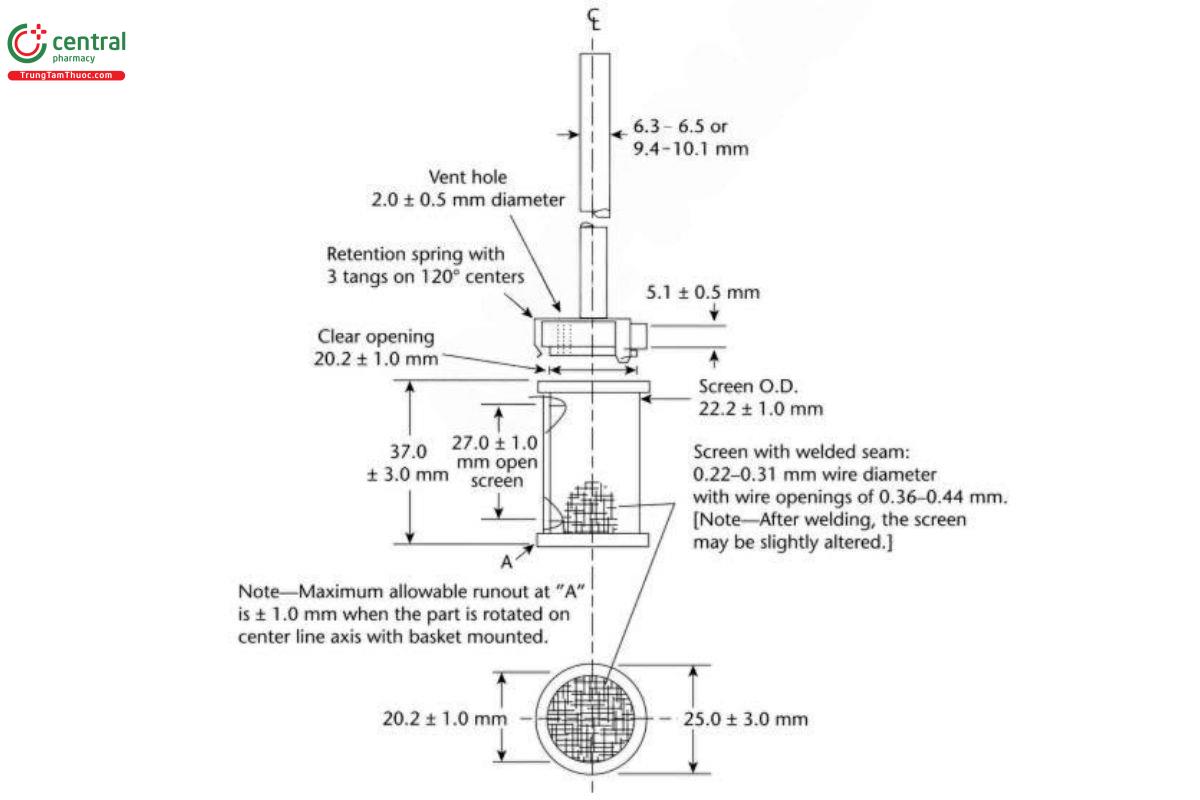
Shaft and basket components of the stirring element are fabricated of stainless steel, type 316, or other inert material, to the specifications shown in Figure 1. A basket having a gold coating of about 0.0001 inch (2.5 µm) thick may be used. A dosage unit is placed in a dry basket at the beginning of each test. The distance between the inside bottom of the vessel and the bottom of the basket is maintained at 25 ± 2 mm during the test.
2.2 Apparatus 2 (Paddle Apparatus)
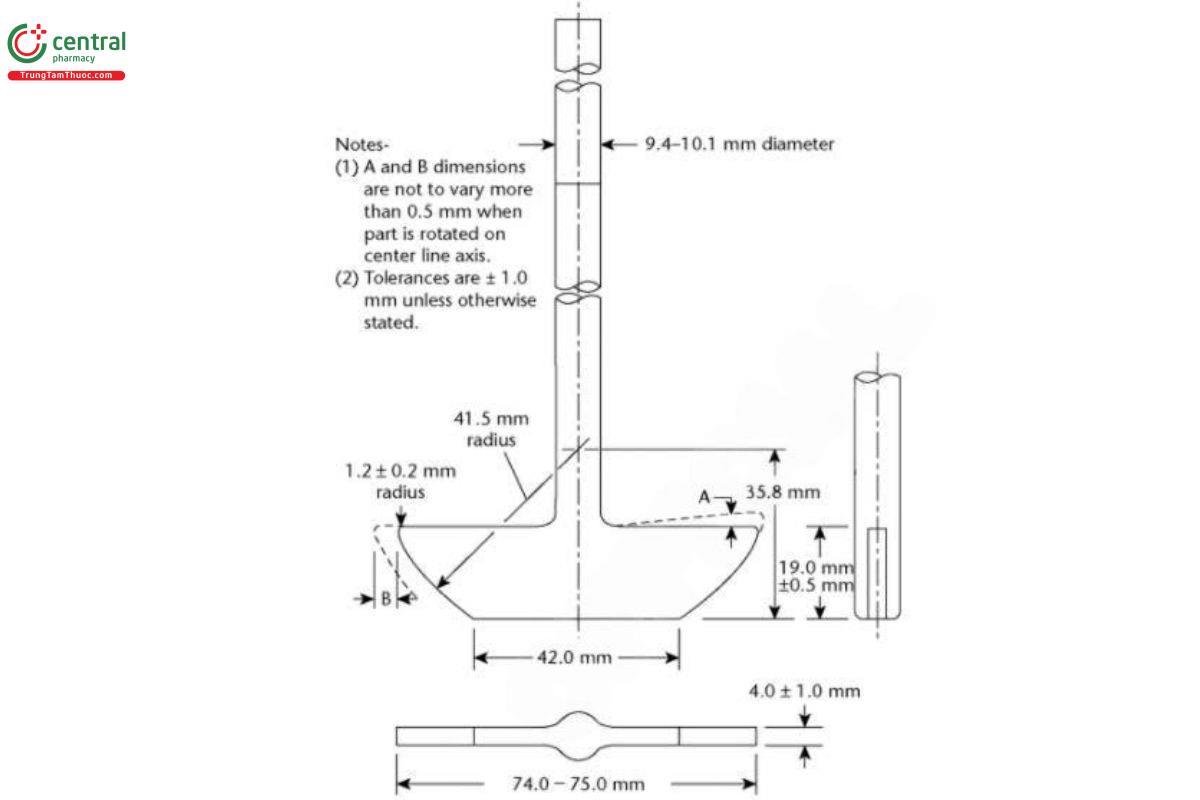
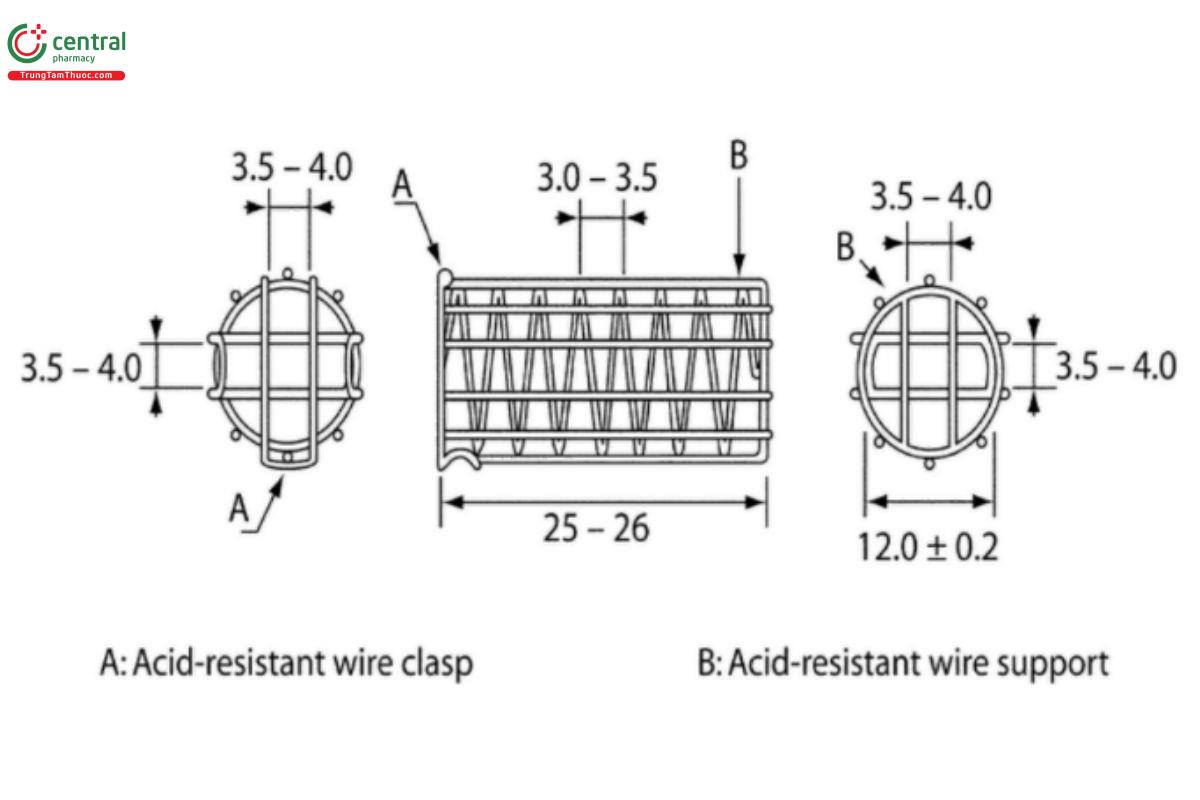
Use the assembly from Apparatus 7, except that a paddle formed from a blade and a shaft is used as the stirring element. The shaft is positioned so that its axis is not more than 2 mm from the vertical axis of the vessel at any point and rotates smoothly without significant wobble that could affect the results. The vertical center line of the blade passes through the axis of the shaft so that the bottom of the blade is flush with the bottom of the shaft. The paddle conforms to the specifications shown in Figure 2. The distance of 25 ± 2 mm between the bottom of the blade and the inside bottom of the vessel is maintained during the test. The metallic or suitably inert, rigid blade and shaft compose a single entity. A suitable two-part, detachable design may be used, provided that the assembly remains firmly engaged during the test. The paddle blade and shaft may be coated with a suitable coating so as to make both of them inert. The dosage unit is allowed to sink to the bottom of the vessel before rotation of the blade is started. A small, loose piece of nonreactive material, such as not more than a few turns of wire helix, may be attached to dosage units that would otherwise float. An alternative sinker device is shown in Figure 2a. Other validated sinker devices may be used.
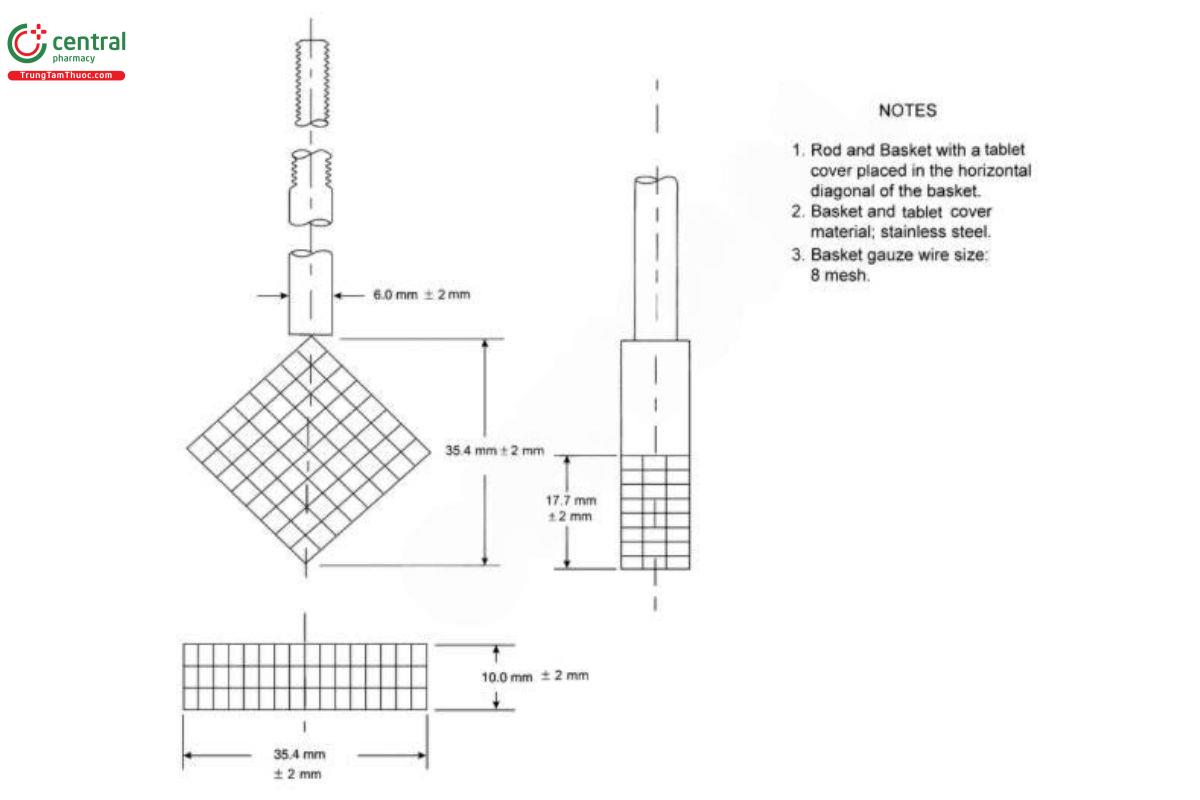
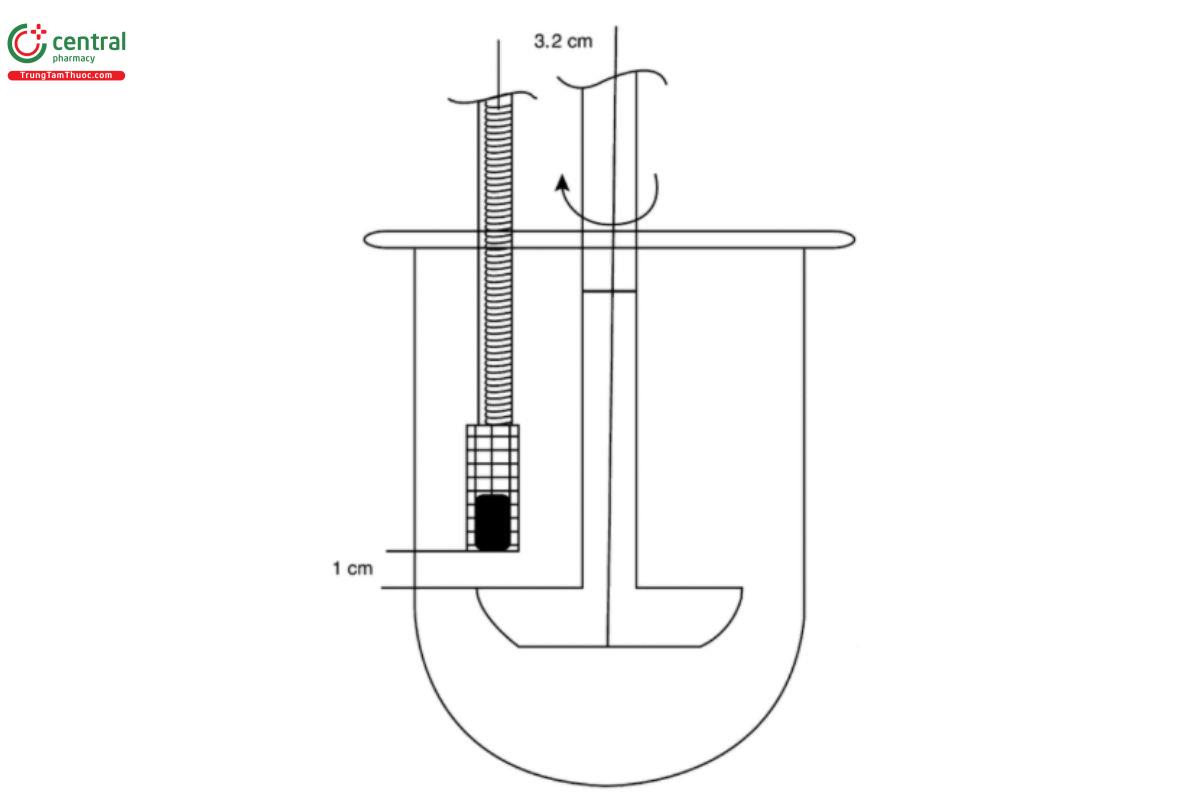
⧫An alternative to sinkers is the stationary basket. The dosage form is placed in a quadrangular basket made of stainless steel wire mesh, soldered in one of its upper, narrow sides and attached to the end of a stainless steel connecting rod (see Figure 2b). The cover is placed in the horizontal diagonal of the basket. The rod assembly is attached to the cover of the dissolution vessel via an adjustable threaded steel rod, and is fixed by means of two Teflon nuts, about 3.2 cm from the center of the vessel, or by another appropriate means. The lower corner of the bottom of the basket is adjusted to about 1 cm above the top of the paddle blade (see Figure 2c). The axis of the connecting rod is parallel to the axis of the paddle shaft along the vertical length of the connecting rod and the largest face of the basket lies in a vertical plane perpendicular to the radius of the cylinder of the vessel.
2.3 Apparatus 3 (Reciprocating Cylinder)3
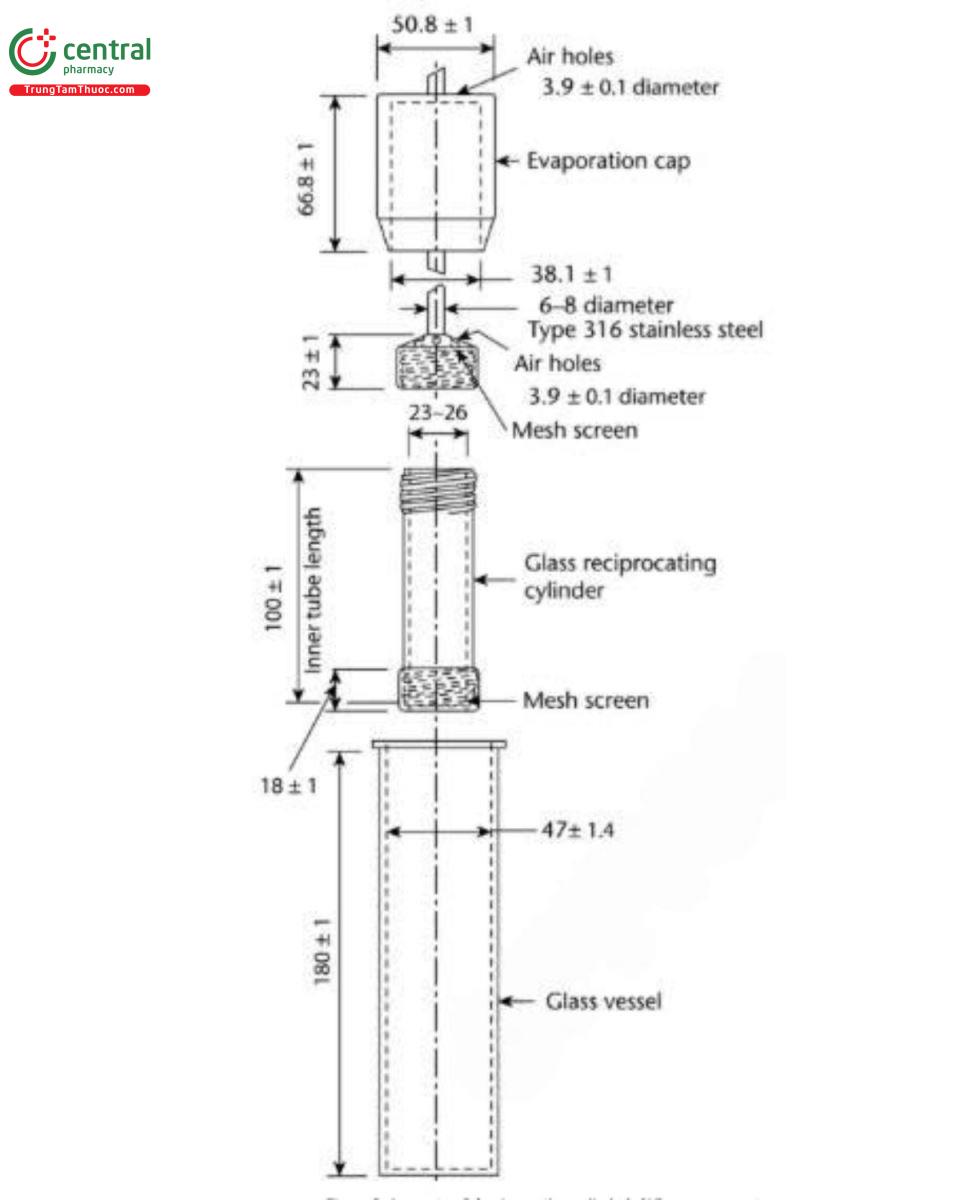
The assembly consists of a set of cylindrical, flat-bottomed glass vessels, a set of glass reciprocating cylinders; inert fittings (stainless steel type 316 or other suitable material), and screens that are made of suitable nonsorbing and nonreactive material and that are designed to fit the tops and bottoms of the reciprocating cylinders, and a motor and drive assembly to reciprocate the cylinders vertically inside the vessels; if desired, index the reciprocating cylinders horizontally to a different row of vessels. The vessels are partially immersed in a suitable water bath of any convenient size that permits holding the temperature at 37 ± 0.5° during the test. No part of the assembly, including the environment in which the assembly is placed, contributes significant motion, agitation, or vibration beyond that due to the smooth, vertically reciprocating cylinder. A device is used that allows the reciprocation rate to be selected and maintained at the specified dip rate ⧫given in the individual monograph♦ within ±5%. An apparatus that permits observation of the specimens and reciprocating cylinders is preferable. The vessels are provided with evaporation caps that remain in place for the duration of the test. The components conform to the dimensions shown ⧫in Figure 3, unless otherwise specified in the individual monograph♦.
2.4 Apparatus 4 (Flow-Through Cell)
The assembly consists of a reservoir and a pump for the Dissolution medium; a flow-through cell; and a water bath that maintains the Dissolution medium at 37 ± 0.5°. Use the specified cell size ⧫as given in the individual monograph♦.
The pump forces the Dissolution medium upward through the flow-through cell. The pump has a delivery range between 240 and 960 mL/h, with standard flow rates of 4, 8, and 16 mL/min. It must deliver a constant flow (±5% of the nominal flow rate); the flow profile is sinusoidal with a pulsation of 120 ± 10 pulses/min. A pump without pulsation may also be used. Dissolution test procedures using a flow-through cell must be characterized with respect to rate and any pulsation.
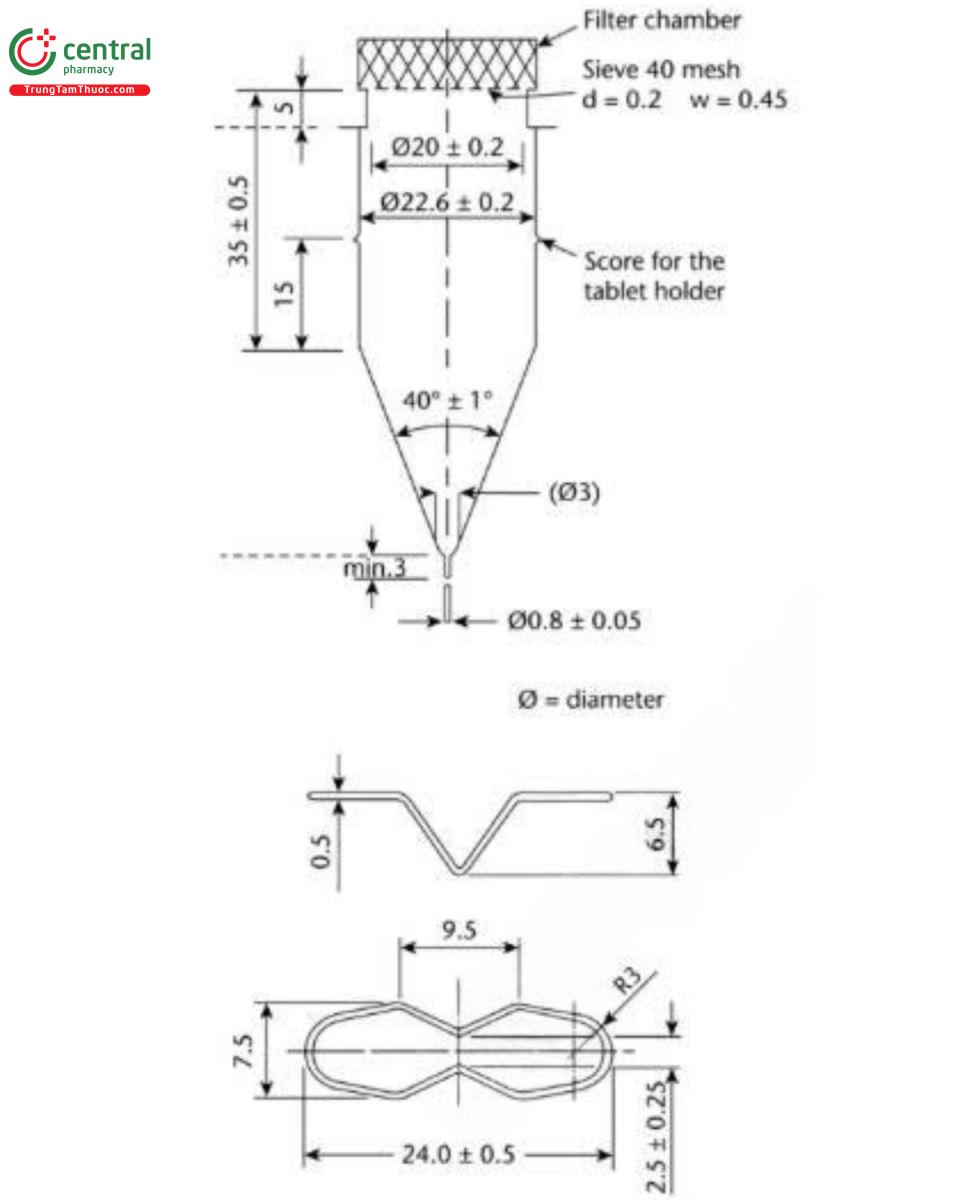
The flow-through cell (see Figure 4 and Figure 5), of transparent and inert material, is mounted vertically with a filter system (specified in the individual monograph) that prevents escape of undissolved particles from the top of the cell; standard cell diameters are 12 and 22.6 mm; the bottom cone is usually filled with small glass beads of about 1-mm diameter with one bead of about 5 mm, positioned at the apex to protect the fluid entry tube; and a tablet holder (see Figure 4 and Figure 5) is available for positioning of special dosage forms, e.g., inlay tablets. The cell is immersed in a water bath, and the temperature is maintained at 37 ± 0.5°.
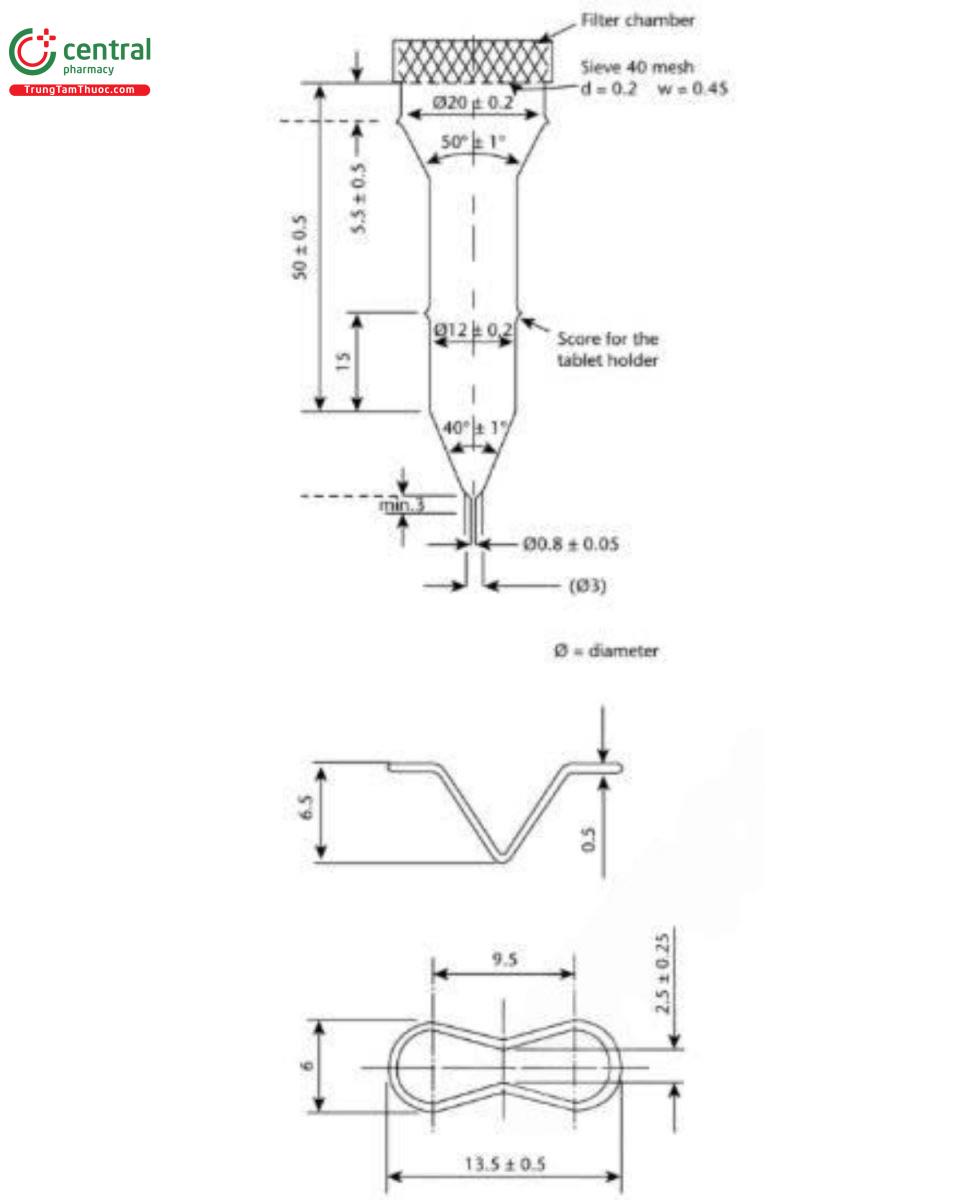
The apparatus uses a clamp mechanism and two O-rings to assemble the cell. The pump is separated from the dissolution unit to shield the latter against any vibrations originating from the pump. The position of the pump should not be on a level higher than the reservoir flasks. Tube connections are as short as possible. Use suitably inert tubing, such as polytef, with about a 1.6-mm inner diameter and chemically inert, flanged-end connections.
2.4.1 APPARATUS SUITABILITY
The determination of suitability of a test assembly to perform dissolution testing must include conformance to the dimensions and tolerances of the apparatus as given above. In addition, critical test parameters that have to be monitored periodically during use include volume and temperature of the Dissolution medium, rotation speed (Apparatus 1 and Apparatus 2), dip rate (Apparatus 3), and flow rate of medium (Apparatus 4).
Determine the acceptable performance of the dissolution test assembly periodically. The suitability for the individual apparatus is demonstrated by the Performance verification test.
USP REFERENCE STANDARDS (11): ▲USP Dissolution Performance Verification Standard-Prednisone RS▲(IRA 1-May-2023)
Performance verification test, Apparatus 1 and Apparatus 2: Test ▲USP Dissolution Performance Verification Standard-Prednisone RS, ▲(IRA 1-May-2023) according to the operating conditions specified. The apparatus is suitable if the results obtained are within the acceptable range stated in the technical data sheet specific to the lot used and the apparatus tested.
Performance verification test, Apparatus 3: [To come]
Performance verification test, Apparatus 4: [To come],
3 PROCEDURE
3.1 Apparatus 1 and Apparatus 2
3.1.1 IMMEDIATE-RELEASE DOSAGE FORMS
Place the stated volume of the Dissolution medium (±1%) in the vessel of the specified apparatus ⧫given in the individual monograph♦, assemble the apparatus, equilibrate the Dissolution medium to 37 ± 0.5°, and remove the thermometer. Place 1 dosage unit in the apparatus, taking care to exclude air bubbles from the surface of the dosage unit, and immediately operate the apparatus at the specified rate ⧫given in the individual monograph♦. Within the time interval specified, or at each of the times stated, withdraw a specimen from a zone midway between the surface of the Dissolution medium and the top of the rotating basket or blade, not less than 1 cm from the vessel wall.
[NOTE-Where multiple sampling times are specified, replace the aliquots withdrawn for analysis with equal volumes of fresh Dissolution medium at 37" or, where it can be shown that replacement of the medium is not necessary, correct for the volume change in the calculation. Keep the vessel covered for the duration of the test, and verify the temperature of the mixture under test at suitable times.]
Perform the analysis ⧫as directed in the individual monograph♦, using a suitable assay method. 4Repeat the test with additional dosage form units.
If automated equipment is used for sampling or the apparatus is otherwise modified, verification that the modified apparatus will produce results equivalent to those obtained with the standard apparatus described in this general chapter is necessary.
Dissolution medium: A suitable dissolution medium is used. Use the solvent specified ⧫in the individual monograph♦. The volume specified refers to measurements made between 20° and 25°. If the Dissolution medium is a buffered solution, adjust the solution so that its pH is within 0.05 unit of the specified pH ⧫given in the individual monograph♦, [NOTE-Dissolved gases can cause bubbles to form, which may change the results of the test. If dissolved gases influence the dissolution results, dissolved gases should be removed before testing5].
Time: Where a single time specification is given, the test may be concluded in a shorter period if the requirement for the minimum amount dissolved is met. Specimens are to be withdrawn only at the stated times, within a tolerance of ±2%.
⧫Procedure for a pooled sample for immediate-release dosage forms: Use this procedure where Procedure for a Pooled Sample is specified in the individual monograph. Proceed as directed for Immediate-Release Dosage Forms in Apparatus 1 and Apparatus 2 in the Procedure section. Combine equal volumes of the filtered solutions of the 6 or 12 individual specimens withdrawn, and use the pooled sample as the test specimen. Determine the average amount of the active ingredient dissolved in the pooled sample.♦
3.1.2 EXTENDED-RELEASE DOSAGE FORMS
Proceed as directed for Immediate-Release Dosage Forms.
Dissolution medium: Prepare as directed for Immediate-Release Dosage Forms.
Time: The test time points, generally three, are expressed in hours.
DELAYED-RELEASE DOSAGE FORMS3
Use Method A Procedure or Method B Procedure and the apparatus specified in the individual monograph. All test times stated are to be observed within a tolerance of ±2%, unless otherwise specified.
3.2 Method A Procedure ⧫(unless otherwise directed in the individual monograph)♦
3.2.1 ACID STAGE
Place 750 mL of 0.1 N hydrochloric acid in the vessel, and assemble the apparatus. Allow the medium to equilibrate to a temperature of 37 ±0.5°. Place 1 dosage unit in the apparatus, cover the vessel, and operate the apparatus at the specified rate ⧫given in the monograph♦. After 2 h of operation in 0.1 N hydrochloric acid, withdraw an aliquot of the fluid, and proceed immediately as directed in the Buffer Stage. Perform an analysis of the aliquot using a suitable assay method. ⧫The procedure is specified in the individual monograph.♦
3.2.2 BUFFER STAGE
[NOTE-Complete the operations of adding the buffer and adjusting the pH within 5 min.] With the apparatus operating at the rate specified ⧫in the monograph♦, add to the fluid in the vessel 250 mL of 0.20 M tribasic sodium phosphate that has been equilibrated to 37 ± 0.5°. Adjust, if necessary, with 2 N hydrochloric acid or 2 N sodium hydroxide to a pH of 6.8 ± 0.05. Continue to operate the apparatus for 45 min, or for the specified time given in the individual monograph. At the end of the time period, withdraw an aliquot of the fluid, and perform the analysis using a suitable assay method. The procedure is specified in the individual monograph. ⧫The test may be concluded in a shorter time period than that specified for the Buffer Stage if the requirement for the minimum amount dissolved is met at an earlier time.♦
3.3 Method B Procedure⧫(unless otherwise directed in the individual monograph)♦
3.3.1 ACID STAGE
Place 1000 mL of 0.1 N hydrochloric acid in the vessel, and assemble the apparatus. Allow the medium to equilibrate to a temperature of 37 ± 0.5". Place 1 dosage unit in the apparatus, cover the vessel, and operate the apparatus at the rate specified ⧫in the monograph♦. After 2 h of operation in 0.1 N hydrochloric acid, withdraw an aliquot of the fluid, and proceed immediately as directed in the Buffer Stage.
Perform an analysis of the aliquot using a suitable assay method. ⧫The procedure is specified in the individual monograph.♦
3.3.2 BUFFER STAGE
[NOTE-For this stage of the procedure, use buffer that previously has been equilibrated to a temperature of 37 ± 0.5°.] Drain the acid from the vessel, and add to the vessel 1000 mL of pH 6.8 phosphate buffer, prepared by mixing 0.1 N hydrochloric acid with 0.20 M tribasic sodium phosphate (3:1) and adjusting, if necessary, with 2 N hydrochloric acid or 2 N sodium hydroxide to a pH of 6.8 ±0.05. [NOTE-This may also be accomplished by removing from the apparatus the vessel containing the acid, then replacing it with another vessel containing the buffer, and transferring the dosage unit to the vessel containing the buffer.]
Continue to operate the apparatus for 45 min, or for the specified time ⧫given in the individual monograph♦. At the end of the time period, withdraw an aliquot of the fluid, and perform the analysis using a suitable assay method. ⧫The procedure is specified in the individual monograph. The test may be concluded in a shorter time period than that specified for the Buffer Stage if the requirement for minimum amount dissolved is met at an earlier time.♦
3.4 Apparatus 3 (Reciprocating Cylinder)
3.4.1 IMMEDIATE-RELEASE DOSAGE FORMS3
Place the stated volume of the Dissolution medium in each vessel of the apparatus, assemble the apparatus, equilibrate the Dissolution medium to 37 ±0.5°, and remove the thermometer. Place 1 dosage form unit in each of the six reciprocating cylinders, taking care to exclude air bubbles from the surface of each dosage unit, and immediately operate the apparatus as specified ⧫in the individual monograph♦. During the upward and downward strokes, the reciprocating cylinder moves through a total distance of 9.9-10.1 cm. Within the time interval specified, or at each of the times stated, raise the reciprocating cylinders and withdraw a portion of the solution under test from a zone midway between the surface of the Dissolution medium and the bottom of each vessel. Perform the analysis as directed ⧫in the individual monograph♦. If necessary, repeat the test with additional dosage-form units.
Dissolution medium: Prepare as directed for Immediate-Release Dosage Forms in Apparatus 1 and Apparatus 2.
Time: Proceed as directed for Immediate-Release Dosage Forms in Apparatus 1 and Apparatus 2.
3.4.2 EXTENDED-RELEASE DOSAGE FORMS
Proceed as directed for Immediate-Release Dosage Forms in Apparatus 3.
Dissolution medium: Prepare as directed for Extended-Release Dosage Forms in Apparatus 1 and Apparatus 2.
Time: Proceed as directed for Extended-Release Dosage Forms in Apparatus 1 and Apparatus 2.
3.4.3 DELAYED-RELEASE DOSAGE FORMS
Proceed as directed for Delayed-Release Dosage Forms, Method B Procedure in Apparatus 1 and Apparatus 2, using one row of vessels for the acid stage media and the following row of vessels for the buffer stage media, and using the volume of medium specified (usually 300 mL).
Time: Proceed as directed for Immediate-Release Dosage Forms in Apparatus 1 and Apparatus 2.
3.5 Apparatus 4 (Flow-Through Cell)
3.5.1 IMMEDIATE-RELEASE DOSAGE FORMS
Place the glass beads into the cell specified ⧫in the monograph♦. Place 1 dosage unit on top of the beads or, if specified ⧫in the monograph♦, on a wire carrier. Assemble the filter head, and fix the parts together by means of a suitable clamping device. Introduce by the pump the Dissolution medium warmed to 37 ± 0.5° through the bottom of the cell to obtain the flow rate specified ⧫in the individual monograph♦, and measured with an accuracy of 5%. Collect the eluate by fractions at each of the times stated. Perform the analysis as directed ⧫in the individual monograph♦. Repeat the test with additional dosage form units.
Dissolution medium: Prepare as directed for Immediate-Release Dosage Forms in Apparatus 1 and Apparatus 2.
Time: Proceed as directed for Immediate-Release Dosage Forms in Apparatus 1 and Apparatus 2.
3.5.2 EXTENDED-RELEASE DOSAGE FORMS
Proceed as directed for Immediate-Release Dosage Forms in Apparatus 4.
Dissolution medium: Prepare as directed for Immediate-Release Dosage Forms in Apparatus 4.
Time: Proceed as directed for Immediate-Release Dosage Forms in Apparatus 4.
3.5.3 DELAYED-RELEASE DOSAGE FORMS
Proceed as directed for Delayed-Release Dosage Forms in Apparatus 1 and Apparatus 2, using the specified media.
Time: Proceed as directed for Delayed-Release Dosage Forms in Apparatus 1 and Apparatus 2.
4 INTERPRETATION
4.1 Immediate-Release Dosage Forms
Unless otherwise specified ⧫in the individual monograph♦, the requirements are met if the quantities of active ingredient dissolved from the dosage units tested conform to Acceptance Table 1. Continue testing through the three stages unless the results conform at either S, or S₂ The quantity (Q) is the amount of dissolved active ingredient ⧫specified in the individual monograph♦, expressed as a percentage of the labeled content of the dosage unit, the 5%, 15%, and 25% values in Acceptance Table 1 are percentages of the labeled content so that these values and Q are in the same terms.
Acceptance Table 1
| Stage | Number Tested | Acceptance Criteria |
| S1 | 6 | Each unit is NLT Q + 5%. |
| S2 | 6 | Average of 12 units (S1 + S2) is ≥Q, and no unit is <Q − 15%. |
| S3 | 12 | Average of 24 units (S1 + S2 + S3) is ≥Q, NMT 2 units are <Q − 15%, and no unit is <Q − 25%. |
4.1.1 Immediate-Release Dosage Forms Pooled Sample
Unless otherwise specified in the individual monograph, the requirements are met if the quantities of active ingredient dissolved from the pooled sample conform to the accompanying Acceptance Table for a Pooled Sample. Continue testing through the three stages unless the results conform at either S1 or S2. The quantity (Q) is the amount of dissolved active ingredient specified in the individual monograph, expressed as a percentage of the labeled content.
Acceptance Table for a Pooled Sample
| Stage | Number Tested | Acceptance Criteria |
| S1 | 6 | Average amount dissolved is NLT Q + 10%. |
| S2 | 6 | Average amount dissolved (S1 + S2) is ≥Q + 5%. |
| S3 | 12 | Average amount dissolved (S1 + S2 + S3) is ≥Q. |
4.2 Extended-Release Dosage Forms
Unless otherwise specified ⧫in the individual monograph♦, the requirements are met if the quantities of active ingredient dissolved from the dosage units tested conform to Acceptance Table 2. Continue testing through the three levels unless the results conform at either L, or L₂ Limits on the amounts of active ingredient dissolved are expressed in terms of the percentage of labeled content. The limits embrace each value of Q, the amount dissolved at each specified fractional dosing interval. Where more than one range is specified ⧫in the individual monograph♦, the acceptance criteria apply individually to each range.
Acceptance Table 2
| Level | Number Tested | Acceptance Criteria |
| L1 | 6 | No individual value lies outside each of the stated ranges, and no individual value is less than the stated amount at the final test time. |
| L2 | 6 | The average value of the 12 units (L1 + L2 ) lies within each of the stated ranges and is not less than the stated amount at the |
| L3 | 12 | The average value of the 24 units (L1 + L2 + L3) lies within each of the stated ranges and is not less than the stated amount at the final test time; NMT 2 of the 24 units are more than 10% of labeled content outside each of the stated ranges; NMT 2 of the 24 units are 10% of labeled content below the stated amount at the final test time; and none of the units are 20% of labeled content outside each of the stated ranges or >20% of the labeled content below the stated amount at the final test time. |
4.3 Delayed-Release Dosage Forms3
4.3.1 ACID STAGE
Unless otherwise specified ⧫in the individual monograph♦, the requirements of this portion of the test are met if the quantities, based on the percentage of the labeled content, of active ingredient dissolved from the units tested conform to Acceptance Table 3. Continue testing through all levels unless the results of both the Acid Stage and Buffer Stage conform at an earlier level.
Acceptance Table 3
| Level | Number Tested | Acceptance Criteria |
| A1 | 6 | No individual value exceeds 10% dissolved. |
| A2 | 6 | Average of the 12 units (A1 + A2) is NMT 10% dissolved, and no individual unit is >25% dissolved. |
| A3 | 12 | Average of the 24 units (A1 + A2 + A3) is NMT 10% dissolved, and no individual unit is >25% dissolved. |
4.3.2 BUFFER STAGE
Unless otherwise specified ⧫in the individual monograph♦, the requirements are met if the quantities of active ingredient dissolved from the units tested conform to Acceptance Table 4. Continue testing through the three levels unless the results of both stages conform at an earlier level. The value of Q in Acceptance Table 4 is 75% dissolved unless otherwise specified ⧫in the individual monograph♦. The quantity (Q) ⧫specified in the individual monograph♦, is the total amount of active ingredient dissolved in both the Acid Stage and the Buffer Stage, expressed as a percentage of the labeled content. The 5%, 15%, and 25% values in Acceptance Table 4 are percentages of the labeled content so that these values and Q are in the same terms.
Acceptance Table 4
| Level | Number Tested | Acceptance Criteria |
| B1 | 6 | Each unit is NLT Q + 5%. |
| B2 | 6 | Average of 12 units (B1 + B2) is ≥Q, and no unit is <Q − 15%. |
| B3 | 12 | Average of 24 units (B1 + B2 + B3) is 2Q. NMT 2 units are <Q-15%, and no unit is <Q 25%. |
1 The materials should not sorb, react, or interfere with the specimen being tested.
2 If a cover is used, it provides sufficient openings to allow ready insertion of the thermometer and withdrawal of specimens.
3 Not accepted by the Japanese Pharmacopoeia.
4 Test specimens are filtered immediately upon sampling unless filtration is demonstrated to be unnecessary. Use an inert filter that does not cause adsorption of the active ingredient or contain extractable substances that would interfere with the analysis.
5 One method of deaeration is as follows: Heat the medium, while stirring gently, to about 41°, immediately filter under vacuum using a filter having a porosity of 0.45 µm or less, with vigorous stirring, and continue stirring under vacuum for about 5 min. Other validated deaeration techniques for removal of dissolved gases may be used.

